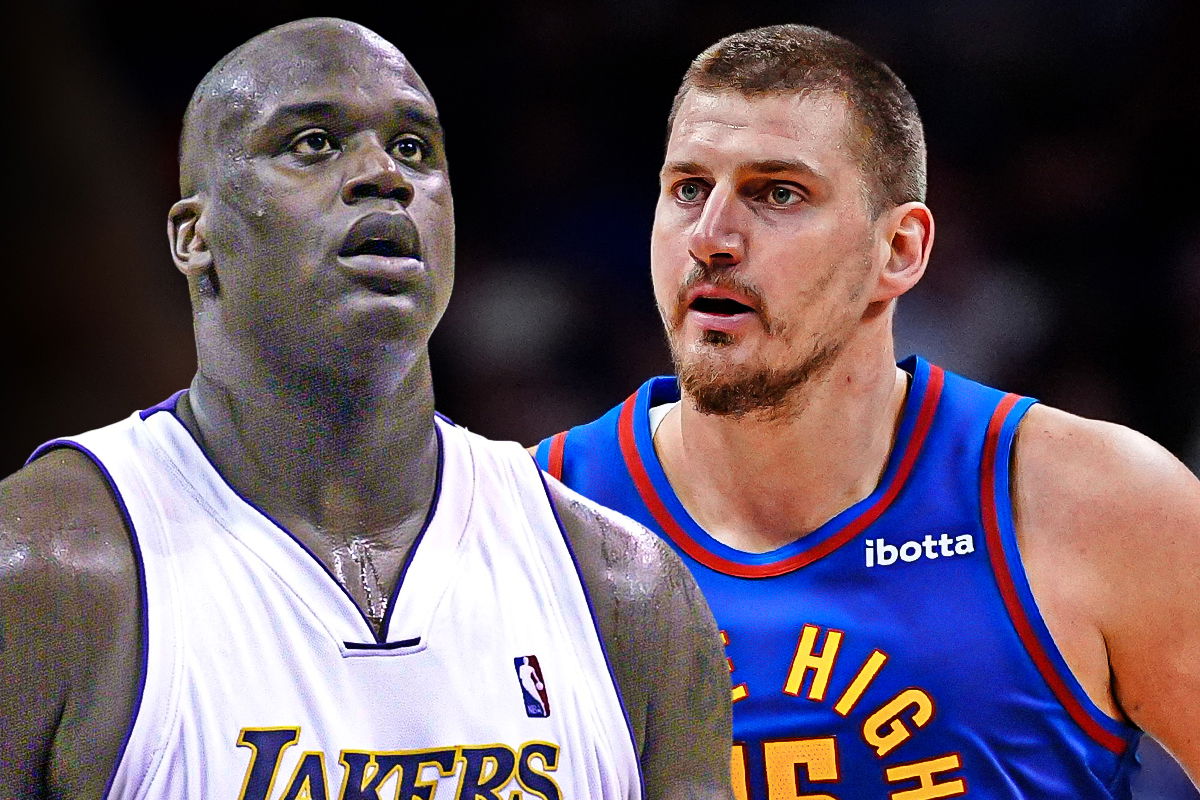
Throughout history, up until the positionless era, the NBA center position has been the most important spot on any roster.


Since its inception in the 1955-56 season, the center position has won 30 Most Valuable Player Awards out of 70. From 1960 through 1980 saw 19 of 20 MVP awards go to centers, and that was much of the case in the old era.
Watch What’s Trending Now!
The position has had to adapt to different eras, from the 1940s and ‘50s when the game was a gritty and low-scoring affair where every player on the floor had to be of good height. Then to the 1960s when the game opened more and offense began taking shape, which led to the ‘70s where the center evolution moved from brute force to finesse.
The game was speeding up, but centers remained the linchpin, controlling tempo and space. The ‘90s are regarded as the golden age of big men as teams had to have a dominant center to compete.
USA Today via Reuters
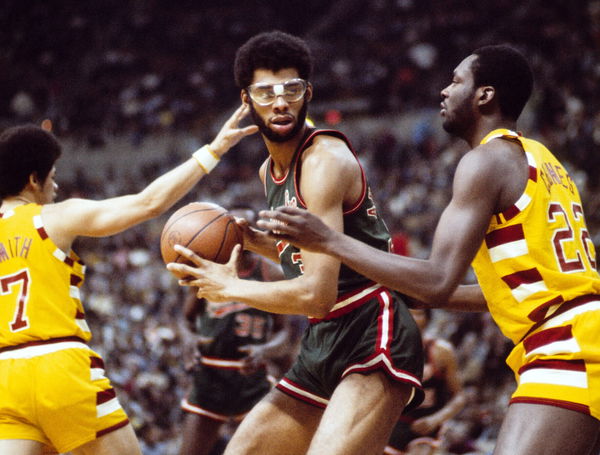
Feb 18, 1975; Richfield, OH, USA; FILE PHOTO; Milwaukee Bucks center Kareem Abdul-Jabbar (33) in action against Cleveland Cavilers center Jim Chones (22) at Richfield Coliseum during the 1974-75 season. Mandatory Credit: Tony Tomsic-USA TODAY NETWORK
The turn of the millennium brought rule changes like hand-checking bans and zone defenses which naturally started chipping away at the traditional center’s dominance. The game spread out and everyone focused on perimeter play. Centers adapted and started orchestrating plays on the floor, which led to the modern era post-2010s, where the 3-point revolution and small ball lineups threatened to make centers obsolete.
Throughout these eras, some select few made a mark in the center position and became all-time greats in the position that has seen many noteworthy and legendary players.
In the formulation of EssentiallySports’ all-time ranking, very specific criteria have been consulted.
First off is championships and playoff success; rings aren’t a must to be called an all-time great, however, they are vital to the pedigree of any NBA player, and there’s no better way to be called “dominant” if a title isn’t achieved at the finish line. Players who led their teams to titles as the focal point are prioritized.
The second criteria are individual accolades; giving credit to players who made multiple All-NBA selections, won MVPs, Finals MVPs, Defensive Player of the Year awards and led the league in vital metrics such as scoring, rebounding, steals and blocks.
The third factor is statistical dominance; even though raw numbers are contextualized because the NBA has evolved throughout eras, career averages in points, rebounds, assists and blocks show the effective dominance of the player. But it has been normalized for pace, opponents and rule changes using advanced metrics like player efficiency rating, win shares and value over replacement player.
Fourth is impact and innovation; this is a crucial criteria because it answers two important questions: did they change the game? Were they feared? That is the only way a legendary big is separated from other players in that position and makes them Hall of Famers.
Fifth criteria is longevity and peak performance; in the NBA, sustained and consistent dominance over 10+ years always tilts the scales against short bursts. But peak dominance also matters during that period.
The Final criteria is era adjustment and head-to-head context; eras are different and players are defined by how dominant they were in the toughest of eras and how they would fare hypothetically in a different era. It is comparing relative to contemporaries and the impact is scaled accordingly.
Ranking the 10 Greatest Centers of All Time
10: Patrick Ewing
Ewing is one of the greatest NBA players not to win a championship, and the fact that he doesn’t pass the championship criteria is the reason why he isn’t much higher in this list. The Georgetown University product became the face of the gritty New York Knicks of the ‘80s and ‘90s, and he was the full face of toughness in a brutal era.
Ewing came first overall in 1985 and, over a 17-year-career, he averaged 21 points, 9.8 rebounds and 2.4 blocks, which earned him 11 NBA All-Star appearances, seven All-NBA selections and three All-Defensive Second Team honors. But Ewing’s story will always be about the what-ifs regarding winning a title. He led the Knicks to the 1994 Finals, only to fall short and, if not for Michael Jordan and the Chicago Bulls, the Knicks would have been to more Finals and perhaps have won a ring.
Ewing built a Hall of Fame career embodying the “warrior center” archetype who grinded without glory at the end of the day. His post moves were lethal, but “positional scarcity” should be considered, because in Ewing’s time, centers were plentiful, diluting some individual shine.
9: George Mikan
Mikan is the OG of NBA centers and, even though he emerged from the earliest of eras, his impact made him a Hall of Famer. From 1948-1956 with the Minneapolis Lakers, he averaged 23.1 points and 13.4 rebounds; blocks weren’t tracked then, otherwise he would have had an unprecedented number. He led his team to five championships and his hook shot and size forced the league to widen the foul lane in 1951 with the “Mikan Rule.”
Mikan won three scoring titles as a pioneer. He deserves his flowers. Without him, there would be no era that made centers dominant and focal points. His era had only 8-11 teams and few athletic freaks, but his dominance innovated the position and sparked the center’s evolution from sideshow to star.
8: David Robinson
Robinson combined military discipline with his freakish athleticism for the San Antonio Spurs.
He averaged 21.1 points, 10.6 rebounds and 3.0 blocks in 14 years in the NBA, earning two championships, an MVP, Rookie of the Year and Defensive Player of the Year. He also made ten All-NBA and All-Star appearances and eight All-Defensive Teams and he won the scoring title once for good measure. He is only one of three recognized centers that have had a 70-point game, showing how good he was offensively and defensively.
Robinson makes a case as being the most underrated big in this list. He bridged eras, dominating inside while adapting to Tim Duncan’s arrival and ushering in a Spurs dynasty. Athletic centers like him paved the way for versatile modern bigs. His speed also made him one of the fastest big guys ever who could slide seamlessly into today’s pace-and-space.
7. Nikola Jokic
Jokic is yet to crack the top five because he is still in his prime years and is the only active player in the list. That is enough to show that the 6-foot-11 Serbian superstar is one of the greatest NBA players of all-time, not just in the center position.
No one saw it coming when the Denver Nuggets drafted him deep in the second round, but Jokic is now a three-time MVP, a Finals MVP after leading the Nuggets to their first-ever championship in 2023 and already a seven-time All-NBA Team member.
Jokic has the highest player efficiency rating of any NBA player in history because of his overall influence on the court. He averaged a triple-double or close to it in each of the last three seasons. He is the ultimate modern big and is showing that the position is always the most dominant on the floor even in this positionless and shooting era.
Jokic is revolutionary. He’s 31 and closer to the latter stage of his prime than the start. To earn a strong grasp on the top five, he’ll at least need to capture another title and Finals MVP. But with how the last few seasons have gone for Denver, that appears to be an extremely tall task especially this season and beyond.
However, there is no doubt that he is an all-time big who has already crafted a Hall of Fame career.
6. Moses Malone
Malone transitioned from the ABA to the NBA, and it never deterred him. He averaged 20.3 points and 12.3 rebounds over 21 seasons, winning three MVPs, one championship with Finals MVP and had 12 NBA All-Star appearances and eight All-NBA Teams memberships. His offensive rebounding was on another level, and he led the 1983 Philadelphia 76ers to the title — in a league with the Los Angeles Lakers’ Showtime era still at its apex. And let’s not forget Larry Bird’s Boston Celtics.
On degree of difficulty alone, it was tempting to rank Malone in the top five. He is certainly greater than the names before him on this list.
Malone was a grinder who outworked everyone on both sides. He led the NBA in rebounds on six occasions and that prowess proved controlling second chances equals wins. Without him, there would be no emphasis on retaining possession and efficiency with the ball.
5. Wilt Chamberlain
Chamberlain was a good enough player that the NBA has spent decades after he retired trying to break or match the mountain of records he set.
The 7-foot-1 legend averaged 30.1 points and 22.9 rebounds in his 21-year career, with four MVPs, two championships and records that seemed impossible like scoring 100 points in a game, the only 100-point game in history. He added seven scoring titles and led in rebounding 11 times.
Chamberlain is the ultimate stat legend but dinged for team success, with his two titles coming in his final years with the Lakers when his scoring dropped. However, his individual vs. collective dominance stands out and shows how personal feats can overshadow rings. That’s a debate that has followed many worthy legends over the years.
4. Hakeem Olajuwon
Olajuwon could pass for the greatest footwork ever by an NBA center.
He was so smooth with it that his “Dream Shake” became one of the most lethal offensive moves. He led the Houston Rockets to back-to-back titles in 1994 and 1995, earning two Finals MVPs, one league MVP and two DPOYs. He also led the league in rebounding two times, blocks three times and made nine All-Defensive Teams.
Olajuwon is the most skilled center ever and blended offense with defense seamlessly, teaching balance. He made the center position less about just being a brute force but all about control and precision, and it made him a Hall of Famer.
No. 3. Shaquille O’Neal
Deciding between O’Neal and Olajuwon was like (pardon the cliché) choosing a favorite child.
O’Neal could easily be No. 1 in this list and no one would give much fuss about it. That is how dominant he was. His dominance led the Lakers to win three consecutive NBA titles in the early 2000s and together with Kobe Bryant, they formed one of the greatest duos in NBA history. Even before making the move to L.A, O’Neal was a brute force, shattering backboards on multiple occasions, forcing the league to change its design and when he was running on offense, he was a freight train.
O’Neal won four championships, including a final one with the Miami Heat in 2006. He earned three Finals MVPs, one league MVP, led the league in scoring twice and made 14 All-NBA Teams in his 19-year career. The Hall of Famer is a bold pick for the most dominant peak career as he was easily the best center of all-time in his prime years. He forced hacks, reminding the NBA that size still mattered in an increasingly small-ball era. He is still regarded as the very last true big to this day.
2. Bill Russell
Russell is remembered for winning 11 championships, which is the most for any player in history, and played 13 seasons, meaning he won a title in almost every year in his career.
He earned five MVPs, 11 All-NBA teams, one All-Defensive First Team honor, made 12 All-Star appearances and led in rebounding four times. Defensive awards started late in his career, otherwise he could have been the greatest defensive-oriented center in history. He averaged 22.5 rebounds in his career; blocks weren’t officially tracked back then, but he was one of the best in that category.
Russell is the benchmark of the phrase, “defense wins championships.” He was physically and psychologically dismantling opponents, forcing them into bad decisions while elevating his teammates. He was the ultimate team player and pulled offenses out of rhythm like a black hole, which resulted in the most consistent title runs of any NBA dynasty.
If there is anyone to thank for the greater history of the game, it is Russell. His position close to the top will remain untouched for a very long time.
1. Kareem Abdul-Jabbar
No doubt, Abdul-Jabbar is the greatest center to play the game.
He dominated different eras from the early ‘70s to the late ‘80s. He won six championships with the majority being with the Lakers, a record six MVPs, two Finals MVPs, 19 All-Star appearances, 15 All-NBA selections and 11 All-Defensive honors in over 20 seasons. He averaged 24.6 points, 11.2 rebounds, 3.6 assists and 2.6 blocks per game and held the all-time record until LeBron James passed it in 2023.
Abdul-Jabbar’s efficiency and longevity set the bar. His skyhook is the most unbeatable move and tormented defenses for two decades. He brought versatility through mastery which trumps the raw athleticism, vision, footwork and stats other great centers have. He leads in total blocks in NBA history, which shows how effective he was on defense and on offense.
No one did it quite like Abdul-Jabbar. He had the stats, rings and pedigree of the greatest to ever play.
The Legacy of the NBA Center Position
The center position hasn’t been spared from the NBA’s evolution over the years, and there is a reason O’Neal is still regarded as the last true big.
From his MVP award in 2000, the league had to wait 21 years for another center to win it. It doesn’t mean the league hasn’t seen players with similar characteristics since he retired; however, the work of a center has shifted drastically and simply being a dominant big won’t cut it in the modern game.
These icons changed the game, from Mikan’s pioneering to Chamberlain’s statistical dominance to Abdul-Jabbar’s longevity and consistency to Olajuwon’s footwork that revolutionized post play, to O’Neal’s brute force and down to Jokic’s passing which is redefining the “facilitator center” concept.
The greatest centers are architects who shaped their eras. Abdul-Jabbar’s skyhook forced defenses to evolve, much like Jokic’s vision is doing now. Mikan made the league widen the lane and O’Neal prompted “Hack-a-Shaq,” which reminded everyone that physicality can shatter defensive coordination, even as the game was slowly moving to a three-point style.
It is worthy to note that there are fears of the center position going extinct in the NBA seeing how Jokic is the only modern big man superstar in all-time conversations. However, the modern game would tailor its center characteristics as what is now seen with young players like Victor Wembanyama who, at 7-foot-2 can shoot, orchestrate plays, and coordinate defense in this space era.
With big men continuously evolving and the standard constantly changing, the epic reminder here is that the 10 top centers ranking may look substantially different in 30 or 40 years.
Written by

Edited by

Ved Vaze