Imago
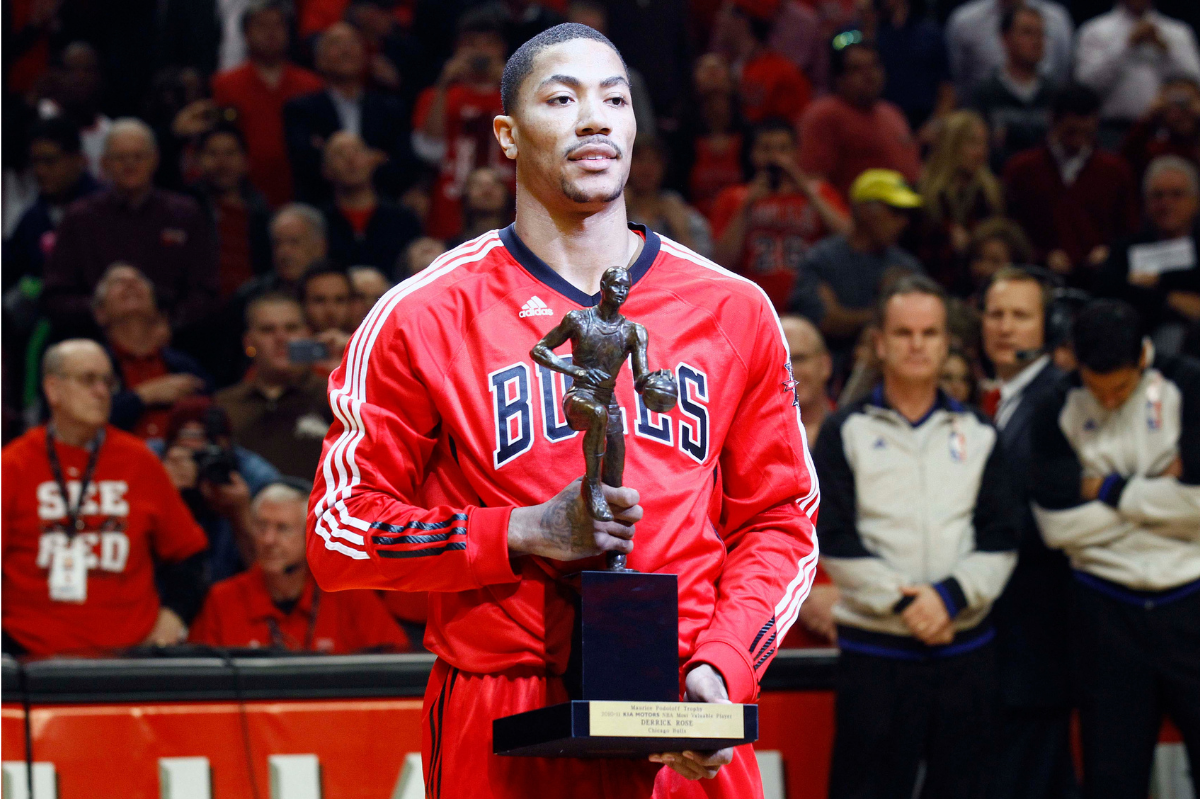
May 4, 2011; Chicago, IL, USA; Chicago Bulls point guard Derrick Rose (1) is presented the MVP trophy before game one of the second round of the 2011 NBA playoffs against the Atlanta Hawks at the United Center. Mandatory Credit: Mike DiNovo-Imagn Images
Imago
May 4, 2011; Chicago, IL, USA; Chicago Bulls point guard Derrick Rose (1) is presented the MVP trophy before game one of the second round of the 2011 NBA playoffs against the Atlanta Hawks at the United Center. Mandatory Credit: Mike DiNovo-Imagn Images
Imago
May 4, 2011; Chicago, IL, USA; Chicago Bulls point guard Derrick Rose (1) is presented the MVP trophy before game one of the second round of the 2011 NBA playoffs against the Atlanta Hawks at the United Center. Mandatory Credit: Mike DiNovo-Imagn Images
Imago
May 4, 2011; Chicago, IL, USA; Chicago Bulls point guard Derrick Rose (1) is presented the MVP trophy before game one of the second round of the 2011 NBA playoffs against the Atlanta Hawks at the United Center. Mandatory Credit: Mike DiNovo-Imagn Images
Basketball has always been a demanding sport. It takes a toll on players, both physically and mentally, and the physical toll is the reason many athletes lose the very explosiveness that made them special. Careers have been shortened and stolen because their bodies couldn’t keep up, and while it can be called “bad luck,” it is essentially the cruelest tax, paid in full.
Watch What’s Trending Now!
Unfortunately, there have been many such instances in the league’s history. And many of these players are those whom we loved seeing on our television screens the most.
Ten Players Whose Careers Were Ruined by Injuries
1. Derrick Rose (2008-2024): The name that registers first in our minds when we hear the word “injuries.” Rose is the ultimate “what-if” for what he could have become. In just his third season in 2010-11, he became the youngest MVP at 22 years. The Chicago Bulls were his, and he was their hero, one not seen since the days of Michael Jordan.
The unfortunate injury-stricken run started in the 2012 playoffs when Rose tore his ACL in Game 1 of the first round against the Philadelphia 76ers. He missed the entire 2012-13 season and, although he came back on schedule, things just got worse as he tore his meniscus in his right knee in 2013. Ankle issues followed, then orbital fracture and more knee problems. The explosiveness that defined him never returned, even though he managed to play 15 seasons in the NBA. However, the MVP version of Rose was one and done, and the Jordan 2.0 hype never materialized in Chicago.
2. Bill Walton (1974-1988): Walton is the original what-if. He entered the league in 1974 as the most complete center anyone had seen since Bill Russell. He was the kind of passing big who could run the floor like a guard. In 1977, he delivered the Portland Trail Blazers their first and only championship, then followed it up by winning the MVP the following year.


However, his body betrayed him, particularly his feet, and several surgeries meant he missed more games in his career than he played. By the time he resurfaced as an elite sixth man legend with the Boston Celtics, his prime was long gone.
3. Greg Oden (2007-2016): Oden didn’t even get a chance to show what he was made of before injuries started taking a toll on the former No. 1 pick. In the 2007 draft night, he was selected over Kevin Durant. The seven-foot project from Ohio State looked like the next great defensive anchor with soft hands and elite timing. Then, before he even played a single NBA minute, he had microfracture surgery on his right knee and missed all of his rookie year.
He came back for 61 games the following year, but knee after knee after knee limited him to 105 career games. He had the tools to be a perennial Defensive Player of the Year candidate but his body quit on him before his game could evolve.
4. Brandon Roy (2006-2011, 2012-2013): Still with another Portland superstar, Roy was the 2006 Rookie of the Year and a three-time NBA All-Star before turning 25, and even earned two All-NBA nods. He retired at the age of 27 because his knees failed him.
He tried a brief comeback with the Minnesota Timberwolves in 2012-13, but after five games, that was it. He was on his way to becoming one of the top shooting guards in the association before being shut down. Roy’s game translated perfectly to winning basketball for the Blazers during their “jail Blazers” era.
5. Penny Hardaway (1993-2007): Hardaway came into the league in 1993 as a Magic Johnson 2.0 but rangier, more athletic, with a smooth handle. He earned four straight All-Star appearances with the Orlando Magic and hit peak form in the 1995-96 season, averaging 21.7 points and 7.1 assists per game while dragging the Magic to the conference finals without a healthy Shaquille O’Neal for stretches.
But after a knee tendon injury in 1997, he was a totally different player. He lost the first-step explosion that made him unguardable. He played 14 seasons, but his prime lasted roughly five years.
6. Grant Hill (1994-2013): For the Detroit Pistons, Hill was a co-Rookie of the Year, a perennial All-Star, a 20+ points per game scorer, elite passer and a capable defender. Despite easily being one of the best players of his era, he never reached the maximum everyone expected him to.
In the early 2000s, ankle injuries became constant for Hill, and he had five ankle surgeries in four years. He missed the entire 2003-04 season. Although Hill couldn’t tap into all his gifts, he still managed to produce 19 seasons thanks to an insane work ethic. He did rediscover his durability in his latter years for the Phoenix Suns, playing 80 games for three seasons, but the explosive two-way wing was gone after six years. Hill made the Hall of Fame on longevity, collegiate resume and early NBA brilliance, but the “what if” is massive.
7. Yao Ming (1997-2011): Sure enough, Ming showed he was the global icon he was brought in for when he arrived in 2002. At a massive 7-foot-6, he was skilled and unstoppable in the post when on the floor, earning him eight All-Star appearances in nine seasons. He also formed one of the most deadly backcourt duos with Tracy McGrady on the Houston Rockets. But the issue was that he wasn’t always on the floor.
As it is with most players his build, the Chinese superstar struggled with consistency in the availability department, missing 250 games in his final six seasons. The league got robbed of a potential top 10 center in the history of basketball.
8. Chris Webber (1993-2008): Webber was the face of the early 2000s Sacramento Kings. He earned the Rookie of the Year and five All-Star and All-NBA selections as an explosive force. But that force would come to a halt with constant knee injuries and, with the surgeries that followed, he was never the same.
Webber managed to play until 2008 as a diminished version and bounced teams before his career ultimately ended at age 34. Webber’s vision and skill at 6-foot-9 were revolutionary, and the Kings could have been a true power player if their star big man was always healthy.
9. Tracy McGrady (1997-2013): McGrady in his prime years for the Magic and early in his Rockets tenure was one of the best scorers in the league. He won consecutive scoring titles averaging as high as 32.1 points per game. He was unguardable and made seven All-Star and All-NBA teams.
Then after his first year in Houston, chronic back spasms, knee issues, shoulder issues (to name a few) slowed down his game. He became a bench veteran bouncing around the league and had a cameo in China before retiring as a member of the San Antonio Spurs in 2013.
McGrady paid the athleticism tax as a 6-foot-8 wing who played above the rim constantly. He had the tools to be contend with Kobe Bryant as the best two-guard in the game. Bryant, one of the most awe-inspired of McGrady’s game, would have been one of the first to admit that.
10. Amar’e Stoudemire (2002-2020): In 2005, Stoudemire was entering his peak as a 22-year-old power forward off the heels of season averaging 26 points and 8.9 rebounds in 80 games for the Phoenix Suns. They won 62 games that year and pushed the San Antonio Spurs to six games in the Western Conference finals. However, a knee injury and subsequent surgeries saw him play just three games in the 2005-06 season.
Unlike most superstars on this list, he did rediscover his form post-injury and made All-NBA First Team. But after a solid first season with the New York Knicks, same knee issues resurfaced, forcing the gifted forward to call it quits after 14 seasons.
The Cruel Reality Check
These careers were tragic in the sense of what they were supposed to become. It wasn’t these players’ fault that their bodies failed them, but the athleticism that made Rose, McGrady, Hardaway, Roy and the rest must-see TV was the exact thing that doomed them in the end. With time, the NBA stopped gearing towards that kind of play as evident in the spacing and shooting era in full force today. They paid the ultimate price for the modern NBA to learn.
USA Today via Reuters
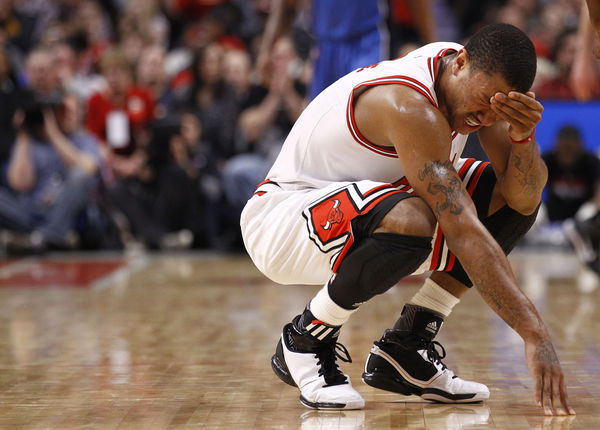
Jan 28, 2011; Chicago, IL, USA; Chicago Bulls point guard Derrick Rose (1) gets injured against the Orlando Magic during the third quarter at the United Center. Mandatory Credit: Mike DiNovo-USA TODAY Sports
The common factor in these career-defining injuries are joints, bones and feet, which are totally worse than the normal injuries that take weeks to recover from. These injuries, however, create a kind of an echo chamber effect, because one tear or fracture forces compensatory movement. That overloads another joint, or tendon, or muscle. Rose’s ACL led to extended knee problems. McGrady’s back spasms altered his balance and wrecked his lower body. Ming’s foot issues were compounded because of his size.
Injuries conținue to be a deciding factor in the NBA and in all sports. In fact, sports are a glorified battle of attrition. Who can outlast the rest? Although NBA medical staffs are presumably better than ever, the injury rate has boomed, leading to bigger picture conversations about whether the league should consider shortening the season. Then again, whatever attempt is made to curb superstar players from missing time due to injury, the name of the game is physicality, and physically will inevitably lead to injuries.