
With the 2025-26 NBA season officially complete and the New York Knicks champions for the first time since 1973 (!!), we have all the information we need to recap the year and rank the best players in the league.
Watch What’s Trending Now!
Our Criteria
There are four very important things to note when reading through this list. First, our rankings aren’t about who fills up the box score the most or who can get you a bucket in a pinch. This list is based on which players we believe give you the best chance of winning an NBA Championship. For instance, a flawed number one offensive option may give you a higher floor, but they don’t make good teams great in the same way that a high-end number two option can. At the end of the day, the goal of all of this is to be the last team standing. So, a good rankings list should be based on this ideal.
Second, this list is solely tied to the 2025-26 season. This means that it is not based on future upside heading into next year. It is all about how much championship equity a player added to their team this season.
Third, we have this list organized by tiers. What this means is that we believe you could make an argument for any player within a tier being ranked above/below the other players in that group. Player evaluations are fluid, and anyone who tells you differently doesn’t know what they are talking about.
And lastly, injuries are considered, but they are not an end-all, be-all. To be considered for this list, players need to have played at least 30 regular season games. However, some guys who crossed this threshold were still penalized if we never got to see the best version of them (i.e., Jalen Williams).
Anyway, enough talking; let the games begin!
Tier #1: Strong MVP Candidates
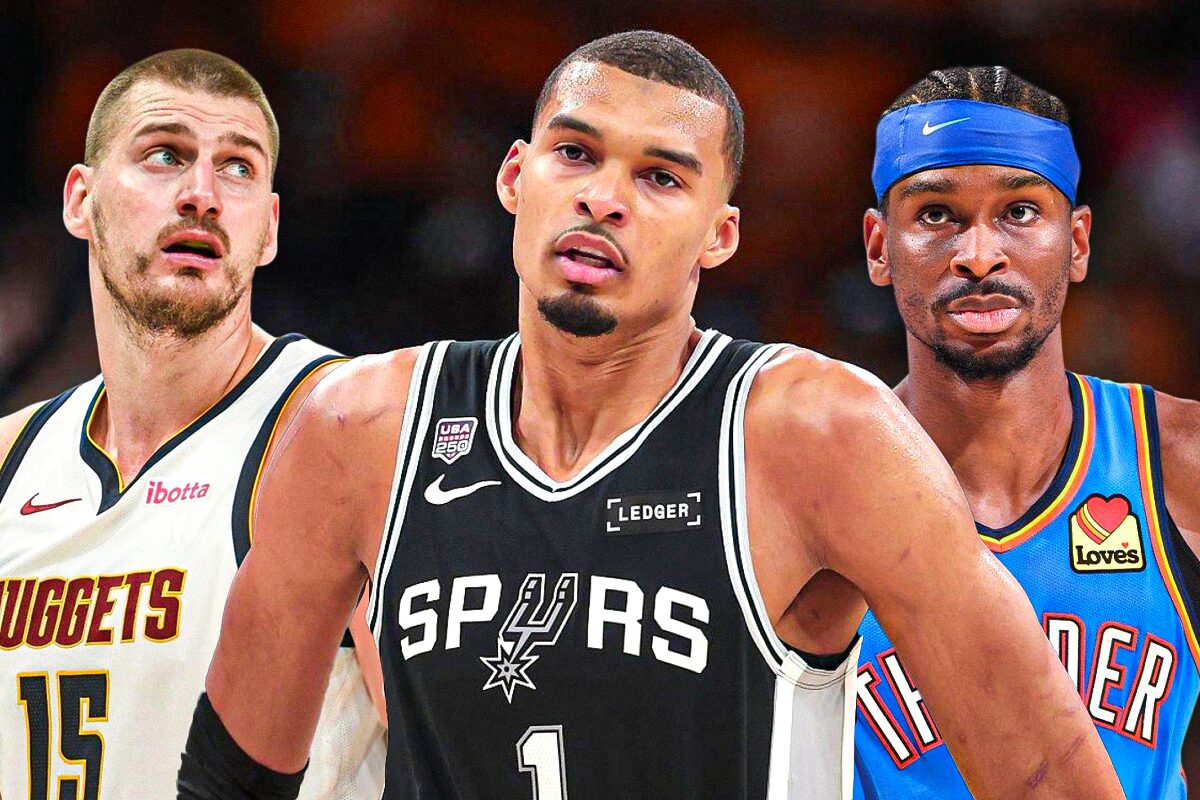
#1: Victor Wembanyama, San Antonio Spurs
Victor Wembanyama’s reign of dominance over the NBA has officially begun. After questions about his durability, Wembanyama made it through an entire regular season and a trip to the Finals and only missed 19 of 105 games.
Mostly-healthy Wembanyama was an absolute monster. He finished second in the regular season in Estimated Plus-Minus, and first in the postseason in this metric (per Dunks & Threes). Wembanyama was the first unanimous Defensive Player of the Year (DPOY), while also averaging 30.7 points per 75 possessions (98th percentile) on 62.5% true shooting (83rd). Of all players who played at least 1,000 minutes this season, only Nikola Jokic (who doesn’t have a backup as good as Luke Kornet) had a better on-off rating than Wembanyama (per Cleaning the Glass).
Some folks may want to penalize Wembanyama for falling in the Finals, but that was not on the prodigious Frenchman. Wembanyama played 199 of 240 minutes against New York, and in those minutes, the San Antonio Spurs outscored the Knicks by eight points (they were outscored by 20 in the 41 minutes he was on the bench). What lost the Spurs that series was their lack of an elite perimeter creator who could match Jalen Brunson in clutch situations, not the best player in the world coming up short.
#2: Shai Gilgeous-Alexander, Oklahoma City Thunder
You really got to feel for Shai Gilgeous-Alexander. The back-to-back regular season MVP finally seemed to leapfrog Jokic for the title of the best player in the world, only to have another big man take the throne that was supposed to be his.
Still, Gilgeous-Alexander is no slouch. No one since Michael Jordan really compares to him as a midrange shooter, and he is the most reliable bucket in the association (99th percentile scoring volume, 94th percentile efficiency). I know we just said that this wasn’t all about scoring, but you do still need to score points to win!
Gilgeous-Alexander also deserves credit for upping his playmaking this season – upping his assist rate (33.2%) by 3.4% from last season. He is also one of the few high-usage backcourt players who is still a clear positive (95th percentile DEF EPM) on defense, which is such a cheat code from a team-building perspective, as you don’t have to make sure that every other player he shares the floor with is a good enough defender to hide him.
#3: Nikola Jokic, Denver Nuggets
Jokic got nerfed this postseason, but the Minnesota Timberwolves have always been the Denver Nuggets’ kryptonite, and Rudy Gobert has always been the perfect foil to the three-time MVP. It also needs to be said that Jokic was never really the same after the knee injury he sustained at the end of December.
We can’t let Jokic completely off the hook, though. He’s getting older (this was his age-30 season), and his once sneaky-effective defense has taken a nose dive over the last couple of years. After placing in the 86th percentile or higher every year from 2018 to 2024, Jokic has failed to eclipse the 80th percentile in each of his last two seasons. Jokic is still an MVP-caliber player (finishing second in MVP voting this season), but he’s no longer the best player in the league.
Tier #2: Fringe MVP Candidates
#4: Kawhi Leonard, Los Angeles Clippers
I know it is weird to think that the fourth-best player in the world couldn’t even get his team to the playoffs, but remember, basketball is a team game. And if you’re having a hard time understanding how much impact Kawhi Leonard can make on a team, here is a good stat. Despite being on the Los Angeles Clippers, who were 11th in offensive rating (117.3), Leonard quarterbacked the team to a 121.1 offensive rating in his minutes. That’s higher than Luka Doncic with the Los Angeles Lakers, Giannis Antetokounmpo with the Milwaukee Bucks, and Stephen Curry with the Golden State Warriors.
Leonard’s blend of isolation scoring (99th percentile scoring, 83rd percentile scoring efficiency) and turnover suppression (97th percentile turnover on/off) makes him an elite offensive number one. And thanks to his ability to play off the ball (just 45th in time of possession, despite being sixth in PPG), he pairs perfectly with other high-usage offensive players (like James Harden and Darius Garland).
And while he isn’t the defender he was in his glory days, he’s still an above-average defender for his position. This season, he ranked in the 95th percentile in steal rate. This two-way impact made him fourth in on-off rating behind Jokic, Wembanyama, and the next player on our list. The only things keeping him from being in the top tier are his playmaking (a clear level below Gilgeous-Alexander) and the never-ending questions about his durability, despite him staying pretty healthy this year (65 games played).
#5: Giannis Antetokounmpo, Milwaukee Bucks
The Bucks were bad this year, but when Antetokounmpo was on the floor, he was able to make them look like a playoff team. When Antetokounmpo was on the floor, the Bucks outscored teams by 4.1 points per 100 (the Cleveland Cavaliers’ net rating from this season). And when he wasn’t, they were outscored by -10.3 per 100 (the Brooklyn Nets’ net rating).
Some may see this and call him a floor-raiser, but Antetokounmpo has already shown that he can be the best player on a title contender. And yes, he only played in 36 games this year, but part of that was the Bucks not wanting to risk him sustaining a serious injury, and when he was out there, we saw enough to show that he’s still one of the best at what he does.
No one scored more points per 75 this year than Antetokounmpo, and he managed this feat on 93rd percentile scoring efficiency. His defense may not be what it was during his glory days, but he’s still capable of ramping it up when he needs to. Plus, he may be the league’s best bet to slow down Wembanyama.
Like with Leonard, durability is a concern with the 31-year-old, and his lack of shooting means that he needs a specific type of center to truly be unleashed. But there is still enough evidence present to consider Antetokounmpo a top five player in the association.
#6: Luka Doncic, Los Angeles Lakers
What a shame that injuries kept us from watching him in the postseason because Doncic was absolutely cooking before a hamstring strain ended his season. In the month of March (16 games), Doncic averaged 37.5 PPG, 8 RPG, and 7.4 APG on 62.9% TS.
Doncic is the best offensive player of all the high-usage creators who struggle on the defensive side of the ball. The only players with a higher OFF EPM than him are Jokic, Gilgeous-Alexander, and, for some reason, Ty Jerome. And his burly build (6’8, 230 pounds) makes him less of a moving target than many of those other guys.
Why Doncic doesn’t rank any higher is the specificity that it takes to build a team around him. Of the 51 players we considered for this list, Doncic ranks 34th in on-court rating (+3.9 per 100), despite playing on a team that won 53 games. The Los Angeles Lakers are an imperfect roster (too many ball handlers, not enough athleticism, and no elite interior presence), and Doncic’s playstyle is not flexible enough to elevate this group. Doncic is good enough to be the best player on a championship team (if you swapped Brunson for Doncic, I’d wager the Knicks win the title even more handedly), but building a team that’s strong enough to give him a chance is a lot trickier than it is for the people ahead of him.
#7: Stephen Curry, Golden State Warriors
At 38 years old, Curry is still an Earth-shattering shooter and scorer. His scoring volume (30.2 points per 75) sits in the 98th percentile, and his efficiency isn’t far behind that (64.8% TS). The league may have caught up to the Warriors’ motion-heavy offense, but it still hasn’t figured out how to slow down Curry – who remains the perfect player to play alongside virtually any star player in NBA history. When he shared the floor with Jimmy Butler III, this Warriors’ team (that finished 18th in offensive rating) was still able to post a 122.8 offensive rating (per PBP Stats).
That is why, despite him missing nearly half of the Warriors’ games (39), we still feel comfortable putting him in this tier. However, his age and looming injury concerns keep him from climbing even higher.
Tier #3: Strong All-NBA Players
#8: Cade Cunningham, Detroit Pistons
Cade Cunningham is one of the best scorers in the league (2nd in playoff PPG) whose 9.9 APG (second in the NBA during the regular season) somehow underestimates his value as a playmaker. This season, only Jokic had more rim assists (321) than Cunningham (311). That is why, even though he often shared the floor with two or three non-shooters, Cunningham was able to quarterback the Detroit Pistons to a 121.4 offensive rating (92nd percentile).
But what really stands out about Cunningham is just how good of a defender he is, even with the massive offensive burden he carries. Once Jalen Duren’s defensive limitations were exposed, it became clear that Cunningham was the second-best defender in the Pistons’ starting lineup (behind only Ausar Thompson), meaning that he was the driving force of their offense while also being a key cog in their second-ranked defense. In the playoffs, Cunningham managed to hold James Harden and Paolo Banchero to a combined 19-for-59 (32.2%) from the floor when he was shadowing them (per NBA.com).
Cunningham’s two-way excellence gives teams a lot of the same optionality that Gilgeous-Alexander does. The only things keeping him from being higher are his efficiency (44th percentile TS) and the relative unknown about his ability to play alongside other high-level offensive players. Something tells me that Cunningham will be up a tier or two in the coming seasons (remember, he’s only 24), but for now, he sits at the top of Tier 3.
#9: Jalen Brunson, New York Knicks
I know, I know. Brunson is fresh off an NBA Championship where he was the Finals MVP, and no one in the state of New York carries a higher q-rating than he does at the moment. With that said, you have to factor in how well-constructed this Knicks’ team was and all that had to go right for them to accomplish this feat.
Arguably no team boasts the trio of do-it-all wings (OG Anunoby, Mikal Bridges, and Josh Hart) that the Knicks have. They also had pristine floor spacing (thanks to guys like Karl-Anthony Towns and Landry Shamet), and a coach who knew how to extract the most out of this team in Mike Brown. The Knicks were perfectly constructed to enhance Brunson’s strengths and hide his weaknesses. This is evidenced by the Knicks being able to win two of their first three games against the Spurs, despite Brunson being a -13 in those contests. The Knicks also benefited from the Oklahoma City Thunder being bruised enough to fall to the Spurs in the Western Conference Finals, which allowed them to draw an opponent that they had a handful of strategic advantages over.
The only players ahead of Brunson who are worse defensively than Brunson are Doncic and Curry, and both of those guys are better offensive players. It also needs to be noted that Brunson’s individual numbers are down compared to his last two seasons, which is concerning given that he’ll be 30 at the start of next year. I know it sounds like all we are doing is poo-pooing on the reigning champion, but ninth in the world is nothing to scoff at.
#10: Anthony Edwards, Minnesota Timberwolves
Physically, Anthony Edwards is the closest thing we’ve seen to Dwyane Wade and Michael Jordan since those Hall of Famers dominated the association. His blend of shooting, jaw-dropping athleticism, and acquired change of pace makes him one of the most dynamic and bulletproof scorers in our league (98th percentile scoring volume, 80th percentile efficiency). And when he wants to be, he can impact the game from the defensive side of the ball in a way that few superstars can.
However, Edwards is still missing some of the soft skills necessary to rank higher in the league hierarchy. His playmaking is inconsistent (6th percentile assist to usage rate), and his off-ball defense can border on space cadet territory.
The Timberwolves have yet to field the picture-perfect roster around Edwards in the way that the Knicks just did with Brunson, but Edwards is also part of the problem. He isn’t a strong enough creator for others to be a full-time point guard (a spot the Timberwolves are usually forced to fill with a below-average defender), and he isn’t always 100% engaged, which is why his on-off impact (-0.2 per 100) is far from what you’d expect from a player of his caliber.
Tier #4: Fringe All-NBA Players
#11: Tyrese Maxey, Philadelphia 76ers
Tyrese Maxey has that silver bullet athleticism that makes him immune to high-level playoff defenses, and he’s a great enough shooter (a fluke hand injury has slightly suppressed his percentages) to make defenses pay for overplaying his burst. He’s also not afraid to handle an insane minute load (no player averaged more minutes per game this season), giving his stardom a throwback quality.
Nothing illustrated Maxey’s capabilities as a number one offensive option more than his performance in Game 3 of the Eastern Conference Semifinals against the Knicks. Anytime the Philadelphia 76ers ran offense centered around Maxey, it led to a high-quality look. What killed them was when they pissed away possessions with Paul George and Joel Embiid isolation touches. In that game, Maxey boasted a pristine 70.8% TS (neither George nor Embiid eclipsed the 46% mark) and an assist-to-turnover ratio of 7:2. All this says nothing about how his athleticism and wingspan (nearly 6’8) make him a plus defender for his position (74th percentile DEF EPM).
The only thing stopping him from being higher up on this list is that he’s basically a smaller version of Edwards. But who knows how much he can rise as he continues to sharpen his game and the 76ers continue building a more cohesive team around him.
#12: Scottie Barnes, Toronto Raptors
No one’s individual stock benefited more from this postseason than Scottie Barnes. He scored six more points per game, tallied 2.7 more APG, and increased his TS by 2.8%. Overall, Barnes finished the playoffs sixth in EPM, which is crazy considering he only appeared in one series, and his team ended up losing that matchup. Barnes’ combination of force and intellect makes him perfect for the physicality of playoff basketball. He’s also got a little bit of Cunningham in his game, ranking third in total rim assists in the regular season.
We haven’t even talked about his defense. Barnes finished fifth in DPOY voting, was second team All-Defense, and placed in the 94th percentile DEF EPM. He is one of maybe four non-bigs (the other three being Thompson, Anunoby, and Alex Caruso) who are capable of anchoring a top ten defense as the team’s best defender.
Conceptually speaking, Barnes is a defensive number one and an offensive number two (remember his finishing and connective tissue passing pair well with other great offensive players) on a title-contending team. Historically speaking, those players tend to challenge for a top ten spot in these sorts of rankings. The only real worry with Barnes at this point is how you can build a strong offense with Barnes at the four if you don’t have a true floor-spacing five, especially if Barnes is playing without the ball in his hands.
#13: Karl-Anthony Towns, New York Knicks
Only one player this postseason posted an EPM higher than Towns, and that’s Wembanyama – the guy who occupies the top spot in our rankings. The only player I’ll hear an argument for raising his stock these last couple of months more than Barnes is Towns.
Once an unsolvable riddle because he was at his best offensively while playing the center but couldn’t be a part of strong defenses unless he was at the four, Towns finally cracked the code by being stout enough on defense to make him at the five tenable.
We’ve spent thousands of words cataloguing all that Towns has done to become the best version of himself, but one thing is clear: Towns is one of the top 15 players in the league right now.
For the same reasons why we dinged Brunson, Towns does get taxed for being in the perfect ecosystem to harness his full powers. But it isn’t enough to keep him too far off from his All-NBA teammate.
#14: Donovan Mitchell, Cleveland Cavaliers
Few players are as enigmatic as Donovan Mitchell. On any given night, Mitchell can go blow-for-blow with the league’s most prized heavyweights, like the protagonist of a feel-good boxing move. But other times, he seems to lack the burst (or maybe urgency) to channel the side-to-side euros and gathers that make him so dangerous.
In 18 playoff games, Mitchell had six 30 balls (the Cleveland Cavaliers were 4-2 in those games), but he also had five games where he scored 21 points or less. That kind of stuff can’t happen when the number one attribute you bring to the game is your ability to score.
Part of this certainly needs to be credited to injuries, but if Mitchell’s Barry Sanders-esque drive game isn’t conducive to withstanding an entire postseason run, then he needs to get penalized for it in these rankings. It also doesn’t help that he isn’t as effective of a defensive playmaker (51st percentile DEF EPM) as someone like Maxey or as good of a playmaker as the likes of Brunson or Doncic.
#15: Jaylen Brown, Boston Celtics
Jaylen Brown carries a complicated legacy. On one hand, his physical profile resembles that of a Greek God, and his trophy collection includes five All-Star appearances, two All-NBA nods, an Eastern Conference Finals MVP, and a Finals MVP. Sounds like a superstar, right? Sort of. Throughout his career, his advanced metrics have always lagged behind these accomplishments.
This regular season, Brown was faced with the greatest challenge of his professional career. Injuries and cost-cutting maneuvers forced him to spend the majority of the season with only one of his top five teammates from the 2024 championship group. Brown responded by being the leading scorer (fifth in scoring volume among all players who played at least 30 games) on the second-best regular season team in the Eastern Conference. He mastered the art of using his Herculean frame to barrel his way into the paint, leading to a career year in foul drawing (97th percentile in free throw attempt rate).
Still, for the fourth straight year, Brown’s on-off rating was in the negatives, meaning the Boston Celtics were actually better with him off the floor. To put this into perspective, only one player of the 48 we considered for this list posted a worse on-off rating than Brown (-4.6 per 100). These types of indicators can not be ignored, which makes this ranking feel appropriate, despite the gaudy numbers he put up in the name of team success.
#16: Chet Holmgren, Oklahoma City Thunder
I know, I know. It isn’t exactly cool to be singing Chet Holmgren’s praises. But what did Holmgren do wrong? Looked inferior in the Western Conference Finals against the one player (Wembanyama) who does everything he can do at a higher level? How is that any different than Hakeem Olajuwon alphaing David Robinson in the 1995 Western Conference Finals? In that instance, was Robinson not a top 20 player in the world at the time? I don’t think so (in fact, he was easily a top ten player at the time, but I digress).
Let’s think about all that Holmgren did well this season. He was the second-best defender in the entire league. A league that touts what may be the single greatest defender we’ve ever seen. He posted the sixth-best on-off rating (+10.9 per 100) of the 48 players we’ve been referencing (the five guys ahead of him make up the top five of this list, by the way). In the first two rounds, Holmgren averaged 18.6 PPG on 70% TS with a net rating of +16.0.
Holmgren is capable of being the best defender on a championship team, and his blend of interior and perimeter play-finishing gives him a lot more offensive juice than the Rudy Goberts of the world. Let’s focus on that instead of fixating on one bad series. One that the Thunder probably win if not for injuries.
Tier #5: Strong All-Star Players
#17: Jamal Murray, Denver Nuggets
Jamal Murray finally showed up ready to go at the start of the regular season, instead of using the early portions of the 82-game schedule as his own training camp, and man, did it pay off. He posted career-highs in scoring volume (96th percentile) and scoring efficiency (85th), and his assist rate (94th) was merely a hair below his previous career-best (95th).
Murray also showed that his impact extends far beyond his partnership with Jokic, as his scoring volume saw a slight uptick, while his TS% only fell by a single percentage point.
Like his lumbering pick-and-roll partner, we’ll forgive Murray’s postseason shortcomings because Jaden McDaniels has Murray’s number, and not every team has a point-of-attack defender with his physical gifts. But Murray lacks the rim gravity or two-foot acumen of the guards ahead of him, and he’s probably a worse defender than all of them (7th percentile DEF EPM). So, his place at the top of this tier seems fitting.
#18: Devin Booker, Phoenix Suns
Devin Booker deserves flowers for helping a revamped Phoenix Suns team largely outperform their preseason expectations. Age has served to sharpen his game. His playmaking seemed more patient. His knack for drawing fouls is more effective (lapping his previous career-high in free throw attempts per 75).
Booker’s ability to blend on-ball and off-ball scoring has always been better utilized alongside a strong ballhandler who can help set the table for him and the rest of his offense (like what Chris Paul was to him in the early 2020s), which is why his efficiency isn’t as strong as his contemporaries (61st percentile).
Still, it seems like Murray is better in that on-ball/off-ball hybrid role, as his true shooting without Jokic (61.2%) was higher than Booker’s season average (58.9%). And while you could argue that Booker’s sturdiness and length (he’s an inch taller and longer than Murray) make him a better defender, the difference isn’t great enough to warrant putting him above the former NBA champion.
#19: LaMelo Ball, Charlotte Hornets
After long being pegged as an “empty-calorie” player, LaMelo Ball proved that he could drive winning basketball when surrounded by a respectable supporting cast. Ball’s blend of wicked pace, audacious passing, limitless range, and reasonably engaged defense was the driving force behind the Charlotte Hornets’ midseason turnaround (they went 28-10 after starting 16-28).
Of the 48 players we looked at, Ball ranked 11th in EPM, 13th in on-off rating, third in assists per 75, and fourth in offensive rating – behind three members of the Nuggets (Jokic, Murray, and Aaron Gordon), who just so happened to be on the best offense in the league this season.
Part of me wonders if we are somehow underrating Ball by putting him at 19th, but since we have not seen him play in a playoff series, and don’t know how a team would look with him at the controls in that type of environment, it doesn’t feel safe to rank him any higher than this. Although Ball could be one strong postseason showing away from threatening for a top 15 spot.
#20: Bam Adebayo, Miami Heat
The only player other than Ball to crack our top 20 and not be an All-Star this year was Bam Adebayo, and he certainly should be ticked off about being snubbed. Adebayo was the glue that kept this mediocre Miami Heat team respectable. With Adebayo on the floor, the Heat outscored opponents by 6.4 points per 100. And without him, they were outscored by -3.1 per 100. That +9.5 per 100 on-off rating ranked ninth among the contenders for this list.
But more than all the floor-raising Adebayo did for the Heat this season, his skill set makes him the perfect second-best player on a team with championship aspirations. The Ringer sums it up best in their Top 100 Player Rankings:
“Tremendously well-rounded in ways that are perfect for an ensemble, but less so for carrying a team of his own.”
Adebayo is one of the best defenders on the planet (94th percentile DEF EPM and 89th percentile Defensive on-off), and his flexibility allows him to slot in at either the four or five spot. Offensively, Adebayo nearly doubled (5.9 3-point attempts per 75) his previous career high (3.1 per 75) in 3-point attempt rate, which makes playing him alongside a non-shooting big man much more doable. And over the years, he’s added enough to his drive and isolation game to create some buckets on his lonesome (88th percentile scoring volume). Adebayo’s rim rates (21st percentile in rim frequency among bigs) are underwhelming, but he also hasn’t played with a true pick-and-roll proficient guard in quite some time.
Adebayo is a clear level below Wembanyama and Holmgren when it comes to anchoring a defense, which is why he isn’t higher on this list. But he’s still a pretty damn good player. Hopefully, the Heat land Antetokounmpo so we can see him playing meaningful basketball again in the near future.
#21: Pascal Siakam, Indiana Pacers
Remember, we are talking about how much the current version of a player would contribute to a hypothetical title team, not how much they contributed to a championship on their current team. That is why we can’t forget about Pascal Siakam just because the Indiana Pacers decided to use the 2025-26 season as a gap year.
Nothing about Siakam’s season this year should make you feel like he can’t be the second-best player on a well-constructed team that came within one win of the Larry O’Brien Trophy. Siakam’s transition cross-matching, isolation scoring, defensive versatility, and sneaky physicality allow him to operate as the second-best offensive player and second/third-best defender on a title-contending team.
But notice how we mentioned how balanced the 2024-25 Pacers were. Part of the reason Siakam was so effective is that he had Myles Turner to space things out for him at the five spot. Floor spacing centers are a dime-a-dozen, making building a winner around Siakam a little trickier than it would be with someone like Adebayo.
Tier #6: Fringe All-Star Players
#22: Lauri Markkanen, Utah Jazz
The Utah Jazz’s endless desire to lose as many games as possible probably (more like, most definitely) caused Lauri Markkanen to miss more games (40) than he needed to. But don’t let that take away from what was an awesome scoring season.
Markkanen had his best volume scoring season (97th percentile), while also placing in the 77th percentile in true shooting, despite a relative down year from three (35.5%). The Jazz were a bottom ten defense, but when Markkanen was on the floor, they were slightly above average (56th percentile). This is without Markkanen being all that good of a passer (22nd percentile assist rate).
Markkanen’s rare combination of size, power, and shooting allows him to have a Curry-like effect on the basketball court without being a strong on-ball playmaker. He’ll never be able to quarterback an elite offense as the primary decision-maker, but his ability to play off others makes him symbiotic with even the most ball-dominant players.
Defense has never been his calling card, but in a game that is trending toward physicality and offensive rebounding, Markkanen’s size (he’s seven freaking feet tall) and ferocity (85th percentile in offensive rebounding among forwards) gives him an edge over the next player on our list, who struggles in both of those areas.
#23: Kevin Durant, Houston Rockets
While guys like Barnes and Towns have never had their stock higher, Kevin Durant’s perceived value is at an all-time low. That’s what happens when you lose a series you’re heavily favored in (something we predicted, by the way) to a team missing its two best players, and you only play in one game that you crap your pants in.
To Durant’s credit, though, he still put up sterling scoring numbers (96th percentile scoring volume, 90th percentile scoring efficiency) in what was his age-37 season, and this Houston Rockets team had some of the worst offensive infrastructure in the entire league.
At this point in time, Durant is who he is. His loose handle (24th percentile turnover rate among wings) and diminishing ability to get to the rim (13th percentile) make him an immensely flawed offensive number one. But his shot-making is still as dialed in as ever, making him a strong number two option.
Unfortunately, the game is a lot thicker and bashful than it was when Durant was in his prime, making his inability to play through contact more detrimental than once was (hence his mediocre -0.3 per 100 on-off rating).
#24: OG Anunoby, New York Knicks
Usually, it is hard for a three-and-D wing/forward to provide enough value to crack a top 25 list because of their lack of on-ball creation or anchoring rim protection, but Anunoby seems to have transcended this archetype.
He is the king of all the little things that you need to field a synergistic five-man lineup. He can credibly defend pretty much any type of player. He swarms gaps and destroys passing lanes (94th percentile steal rate among forwards). His secondary rim protection can make up for having a below average defensive anchor (75th percentile block rate). And Lord help you if you leave him open from downtown (41.9% on wide open threes).
However, Anunoby has slowly been adding to his closeout attacking and off-the-dribble game, culminating in a postseason run where he finished in the 84th percentile in scoring volume. Normally, when a player is asked to abruptly scale up their usage, it leads to a decrease in efficiency. But Anunoby just put together the most efficient TS season of any 20+ PPG scorer in playoff history (minimum 5 games played).
The days of calling Anunoby one of the best role players in the league are over. Now, he is just one of its best players. Period.
#25: Austin Reaves, Los Angeles Lakers
Austin Reaves just keeps getting better. This season, Reaves had his best volume scoring season (93rd percentile), while also putting together his second-best campaign in terms of efficiency (91st percentile).
In theory, Reaves is that offensive number two with defensive limitations whose ability to play both on and off the ball portends well next to a ball-dominant creator (like his current Los Angeles co-star), meaning he should, theoretically, be in the same range as guys like Murray and Booker. But Reaves scoring volume and playmaking is the lowest of those guards, which makes him more of a good offensive number two than a great one.
Still, he did just enough this season to occupy the final spot on our list.