
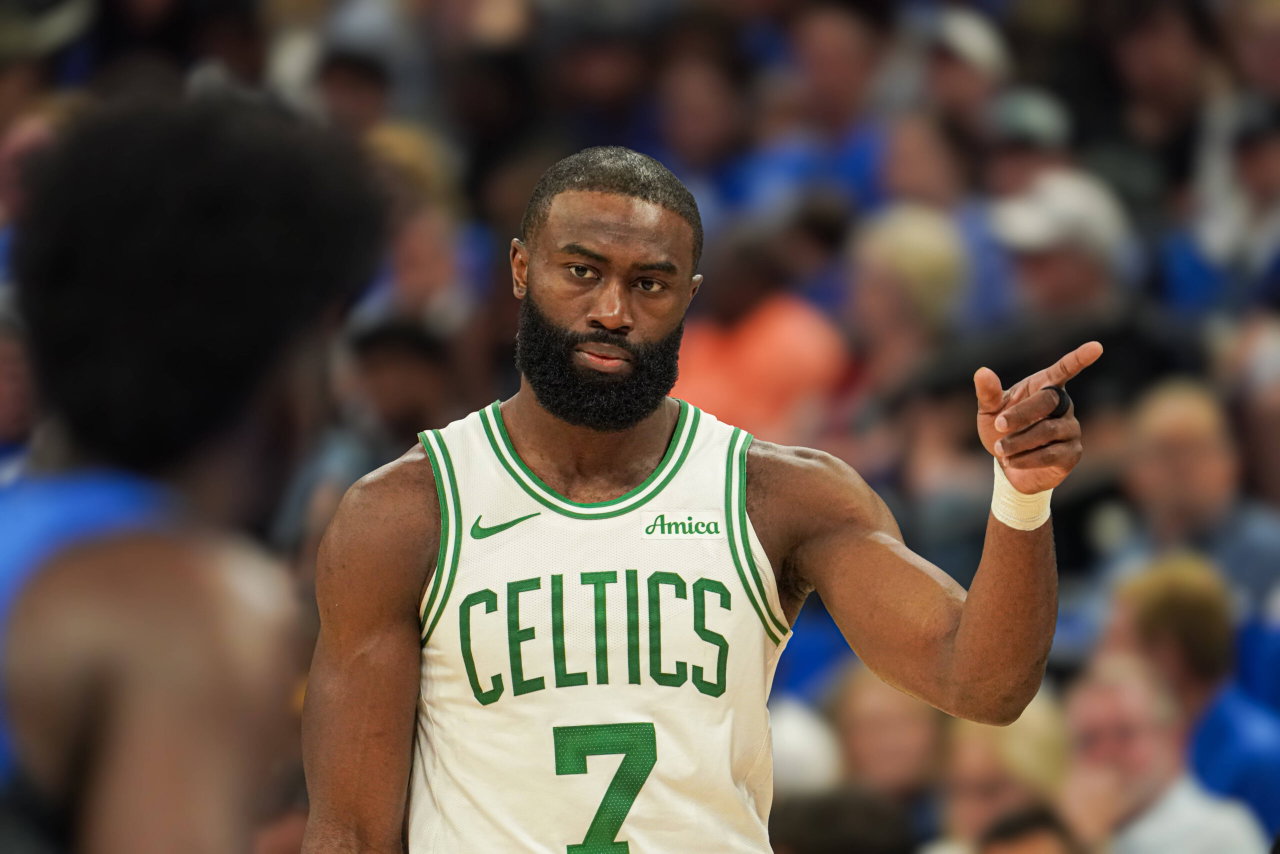
On Sunday, Jaylen Brown returned to Boston Common for a farewell block party, looked out at a crowd he guessed at ten thousand people, and told them he loved the city. His Twitch camera caught the whole thing: a key to the city in his hand, his 2024 championship ring still on his finger, and two and a half hours of a goodbye. “I said I’m going to go to war for this city,” he told the crowd, recalling a promise he’d made as a rookie a decade earlier.
Watch What’s Trending Now!
Two months before that block party, it looked like Brown’s exit from Boston might carry a very different kind of headline. The Celtics had traded him to Philadelphia for Paul George and four draft picks. Within days, Fox Sports’ Colin Cowherd said two anonymous league sources, an executive and a scout, had a word for what they saw as Brown’s real problem, pointing to a belief that he’s the smartest person in whatever room he walks into, a habit of tuning out his coaches, his bosses, and eventually his own teammates once the money got big enough. Cowherd called it a disease.
Brown is still hearing that word months later. But now he sees it from a different perspective, turning that criticism into something bigger, coming to a realisation that the infrastructure around NBA players tends to actively discourage them from investing in the communities that raised them, for having a mind of their own to do so.
“People that are representing, or the people that are around some of our most influential players, are steering them away,” JB said during his latest Twitch livestream. “They’re steering them away from being in their community. They’re steering them away from helping the people in the situation they came from, because there’s no benefit for these people that are representing.”
“They said I had a disease,” Brown added. “They call me the smartest person in the room and all this type of stuff for just trying to uplift my community and showing respect to the places that I came from.”
He had hinted at the same thing at the Francis J. Myers Recreation Center in West Philadelphia earlier, high-fiving kids in shirts with his name on them as he arrived. He didn’t spend the press conference relitigating the diagnosis. He pointed instead at the room he’d chosen for it. A rec center instead of the team’s practice facility, a neighborhood instead of a podium.
That choice has a decade of backing behind it. When Brown signed his five-year, $304 million extension with Boston in 2023, then the richest deal in NBA history, he told reporters at the MIT Media Lab that the money wasn’t really the point. “I want to launch a project to bring Black Wall Street here to Boston,” he said.
That promise became Boston XChange, a nonprofit built with backing from Jrue Holiday’s family foundation and partnerships with MIT and Harvard Business School, aimed at generating five billion dollars in wealth for communities of color across the city. His own 7uice Foundation runs a bridge program out of that same MIT lab. Boston later named October 24th, his birthday, Jaylen Brown Day.
“I announced that I wanted to build, like, Wall Street,” Brown recalled. “And I told you guys I was gonna commit and invest into the city, and that’s what we did. And that’s what I’m continuing to do.”
That said, regarding the “smartest guy in the room” line, there is much nuance that people tend to consign to oblivion. Brown entered the 2016 draft without an agent, later telling podcast hosts Gillie Da King and Wallo that he’d run the math on standard agent fees against what agents were offering him and decided the players’ union could do the job for less. “The math wasn’t mathing for me,” he said.
He’s since applied that same arithmetic to a broader argument about the NBA’s agency model, which he blames in part for poor financial outcomes among players, a structure that rewards whatever pays the agent rather than whatever actually serves the player, or the block they came from.
That’s the version of “doesn’t listen” Brown will own. He didn’t listen to the agents who wanted to fly him to Los Angeles as a rookie. He didn’t fully believe Boston’s front office valued him the way he thought it did, either; on Twitch in August, he said he’d “found out quickly that may or may not be the case.” He kept livestreaming through a trade a lot of players would have handled quietly, telling his chat within a day of the news, “we’ve got to stop with the damn anonymous sources.”
To have a real relationship with his community is one of the reasons Brown turned to Twitch. Streaming gives him a direct relationship with his audience and allows him to discuss subjects he believes traditional sports media and corporate institutions often filter or distort.
“These companies be crazy. Corporation, they be crazy. They be lying to us. They be putting stuff, propaganda out, putting out false statements, stuff that’s not even true. That’s why I started streaming in the first place. Because these industries be so corrupt. You force the hand. I want the chat to be able to see it, to be able to stand up….These entities and organizations, they do not want you to be like that. They do not care about your community. They care about dollars. Everybody only cares about dollars”.
Brown’s message therefore challenges more than sports management. It challenges the idea that an athlete’s greatest achievement comes from escaping the circumstances that produced them. For him, influence means having the resources to return home and create something lasting.
The “disease” label may have been intended as criticism. But Brown sees the willingness to keep giving back as a strength.