
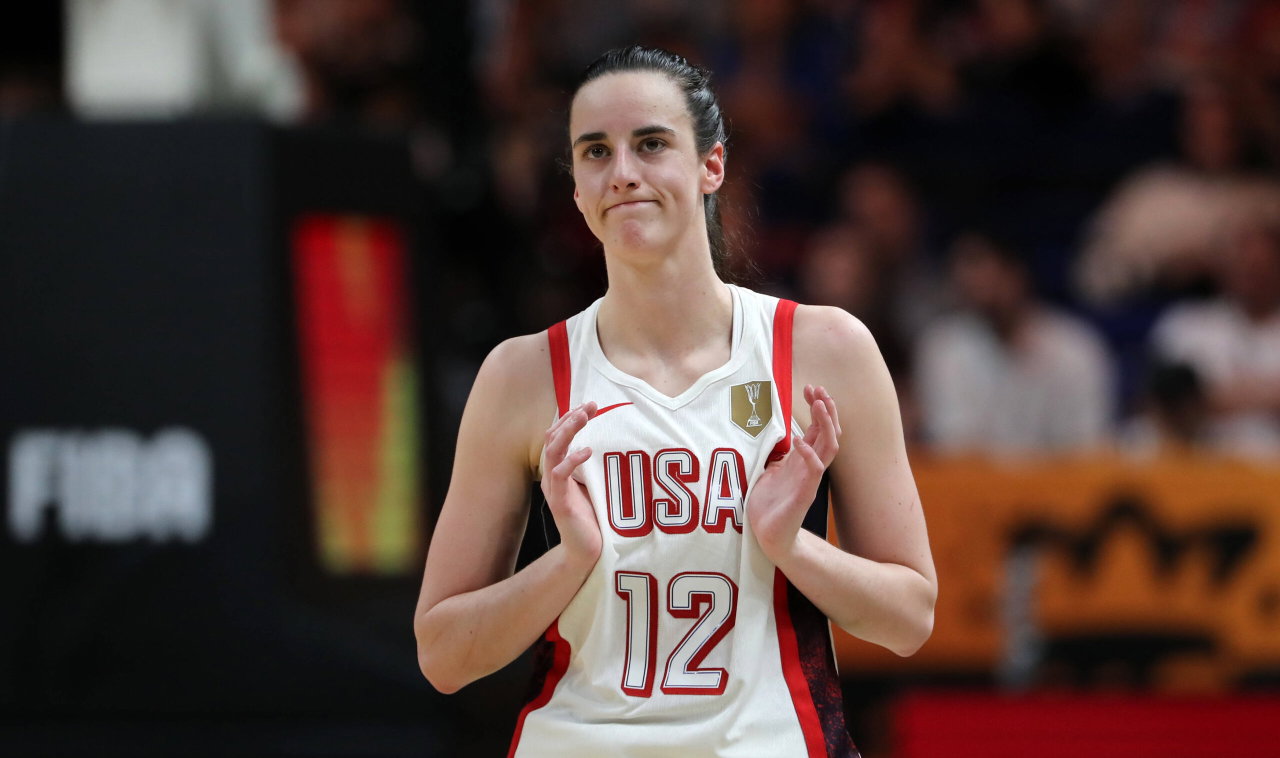
Stephen A. Smith’s fallout with Cari Champion and Jemele Hill has turned into a debate over how much credit people should get for helping others. After their three-hour conversation on Flagrant and Funny, Smith publicly took issue with what he saw as a lack of gratitude for his appearance and the attention it brought the podcast. Hill, however, sees the issue differently, and she drew a comparison to the ongoing debate around Caitlin Clark and how much gratitude others are expected to show her.
Watch What’s Trending Now!
“There is a particular fascination with people wanting people to express a level of gratitude that’s not really gratitude. They just want you to kiss his ass,” Hill said in a recent episode of her podcast. “That’s what they really want… in the mind of some people, not everybody — but until you pay proper tribute, whatever that looks like in their mind. It’s kind of the same thing with Caitlin Clark,
“It is that the reason that whole jealousy and ‘you guys aren’t grateful enough,’ ‘look what she did for you.’ Whenever I ask the additional question, ‘okay, what does that (gratitude) look like to you?’ They never really have an answer. It’s because they just want you to stay in servitude. Like, they want you to stay in servitude of what Stephen A. did for you in your career. And it’s like, well, you could take the credit and can be properly credited, but don’t try to erase me in the process. Because remember, and this is the other part people forget: He tried to take credit for my career too.”
Smith’s side of the dispute is rooted in numbers. He said the Flagrant and Funny podcast had roughly 9,000 YouTube subscribers before he sat down with Champion and Hill, and more than 30,000 afterward, with his interview alone generating over a million views across platforms. In his view, that kind of jump warranted at least an acknowledgment.
“A simple thank you would have sufficed,” Smith said. “Reciprocation seems to be a hard thing to come by.”
But the podcast surfaced a second, thornier disagreement that runs underneath the gratitude complaint: how much Smith actually shaped Champion’s and Hill’s careers.
The episode’s own description framed part of the conversation as the trio “setting the record straight about Stephen A.’s role in Cari securing her job at the network.” At one point, Smith brought up Champion supposedly reaching out to him when Molly Qerim left First Take, a claim contentious enough that Champion pulled out her phone mid-conversation to challenge his recollection. Smith eventually conceded that the person who had actually contacted him appeared to be someone impersonating Champion.
That exchange is the backdrop for Hill’s comment about Clark. She isn’t suggesting Smith is personally campaigning for Clark to be thanked. She’s using a debate she believes already exists around Clark to describe a pattern she sees in her own dispute with Smith: a real contribution gets acknowledged, then stretched into an expectation that the person who benefited should defer to the person who helped them.
Moreover, the Clark comparison isn’t a stretch on Hill’s part, either. Smith has made versions of the “give Clark credit” argument himself.
In October 2024, his show ran a segment titled “WNBA Players Kill Contract. Caitlin Clark deserves a Thank you!”, built around the league’s players opting out of their collective bargaining agreement as the WNBA’s business value climbed. And in July 2026, when a commentator floated the idea that the league might be fine without Clark because other players could now carry it, Smith dismissed the notion outright, calling it “absolutely, positively insane” and describing Clark as the league’s “cash cow.”
What complicates a clean “Smith thinks Clark built the WNBA” read is that Smith has also credited the players who came before her. In that same July segment, he said the league was built on the backs of the women who preceded Clark, “most of them being sisters,” while still arguing that her arrival pushed the WNBA’s visibility to a different level. That’s a more careful position than it’s often given credit for, and it happens to land close to Hill’s own distinction: credit the impact, but don’t erase the people who did the earlier work.
Clark herself has drawn that same line. Before she entered the league, she said of the players who preceded her, “These are the women that kicked down the door so I could walk inside,” naming Sheryl Swoopes, Lisa Leslie, Cynthia Cooper and Maya Moore among those she credited. Even the player at the center of the “gratitude” debate has been careful to separate bringing new attention to a sport from having built it.
That’s the logic Hill is applying to her own situation. She isn’t denying Smith did anything for her. She says plainly, “Yes, I appeared on his show which I have always given him credit for.” But at the same time, she’s rejecting the idea that appearing on his show, or benefiting from his platform, amounts to Smith having built her career. “He put a 100 on 10,” she said.
The historical record backs up more of Hill’s account than it does the inflated version. After online chatter credited Smith with getting her hired at ESPN, Hill corrected it directly: “Stephen A. is not the reason I was hired at ESPN.” She has said the person responsible was Keith Clinkscales, an ESPN executive who brought her on in 2006 after seeing her work at the Orlando Sentinel, hiring her to replace Skip Bayless as an ESPN.com columnist. By her account, Smith had already left the network by the time she began doing television there.
Hill also wasn’t an unknown writer waiting to be discovered. She’d already worked as a sportswriter at the Detroit Free Press and the Orlando Sentinel before ESPN, and she’s said as much herself: “Most people aren’t aware that I had a successful journalism career before coming to ESPN.”
Her ESPN career started as a columnist, not a television personality, the on-air work came later, and by her own telling, it grew almost by accident. She’s said her agent negotiated 20 television appearances into her ESPN contract, expecting her to use them for exposure, and that she blew through all 20 within two months; television grew into 40 to 50 percent of her job in her first year.
The bigger turning point in that trajectory wasn’t Stephen A. Smith, it was Michael Smith. Hill and Michael Smith began building His & Hers, first as a podcast around 2012, and the show became the foundation for their eventual move to SportsCenter. ESPN’s own announcement of that move described His & Hers as the precursor to the pairing, and noted they were the network’s first regular African-American duo to host SportsCenter. By Hill’s account, the chemistry the two built over years on that show is what carried them there, not a door Stephen A. Smith opened for her.
None of that means Smith was irrelevant to her time at ESPN. During Hill’s 2017 suspension, he continued hosting SportsCenter without her, and Hill publicly called him her “biggest supporter” at the time. That’s a genuine professional relationship, and it’s part of why her current argument isn’t that Smith did nothing, it’s narrower than that.
“There was no situation where Stephen A. ever had to vouch for me because our careers did not cross that way,” she’s said, describing their trajectories at ESPN as parallel rather than hierarchical: two personalities who rose within the same organization, not a mentor clearing a path for a protégé.
Strip away the specifics of who said what on which podcast, and Hill’s argument reduces to one idea, applied twice. With Clark: acknowledge what she’s done for the WNBA’s visibility, but don’t treat that as license to erase the players who built the league before her. With Smith: acknowledge the exposure and support he provided, but don’t let that turn into a claim that he authored her career. In both cases, the objection isn’t to gratitude itself, but to gratitude becoming deference.