
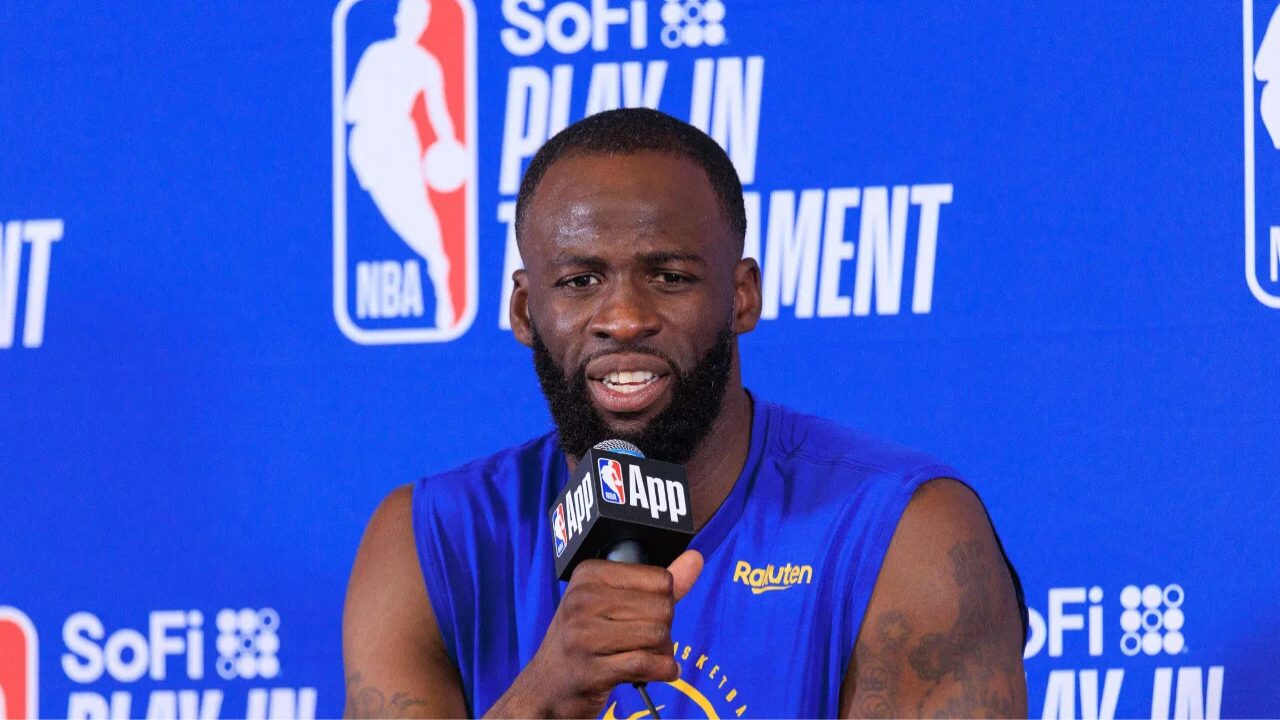
Draymond Green himself revealed that artificial intelligence and high-tech tracking data is the latest trend in every corner of professional sports, from broadcast analysis to even devising strategies on the floor. But there’s one area the Golden State Warriors veteran is drawing the line. The team enforcer with a notoriety for officiating drama is sounding the alarm on how far the NBA should allow technology to dictate the game.
Watch What’s Trending Now!
Responding to NBA Commissioner Adam Silver’s CNBC interview where he revealed that the league is actively testing a Wilson “smart basketball” embedded with a microchip sensor, Green expressed deep skepticism, warning that over-automating officiating risks removing the human element and natural rhythm of basketball.
Speaking on his podcast, Draymond Green reacted to the news that the one-gram sensor that’s capable of tracking spin, movement, and trajectory to assist referees with out-of-bounds calls and goaltending, could make its regular-season debut as early as next year.
“So, I find this one interesting. And I find this one interesting because, you know, this is AI continuing to creep into basketball. It’s actually creeping into the actual gameplay of basketball, and this is right there with it. But I think I just find it interesting because it’s more and more things like this that I think are continuing to turn officials into robots. You know, now you want to see the ball spin like you want to, like, I just think more and more things like this takes away the natural element of the game of basketball.”
Green stressed that taking decision-making entirely away from on-court referees strips the sport of its organic feel, even if the primary motivation is improving accuracy.
“I’m just… my initial thoughts is when you start to see more and more of these things, it’s kind of roboticizing the game in my opinion. I think sometimes it takes away some of the natural feel for officials and things that there are calls that they’ll make and, you know, things that they’re looking at,” Green continued. “And so I, you know, I don’t know that that’s going to be the case, but I just feel like when you’re starting to see more and more of these things, it’s turning officials more and more into robots because it’s taking things more and more out of their hands.”
However, the four-time NBA champion acknowledged the flip side of the technological push, noting that automated precision could silence long-standing conspiracy theories surrounding officiating.
“Now, you could say, ‘Hey, it’s taking away more of the human error…’ For the people out there that say, ‘Oh man, the NBA is rigged,’ or, you know, ‘Referees are betting on games,’ all the things that you hear people saying, you know, this could help with that, you know, right? Like, this helps takes more and more. And so I think there’s multiple different ways to look at this, but ultimately, these things could be used next year, and I think, you know, they could be interesting.”
Interestingly, Dray is one of those players who brings the human element into officiating when he argues about consistency about rules and even when he goes a little too far with the fouls. His concerns are valid. But the NBA commissioner confirmed they’re aware of the uphill battle to get players to agree.
Adam Silver confirms player skepticism over new NBA tech
The introduction of Wilson’s microchip ball marks the league’s latest step toward high-tech officiating. Speaking to CNBC’s Contessa Brewer, Commissioner Adam Silver confirmed that the chip weighs roughly one gram, a fraction of the ball’s overall 620-gram weight, and has already undergone stealth testing in the NBA G League, Summer League, and select preseason action.
Silver noted that players could not tell the difference between traditional basketballs and chip-embedded balls, explaining that the technology can instantly measure subtle variations in rotation to prove if a defender’s finger grazed a ball before it flew out of bounds or if a shot’s trajectory was altered on a potential goaltend.
The smart ball complements the NBA’s existing technological infrastructure, which includes the Replay Center in Secaucus, New Jersey, and Sony’s Hawk-Eye Innovations 3D optical tracking system. The camera setup previously made waves during the 2025 playoffs when sub-second latency tracking reversed a crucial out-of-bounds call in Game 4 between the Los Angeles Lakers and Minnesota Timberwolves that left LeBron James baffled.
Beyond the basketball itself, the league is also navigating resistance regarding wearable technology for players. While Silver noted that athletes regularly use health-tracking wearables during off-court hours for recovery and sleep monitoring, players and the NBPA remain deeply skeptical about permitting wearable tech during official games. Green pointed out that players fear biometric data, such as late-game fatigue metrics or energy dips in the third quarter, could be weaponized against them by front offices during contract extension and free-agency negotiations.
Silver acknowledged the concerns but said, “We’ll work something out with them.”
Previously, Green revealed that teams are using AI in analytics. And while he’s iffy about that too, he accepts it to a limited extent.
While front offices and analytics departments increasingly rely on artificial intelligence and predictive algorithms to calculate roster construction and game strategy, Green’s comments highlight a growing tension in league circles about instinct and athletic feel getting endangered.