
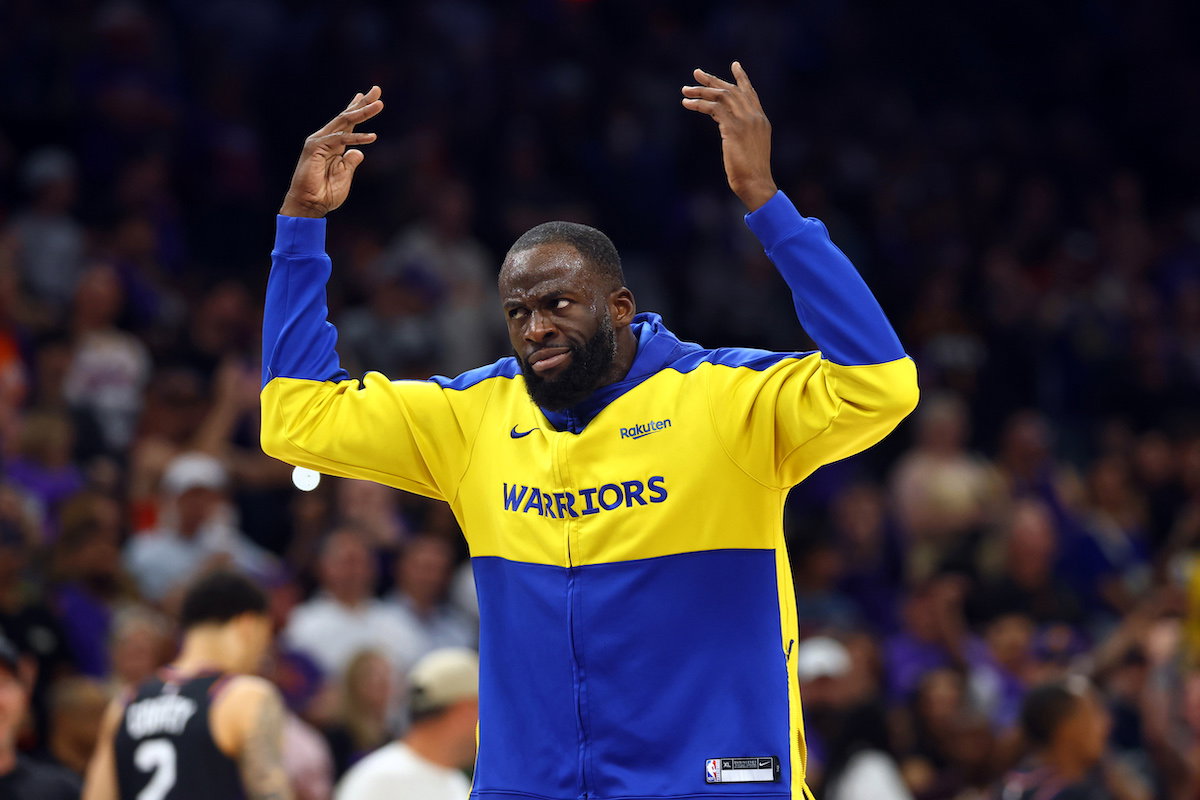
Draymond Green’s latest week in the spotlight had almost nothing to do with basketball itself. Instead, it revolved around a public feud with Austin Rivers and an awkward jab at Charles Barkley that quickly turned into another internet-wide debate about who Green really is.
Watch What’s Trending Now!
Rivers mocked Green after the Warriors forward suggested that playing under Steve Kerr may have limited parts of his offensive game. Green fired back by claiming Rivers peaked before the NBA and benefited massively from playing under his father, Doc Rivers, with the Clippers. The exchange spiraled from there, eventually turning into one of the league’s messiest offseason feuds.
Then came the Barkley comments.
While appearing on Inside The NBA, Green joked that one of his biggest goals late in his career is avoiding the kind of ending Barkley had with the Houston Rockets. The backlash was immediate, with many fans calling the comments disrespectful toward one of the greatest players in league history.
What nobody wants to admit, though, is that Green’s mindset is also a huge reason he became one of the defining winners of his generation in the first place.
Green’s Beef With Austin Rivers And Jabs At Charles Barkley
The original disagreement actually revealed something important about Green. When he said Steve Kerr may have “hindered” parts of his offensive development, people instantly treated it like delusion. Rivers mocked him for it, arguing Kerr helped create Green’s career, not suppress it.
Honestly, both things can be true.
Kerr’s system absolutely maximized Green’s value. At the same time, elite athletes almost never see themselves as role players, even when the rest of the world does. Green’s confidence, irrational or not, is part of what allowed a second-round pick without elite scoring talent to become the defensive backbone of a dynasty.

Austin rivers smoked it here. Said nothing but facts about draymond
Green lowered his Q-Rating even more with his recent appearance on Inside The NBA, where he told the beloved Charles Barkley that his goal for the twilight of his career is to not look like him in a Houston Rockets’ uniform.

Things got a little tense on the 'Inside the NBA set when Draymond took a shot at Chuck's final years in Houston 😬
Some context for our younger audience. After 12 combined seasons with the Philadelphia 76ers and Phoenix Suns, Barkley finished the final four years of his Hall of Fame career with the Houston Rockets.
In Defense Of Draymond Green
Green has absolutely crossed the line before. The Jordan Poole punch deserved criticism. Some of his suspensions hurt the Warriors badly. Certain outbursts have been immature and self-destructive.
Still, the public conversation around him has swung so far in one direction that many fans now refuse to acknowledge how extraordinary of a basketball player he actually was at his peak.
People dislike Draymond Green the personality so much that they sometimes erase Draymond Green the player entirely.
The Warriors dynasty only worked because of the bizarre basketball chemistry between Stephen Curry, Steve Kerr, and Green. Curry bent defenses beyond recognition. Kerr built the movement-heavy system. Green became the connector that held everything together defensively and offensively.
That does not happen without him.
His scoring numbers were never impressive, but basketball has evolved far beyond judging players strictly through points per game. Green’s impact came through defensive versatility, communication, screening, playmaking, rim protection, and his ability to quarterback one of the smartest defenses the league has ever seen.
Green’s reaction to Rivers also makes far more sense when you remember how elite athletes think. Players at that level rarely believe their ceiling is limited. Green especially has built his entire career off proving people wrong.
A player wired like that is never going to calmly accept somebody publicly dismissing his talent ceiling. That edge, irrational as it sometimes looks publicly, is part of the same mentality that helped turn him into a four-time champion and Defensive Player of the Year.
Comparing Green and Rivers strictly through scoring totals completely misses the point. Green’s value was always tied to winning impact, not traditional box-score production.
Advanced metrics consistently graded him as one of the most impactful defenders and connective players of his era. The Warriors’ switching defense, transition game, and offensive flow all revolved around his versatility. Rivers carved out a solid NBA career, but Green became the centerpiece of one of basketball’s greatest dynasties.
That distinction matters.
Green has had far more impacting on winning than Rivers. And while playing alongside an all-time player and coach, Green amplified them with his elite rim protection, ability to execute multiple defensive schemes, and knack for playing in a movement-heavy offense.
The Barkley situation also became bigger than it probably needed to be.
Green was clearly trying to joke around during the show’s usual banter-heavy format. The problem was that the delivery landed awkwardly, especially considering Barkley’s stature in NBA history.
Even Green later admitted the comments were interpreted as disrespectful and publicly apologized for how they came across.
But the larger point he was trying to make actually was not unreasonable.
Green was not calling Barkley washed or irrelevant. Barkley still remained productive in Houston. What Green was really talking about was competitiveness.
Barkley’s Rockets years represented the first stretch of his career where he was no longer seriously competing for championships. For a player wired like Green, that scenario clearly terrifies him more than declining statistically.
That context matters because Green has repeatedly made it clear that he does not want to spend the end of his career playing meaningless basketball. The Warriors may be aging, but his entire mentality still revolves around competing for championships every season.
Whether people like him personally or not, that obsession with winning has defined his entire career.
That is the part many people refuse to separate.
Green can be exhausting, emotional, immature, and occasionally reckless. He also happens to be one of the smartest defenders and most impactful winning players of his generation.
Both things can exist at the same time.
“We’re always going to try to compete. When you win championships, the goal will always be to compete at that level,” Green said on Inside The NBA. “Make no mistake about it, the goal will always be to compete at a championship standard.”
Players who spend their entire careers competing for championships rarely adjust easily to irrelevance. Kobe Bryant struggled with it late in his career. Michael Jordan struggled with it in Washington. Countless veterans chase contenders at the end because elite competitors are wired differently from everybody else.
Green’s comments about Barkley sounded harsh, but the underlying mentality is common among champions.
Green is not beyond criticism. Some of the backlash he receives is completely deserved.
At the same time, what people are often unwilling to admit is that the same personality traits that create the chaos also helped create one of the greatest defensive players and emotional tone-setters modern basketball has seen.
The outbursts, the arrogance, the intensity, the refusal to back down, all of it is tied together.
Draymond Green became Draymond Green because he was never wired to think small.