
USA Today via Reuters
Oct 10, 2023; Seattle, Washington, USA; Fans hold a flag for the Seattle Supersonics during the fourth quarter of a game between the Utah Jazz and LA Clippers at Climate Pledge Arena. Mandatory Credit: Joe Nicholson-USA TODAY Sports
USA Today via Reuters
Oct 10, 2023; Seattle, Washington, USA; Fans hold a flag for the Seattle Supersonics during the fourth quarter of a game between the Utah Jazz and LA Clippers at Climate Pledge Arena. Mandatory Credit: Joe Nicholson-USA TODAY Sports
Despite concerns, the NBA is riding high on a new media deal, with owners smiling all the way to the bank. Revenues are expected to go up by 12% from last year and, despite growing concerns about viewership ratings, the league is still raking in huge sums. That sum may rise in the coming years with the addition of two new franchises, which have been on the air for some years now.


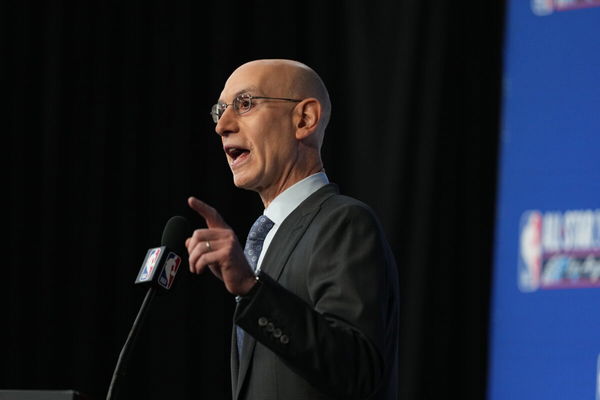
Commissioner Adam Silver has indicated that a final decision will be made this year on whether to add two new teams to the NBA to expand its current 30 teams.
Watch What’s Trending Now!
A vote will take place with the board of governors to start the process, with the new franchises eyeing a debut after the next couple of seasons. No indication yet as to what the rulings may be; however, anything that is guaranteed to bring in money to the league will always be approved.
Imago
Feb 14, 2026; Los Angeles, CA, USA; NBA commissioner Adam Silver speaks to the media during a press conference before 2026 NBA All Star Saturday Night at Intuit Dome. Mandatory Credit: Kirby Lee-Imagn Images
The two cities for the new franchises are almost certainly Las Vegas and Seattle.
Silver has always mentioned these two as the names to be added if ever an expansion is decided. Acquiring one of those teams will be between $7 and $10 billion, which will be among the highest in the league. The other 30 owners may not entirely welcome the idea of a new and expensive franchise, but the long-term goal is the revenue that will be circulated with 32 franchises on the board instead of 30.
On paper, everything looks favorable by all accounts; there will be more markets, more fans, more games, and most importantly, more cash.
Basketball-wise, Seattle finally gets its basketball back after the SuperSonics dissolved in 2008. Vegas, already home to other sports teams, becomes a full-fledged sports city. With 32 teams, the league will match the NFL’s footprint and look modern, ambitious, and enter a new era.
However, not all that glitters is gold, because this expansion talk is giving a lot of NBA enthusiasts serious pause. What the league may see as a new era with more teams may just bring more harm than good. Concerns have been raised that cannot be ignored in the broader context of the future of the sport.
Five Major Concerns Over Adding Two New Teams
5. Talent Dilution
The foundation of everything the NBA has always stood for is its talent pool, and the talent pyramid is about to get diluted when two more teams are added to the existing 30.
The NBA has always been a star-driven sport more than any other major U.S. league because one player can swing the fortunes of an entire franchise just as one injury can also sink those fortunes. The 30 teams have always sifted from a wide base of college prospects, solid role players and two-way players to narrow it to starters and a roster of 15-20 superstars.
Adding two more teams will mean that the league will suddenly need roughly 30 more rotation-caliber players, plus another 20-25 for benches and two-ways. Where do they come from? The main player-addition channels, which is the draft, and in some cases overseas, are already stretched thin enough.
The league is seeing 15-20 win teams every year, scraping to get lottery picks, which is where the “promising” talents are placed in the draft. There isn’t enough talent to circulate to 30 teams, let alone 32, and the NBA isn’t in a place yet to avoid a noticeable drop in quality.
4. Viewership Issue
Viewership has always been an area that the NBA has struggled with, even with 30 teams. There haven’t been improvements in the ratings, and there certainly won’t be with two new teams.
The new franchises will not automatically be handed a free roll to get all the stars they need to be title contenders; they have to lose to get lottery picks to either draft or exchange for established superstars. It will take years for them to find their footing, and before long, any “shiny new toy” excitement will fade as they become losing teams.
3. Owners Don’t Want Ownership Stake Diluted as Well
One of the huge selling points of this expansion is that the owners will see the expansion fee windfall. If those $7-10 billion bids hold, they will split $14-20 billion across 30 teams, and each gets a fat check north of $500 million with zero work.
Dallas Mavericks minority owner Mark Cuban called it a “long-term loan,” not real new money. Because once those two new teams join, every national TV dollar, every sponsorship pool, and every shared revenue stream gets sliced into 32 pieces instead of the normal 30.
The massive $77 billion media rights deal is the golden goose; with two teams, the pie gets cut smaller for everyone. Owners who have built their franchises for decades will now see their slice shrink while new owners get the same cut.
2. Tanking
“Parity” will always be preached by the league, but it has always been a myth sold by lottery tickets.
Until front offices become smart and star development improves, adding more teams will not bring parity, especially when they turn out not to be contenders. Thirty-two teams almost guarantee that there will be more lottery hopefuls and clubs mathematically eliminated from contention earlier. This means more incentive to tank for top draft picks, and the league has already seen enough of that.
The sentiment is that Seattle deserves a franchise and Vegas is a natural sports town now. But they could end up being the next Charlotte or New Orleans in terms of attendance and relevance. The play-in tournament extends the “meaningful” season for marginal teams; however, adding two more could mean that the season basically ends for half the league in March.
1. Expansion Doesn’t Guarantee A Good Market
The last time the NBA added new teams was back in 2004, with the Charlotte Bobcats (now Hornets). The year 2004 was a totally different era; there was no social media explosion, no $14 billion revenue machine, and certainly no $77 billion media deal. After that, the league spent years dealing with roster dilution, shaky competitive balance, and a struggling market.
It didn’t help that the Charlotte franchise was a bad team. It has made the playoffs only three times since 2004, all with first-round exits. The last team added before Charlotte was in 2002, the New Orleans Hornets (now Pelicans), who have had nine postseasons with only two ending in the second round since. They have just been participating for the sake of it, and that may well be the case for the two new teams that will be added.
From a basketball standpoint, there is absolutely no need to have two more losing teams.
It will chip away at the remaining value that the NBA still clings to. The choice to add the new franchises will be the owners’ choosing short-term cash grab over long-term product quality.
Written by

Edited by

Ved Vaze