
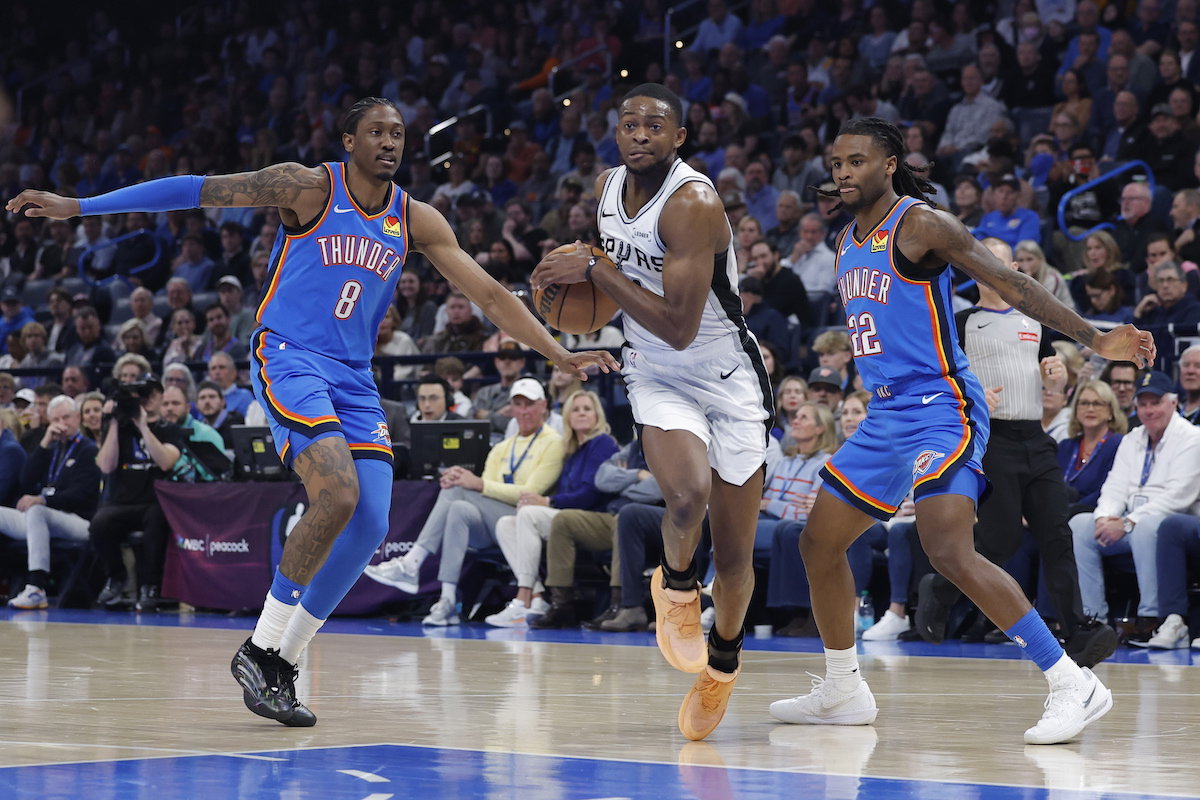
The San Antonio Spurs did not steal Game 1 from the Oklahoma City Thunder. They may have fundamentally changed how the rest of the NBA views the defending champions.
Watch What’s Trending Now!
Normally, losing Game 1 in a playoff series is not cause for panic. This postseason alone, five teams have already recovered after dropping the opener. Last year, the Thunder lost Game 1 to the Denver Nuggets and Indiana Pacers, before ultimately beating them in seven games.
However, something feels very different right now. In the past, when I watched the Thunder lose, it felt like their opponent was pulling out a victory by the skin of their teeth. That the Thunder would bounce back. But after this one, no such confidence existed. That feeling became even more complicated after Game 2, when Oklahoma City responded with a completely different defensive identity just to slow Victor Wembanyama down.
This creates a disturbing possibility. The Thunder, who spent most of the season with a better than 50% chance of repeating as NBA Champions according to most sportsbooks, may be far more vulnerable in this matchup than anyone expected entering the series.
What The Spurs Exposed About The Thunder
This sounds weird to write about a team that starts a lineup featuring two centers, but the Thunder are a smaller team relative to NBA standards. This is especially true when Isaiah Hartenstein is relegated to just 12 minutes because he is unplayable when Victor Wembanyama is on the floor.
There were so many times in the game where Wembanyama would score, and the only thing I could put in my notes (yes, I take notes during games) was that he was too big and too tall for the Thunder to do anything about it. Outside of Jaylin Williams (who only guarded him on one shot attempt), there wasn’t a single player who could hold Wembanyama to under 50% shooting from the floor in Game 1 (per NBA.com).
The Thunder tried putting smaller, quicker defenders like Alex Caruso and Jalen Williams on Wembanyama to try to full front him in the post and deny him interior touches (you can’t score if you can’t shoot). Eventually, though, head coach Mitch Johnson and the team figured out a way to counter this by having Wembanyama post up on the weak side. By doing this, it made it easier for Wembanyama to seal his man and nearly impossible for the Thunder to send any backside help.
The Thunder can try some different things. The non-All-NBA Williams could see more tick against Wembanyama, or maybe the Thunder bite the bullet on how much harder life will be with Hartenstein on the floor (since Wembanyama can easily help off him) and give him more minutes. But even the big man Williams gives up too much size (roughly seven inches), and Hartenstein is probably too slow to keep the prodigious center in front of him.
To Oklahoma City’s credit, Mark Daigneault did adjust in Game 2 by leaning far more heavily into Hartenstein’s physicality against Wembanyama.
The Thunder turned the series into more of a wrestling match, using Hartenstein to crowd catches, absorb contact and push Wembanyama further away from the rim.
It worked — at least relative to the catastrophe of Game 1. Wembanyama still finished with 21 points, 17 rebounds, six assists and four blocks in the Spurs’ Game 2 loss, but the Thunder at least found a survivable version of this matchup.
The Spurs also completely took away the paint from the Thunder. This isn’t so much them exposing anything about Oklahoma City as much as it is a byproduct of having the greatest paint protector of his generation on their side. The Thunder were limited to just 38 points in the paint in Game 1. That is their lowest single-game total of the postseason and nearly 11 points fewer than their per game average in this tournament (48.9).
The Thunder will continue searching for creative ways to occupy Wembanyama away from the rim, but it is still difficult to believe Oklahoma City has discovered a clean or sustainable answer for a full seven-game series. This is just what the Spurs do. Wembanyama has completed nine games this postseason, and in six of those games, they held their opponent to under 40 points in the paint. During the regular season, the Thunder were 4-6 when they couldn’t cross that 40-point threshold.
Why The Thunder Are In Trouble
Game 2 did prove one important thing: Oklahoma City is too smart, too deep and too well coached to simply roll over in this series.
But it also reinforced something equally important. The Thunder are being forced into drastic adjustments much earlier than expected, and almost every solution they have comes with a tradeoff somewhere else on the floor.
Two stats really concerned me after watching Game 1. We knew that the Spurs would leave Thunder role players open in order to load up on Shai Gilgeous-Alexander and the team’s other high-level ball handlers. We also know that the Thunder are notorious for speeding people up, turning them over, and turning basketball games into track meets.
In Game 1, the Thunder shot 37.8% from three on 45 attempts (their second-highest volume of the playoffs) and turned the Spurs over 21 times for 28 points (their third-highest total of the postseason). The Spurs also had poor shooting luck, hitting only 30.2% of their threes (their fourth-lowest conversion rate). Yet, the Thunder could still not win this game.
There is reason to believe that those numbers will only get worse for the Thunder. Alex Caruso scored 31 points and hit 8 of his 14 3-point attempts (all career-highs for the veteran pitbull). Caruso is one of the best role players of his generation, but you can’t realistically bank on him replicating this effort for another game. Let alone an entire series. Without him, the Thunder were just 9-for-31 from three (29%).
It’s hard to remember, given how poised Dylan Harper was in his first ever postseason start, but San Antonio was without their most seasoned backcourt player, De’Aaron Fox, in this one. For his career, Fox has a knack for suppressing his team’s turnover rate when he is on the floor. In his last four seasons, Fox’s teams have been in the 82nd percentile or higher in turnover percentage when he is on the floor (per Cleaning the Glass). There were numerous times (particularly down the stretch) where you felt the absence of the Southpaw’s veteran steadiness.
Even more concerning for Oklahoma City is that San Antonio still does not look close to fully operational offensively. De’Aaron Fox remains limited physically, yet the Spurs continue generating quality looks and controlling stretches of the series through Wembanyama’s interior gravity alone.
That is part of what makes this matchup feel so dangerous for the Thunder long term. Through two games, Oklahoma City has shown enough resilience to keep this series from spiraling. But the larger concern has not disappeared.
Victor Wembanyama has already forced the defending champions to rethink their preferred lineups, abandon portions of their original defensive strategy and lean into a level of physicality they normally try to avoid.
The Thunder may still win this series. They may still reach the Finals. But two games into the Western Conference Finals, the Spurs have already exposed something the rest of the NBA will not ignore anymore: Oklahoma City suddenly looks far more vulnerable than anyone expected.