
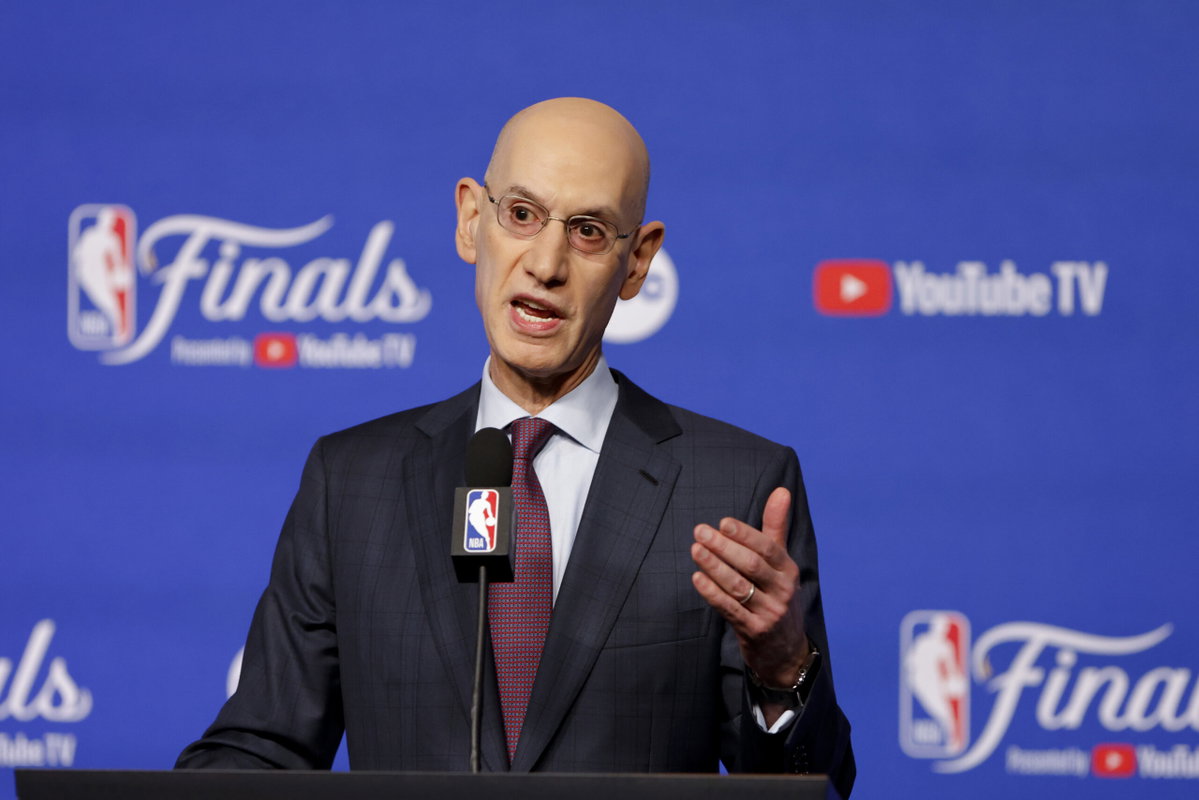
On paper, it definitely didn’t look good for fans. Executives in the NBA’s 5th Avenue offices were probably pumping their fists at the massive financial implications of the new $76 billion media rights deal. But the common man was stuck in an unprecedented loop. Simply said, more money in the league’s pockets meant more money out of audiences’ pockets for multiple subscriptions, while also spending extra time navigating a fragmented viewing schedule. The reality of the situation was not lost on any, including Charles Barkley.
Watch What’s Trending Now!
“I think the NBA has a big problem. How are they going to tell people which night the games are on?” Barkley said on the Bill Simmons Podcast last September. “I think it’s a big deal because they just took the money from all three networks. For the next 11 years, they don’t give a s–t about the fans.
Yet, as the season reaches a fever pitch, Barkley would be surprised to know that the NBA’s gamble might have opened the floodgates for an extremely lucrative future.
Why This Playoff Is Different
Let’s start with the playoff broadcast hubbub. With Prime Video’s exclusive coverage of the Play-In Tournament (two on Tuesday, two on Wednesday, two on Friday), NBC/Peacock’s 28-game broadcast in the first and second rounds of the playoffs (including the Western Conference finals will air on NBC/Peacock), and ESPN/ABC broadcasting 18 games in the first and second rounds of the playoffs (along with the Eastern Conference finals and the NBA Finals), local networks are essentially out.
And, of course, New York Knicks’ play-by-play announcer Mike Breen didn’t take to that kindly.
“First time ever that no longer can the home team announcers and broadcasters televise the first round,” Breen noted on the MSG broadcast during the Knicks’ 110-96 loss to the Hornets. “The entire playoffs are exclusive to national TV broadcasters. I think personally, it’s a poor decision. Fans want to hear their home team announcers, at least in the first round.”
Notably, ESPN and ABC will continue to remain two of the NBA’s biggest partners. Together, they are paying around $2.6 billion every year to keep broadcasting NBA games. At the same time, NBC is making a major comeback to NBA coverage after being away from the league for more than 20 years.
This huge shift clearly shows how the NBA sees streaming as a huge part of its future growth. To match that stride, the league’s new broadcasting partners even made some high-profile recruitments, including Dirk Nowitzki, Blake Griffin, and Dwyane Wade for Amazon, and Carmelo Anthony, Tracy McGrady, and Vince Carter for NBC. Additionally, ‘Inside the NBA’ and its iconic quartet also moved to ESPN and ABC. Theoretically, such massive overhauls should amount to success in viewership. Well, to Barkley’s dismay, the numbers certainly attest to the fact that it did.
The Ratings Explosion
As per reports from earlier this month, the 2026 NBA Playoffs became the most-watched first round in 33 years, averaging a staggering 4 million viewers per game across ABC/ESPN, Amazon Prime Video, and NBC/Peacock.
One of the major examples of that is the Spurs vs Timberwolves series that made NBA history by recording three straight playoff nights with more than 7 million viewers during the first and second rounds for the first time.
Game 4 alone averaged around 7.9 million viewers, showing just how much national attention the matchup is getting. Then Game 5 took things even higher, peaking at 8.2 million viewers as NBC and Peacock finished as the most-watched programs on Tuesday night across all major audience groups and total viewers.
Even more shocking, the Thunder vs Spurs Western Conference Finals Game 1 reportedly generated 15.5 thousand more live viewers than Super Bowl LX in certain live-viewing measurements online. That led many fans online to call it “the most live viewers in real history.”
On top of it, the Philadelphia 76ers’ 109-100 Game 7 road win over the Boston Celtics on May 2 was the most-watched first-round Game 7 ever and the most-watched first-round game in 27 years, averaging 11 million viewers on NBC/Peacock. Notably, this is followed by a historic 24-year high of 170 million US audiences who watched regular-season games. Mind you, that’s an over 86% increase year-on-year.
One of the biggest reasons for this growth is that the NBA placed many more games on free-to-air television. Last season, only 24 games were shown on regular broadcast networks. But in the 2025-26 season, that number jumped to 62 games. Because of that change, broadcast television now makes up 32% of the NBA’s national exposure, compared to only 14% last year. Some games are clear examples of this. The Christmas Day game between the Oklahoma City Thunder and San Antonio Spurs became the most-watched regular-season NBA game of the year.
Plus reports confirm NBC averaged 2.8 million viewers, up 109% from last season, while also delivering the NBA’s most-watched All-Star Game since 2011 at 8.8 million viewers. On top of that, games during the playoffs are averaging nearly 4 million viewers. The main reason behind this success is pretty simple: The league increased its accessibility on broadcast TV.
But it’s not just the NBA and the fans who are profiting off all the increased attention.
What This Means for the NBA and Teams
As the new media rights deal kicks in, the NBA’s national television revenue has ballooned to almost triple the amount as compared to its previous 9-year deal—from $2.7 billion to now $6.9 billion per season. Meaning? Team front offices will directly reap benefits.
To put it in numbers, for the 2024-2025 season (the last year of the previous deal with Disney and Turner), each franchise received around $11.44 million on average over nine months, totaling $103 million. Now consider the 2025-2026 (the first year of the current deal) and that figure stands at $15.84 million over nine months, totaling $142.56 million. Now that’s a cool 39% increase. While that’s supposed to be an opportune moment for a salary cap boom, a look back at recent history shows why teams will be cautious.
Remember the 2015-2016 and 2016-2017 seasons when the salary cap rose a staggering 32% in a single offseason from $70 million to $94.1 million. The Golden State Warriors certainly had their heyday with enough cap space to sign superstar free agent Kevin Durant while also retaining their core of Stephen Curry, Draymond Green, Andre Iguodala and Klay Thompson. Expectedly, with a remarkably dominant team, the Warriors won the following two titles and played for a third. Adam Silver, though, still had intense reservations about the cap luxury back then.
“If you ask me from a league standpoint, we would prefer that our All-Stars be distributed around the league rather than having so many All-Stars in one market,” he said during his annual All-Star news conference in 2016. “But we’ll see what happens this summer. I mean, as I’ve said, there will be unintended consequences from all this additional cap room this summer. I just don’t know what those consequences will be.”
Well, the consequences were pretty loud and clear.
Due to heightened spending in 2016, free agents in 2017 and 2018 went severely underpaid owing to a lack of cap space. Compared to 35 players signing deals worth $40 million and above in 2016, only 10 players were able to get the same figure or more two years later, despite the cap rising by $7 million.
“The lack of smoothing has made it quite a bit challenging this summer,” an agent said back then. “This, in addition to the decline in revenue distributed into the marketplace this summer, has resulted in a significant and unanticipated stagnant free agent market. There are also quite a few teams that have chosen not to aggressively participate in the free agent market.”
Thankfully, the NBA has a mechanism in place to prevent a similar predicament.
While the salary cap grows in tandem with revenue, the NBA and NBPA have agreed to salary cap smoothing that will ensure the year-on-year cap growth stays limited to 10 percent in any given year.
“That’s whose lives are going to change most from this new media deal — it’s the players,” a team exec said.
Notably, he was referring to the basketball-related income (BRI), per which the league shares around half of its income with the player pool.
“We can expect the cap by almost $90 million by the end of the decade,” wrote CBS Sports’ Sam Quinn. “Obviously, this means that player salaries will jump with them. The highest tier of max salary, which is available to 10-year veterans or players with between seven and nine years of experience that reach the supermax criteria, starts at 35% of the cap. That means that a five-year max contract signed with a team that has Bird Rights, and therefore the ability to offer 8% raises annually, would be worth nearly $460 million.”
| Year | Salary |
|---|---|
| 2029-30 | $79.246 million |
| 2030-31 | $85.586 million |
| 2031-32 | $91.926 million |
| 2032-33 | $98.266 million |
| 2033-34 | $104.606 million |
Clearly, the NBA is no longer just a basketball league but an emerging entertainment company earning millions. So, tickets are just one part of the puzzle; subscriptions, views, and league-wide boom are doing more than that.
The Bigger Industry Impact
The NBA’s huge $76 billion media deal is not only changing basketball but also changing how all sports may be shown in the future. Instead of only using traditional TV channels, the NBA is now mixing television with streaming platforms like Amazon. This could also enourage other leagues to follow the the same path.
Major League Baseball is the one topping that list. MLB recently made new deals with companies like ESPN, NBC, and Netflix. The league wants to combine regular television with streaming services so younger fans can watch games more easily as fewer people continue using cable TV.
Netflix spent heavily on WWE content, while Paramount signed a huge $7.7 billion deal for UFC rights to strengthen Paramount+. So, even streaming platforms are slowly realizing that sticking to just one form will not earn them a fortune.
The biggest takeaway is that the NBA may become the model for the future sports industry after cable TV declines. Sports are not just entertainment now, but a way to earn while keeping the viewers hooked.