
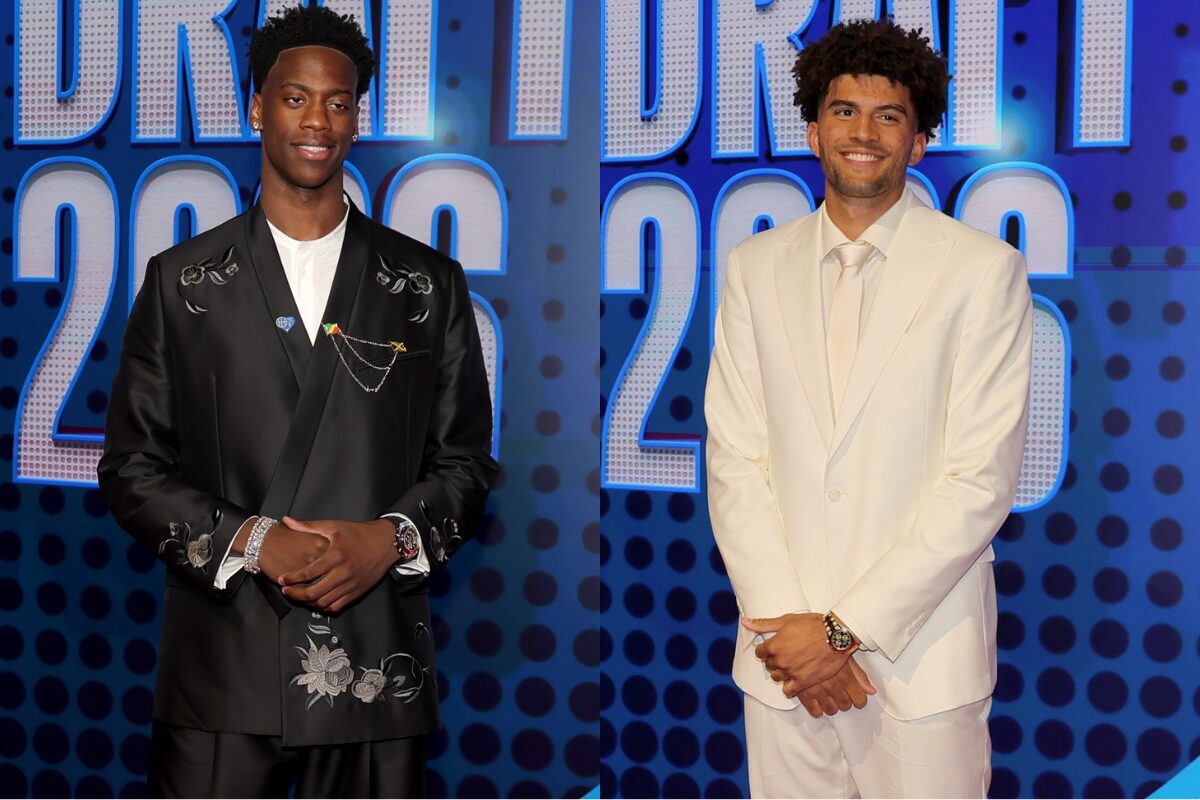
The 2026 NBA Draft kicked off at the Barclays Center as one of the most anticipated and deepest talent pools in recent memory. A draft class defined by four potential No. 1 overall prospects allowed teams like the Washington Wizards, Utah Jazz, and Memphis Grizzlies to land foundational cornerstones capable of spearheading their next eras of contention.
Watch What’s Trending Now!
#1 Washington Wizards select AJ Dybantsa
Washington locked down its first No. 1 overall choice since drafting John Wall back in 2010. AJ Dybantsa was the consensus #1 pick for the longest time, and the Wizards now have their crown jewel. The 6-foot-9 forward has a rare blend of fluid athleticism, explosion, and lateral shifting. He is an elite shot-creator and the leading scorer in Division I college basketball during his lone season at BYU.

WITH THE FIRST PICK IN THE 2026 NBA DRAFT THE WASHINGTON WIZARDS SELECT ANICET DYBANTSA JR. ‼️
#2 Utah Jazz select Darryn Peterson
Dynamic Kansas star Darryn Peterson made waves by refusing to hold an official workout for the Utah Jazz. The 6-foot-5 guard strictly held a workout for the Washington Wizards (who owned the No. 1 pick). But Peterson met virtually with Utah over the weekend to cement the interest. The 19-year-old can handle primary point duties or play off-ball next to Lauri Markkanen.
#3 Memphis Grizzlies select Cameron Boozer
Memphis landed its highest draft pick since taking Ja Morant at No. 2 back in 2019. In Cameron Boozer, they secured a polished forward to accelerate their aggressive roster transition. The son of two-time NBA All-Star Carlos Boozer entered the league carrying arguably the highest basketball maturity and winning resume. The former AP National Player of the Year showcased the rare ability to handle, pass, distribute, stretch the floor, and guard multiple positions efficiently.
#4 Chicago Bulls select Caleb Wilson
The Bulls’ connection with the Tar Heels is legendary, as Michael Jordan was the third overall pick out of UNC and won six NBA championships in Chicago. Caleb Wilson comes with the hype after averaging 19.8 points and 9.4 rebounds during his lone year with the Tar Heels. Widely regarded as one of the best athletes in his class, Wilson gives the rebuilding Bulls an explosive, two-way frontcourt piece alongside Josh Giddey and Matas Buzelis.
#5 LA Clippers select Keaton Wagler
The Clippers chose the 6-foot-6 combo guard at No. 5 over other heavily rumored guard options like Mikel Brown Jr. and Darius Acuff Jr. Keaton Wagler was a late-blooming prospect who was ranked very low nationally coming out of high school (No. 261 composite, three-star recruit). After leading Illinois to a surprise Final Four run, his stock was high. Wagler provides the Clippers with robust playmaking depth and backcourt length, addressing a primary scoring need alongside their veteran core.
#6 Brooklyn Nets select Mikel Brown Jr.
With the Clippers passing on him at No. 5, Brooklyn secured a high-upside lead guard who becomes a cornerstone piece. Brown is the first-ever “one-and-done” draft prospect in the Louisville Cardinals’ program history. Rather than being forced to carry the scoring burden entirely on night one, the 20-year-old will get to share playmaking and ball-handling duties alongside veteran additions like Julius Randle.
#7 Sacramento Kings select Darius Acuff Jr.
The Kings capitalized on Acuff sliding to the No. 7 spot, with General Manager Scott Perry publicly calling him “the best guard in this draft”. It’s also a full-circle moment, as Perry actually coached Acuff’s father, Darius Acuff Sr., nearly three decades ago at Eastern Kentucky. The younger Acuff is an explosive First-team AP All-American who ranked third nationally in scoring at 23.5 points per game.
#8 Atlanta Hawks select Kingston Flemings
Following their monumental decision to trade away Trae Young, the Hawks reset their backcourt identity with an electric perimeter defender. The 6-foot-3 guard from Houston thrives in the open court and knocked down 38.7% of his attempts from beyond the arc. Flemings earned All-America honors and set the all-time Houston freshman program record for total points in a single season, as well as the all-time Houston freshman assists record.
#9 Dallas Mavericks select Morez Johnson Jr.
It was expected that the Mavs’ newly hired coach, Dusty May, would draft a familiar face. Morez Johnson Jr. is a powerhouse interior runner who shields the rim with an immense 7-foot-4 wingspan. The 6-foot-9 Michigan star provides Dallas with direct paint protection and high-end glass clean-up capacity.
Regarded by many draft analysts as a late first-round target, Johnson was selected ahead of his highly touted Michigan teammates, Yaxel Lendeborg (No. 11) and Aday Mara (No. 12), spearheading a historic trio of lottery Wolverines.
#10 Milwaukee Bucks select Brayden Burries
In the first draft move post the Giannis Antetokounmpo era, the Bucks selected the 6-foot-4 guard out of Arizona. The 20-year-old California native put together a physically dominant freshman season, leading Arizona to a program-record 36 wins and a Final Four berth. Burries enters the league as a mature, multi-faceted winner who can rebound, facilitate, and guard multiple positions.
#11 Golden State Warriors select Yaxel Lendeborg
The Warriors stayed put at No. 11 despite heavy, late speculation that they would move the asset. They reinforced their frontline by drafting an incredibly efficient, modern forward out of Michigan. The 6-foot-9 Lendeborg possesses a robust 7-foot-3 wingspan that allows him to anchor small-ball interior lineups.
Nicknamed “Dominican LeBron” by his teammates, Lendeborg earned Big Ten Player of the Year, Big Ten All-Defensive Team honors, and consensus First-Team All-America recognition under coach Dusty May.
#12 Oklahoma City Thunder select Aday Mara
After losing to the Spurs in the Conference Finals, Oklahoma City added a massive strategic curveball to its depth chart by picking up Michigan’s towering 7-foot-3 center.
Aday Mara has an incredible 9-foot-9 standing reach and thus is a dominant shot-blocker and high-post passing hub. He led the entire Big Ten in efficiency, converting an exceptional 66.8% of his shots from the field.
#13 Miami Heat select Nate Ament (Traded to Milwaukee)
The Heat selected him, but they had already traded his rights to the Milwaukee Bucks as part of the blockbuster trade involving Giannis Antetokounmpo.
The Bucks passed on him at No. 10 but were able to capitalize on Nate Ament. Standing 6-foot-10 with a near 7-foot wingspan, Ament projects as a modern, high-upside perimeter forward who is a mismatch weapon.
#14 Charlotte Hornets select Hannes Steinbach
The Hornets selected the top rebounder in this draft, as Hannes Steinbach led the country with 11.8 boards per game last season. He is considered NBA-ready due to his significant international experience and measured well at the combine. He was consistently linked to Charlotte, who were known to be looking for frontcourt help with the first of their two picks.
#15 Chicago Bulls select Dailyn Swain
There was interest from the Grizzlies and Thunder at Nos. 16 and 17, respectively, but the Chicago Bulls got their star. The 20-year-old wing led Texas in points, rebounds, assists, and steals during his final collegiate season.
Swiss Army knife weapon, Swain adds an immediate injection of elite verticality and lockdown perimeter defense to a Chicago rotation looking to establish a fierce defensive identity.
#16 Memphis Grizzlies select Bennett Stirtz (Traded to Oklahoma City)
The Grizzlies initially picked him, but later traded him to the Thunder to draft next. The guard finished his senior campaign with 734 points, the fourth-most in a single season in Hawkeyes history.
In fact, Stirtz scored in double figures in 35 of the team’s 37 games and had three 30-point and 20 20-point contests. He is a rotation-ready playmaker who gives OKC additional shooting and playmaking off the bench.
#17 Oklahoma City Thunder select Ebuka Okorie (Traded to Detroit via Memphis)
The pick was by OKC, but they traded Ebuka Okorie to Memphis. However, ESPN’s Shams Charania reported the Grizzlies traded back again to No. 21, with the Pistons moving up to take Okorie.
So now, the team must have changed, but he still remains a highly intellectual playmaker with deep shooting range and active defensive tendencies.
#18 Charlotte Hornets select Christian Anderson Jr
After drafting a rebounder, the Hornets selected an outstanding 3-point shooter and savvy pick-and-roll navigator.
Anderson can play on and off the ball and is capable of stretching defenses off the catch or executing out of secondary actions. He can be a great number two when LaMelo Ball is not on the hardwood.
#19 Toronto Raptors select Allen Graves
An imposing forward out of Santa Clara who possesses an exceptional touch around the rim, Graves is a smart passer who is comfortable on the perimeter and made 41% of his 3s last season.
He brings clean pick-and-pop potential and is versatile enough to mix and match in the modern frontcourt utility to the Raptors’ system.
#20 San Antonio Spurs select Jayden Quaintance
The need for a frontcourt partner for Victor Wembanyama led San Antonio’s search to Quaintance. The Kentucky forward is a big, long, explosive rim runner who can clean up 50-50 balls around the basket.
Despite a knee injury limiting his collegiate playing time, the 6-foot-9 star’s impressive athletic profile made him a highly coveted asset.
#21 Detroit Pistons selected Karim Lopez (Traded to Memphis)
The Grizzlies kept making moves, trading down twice to reach this spot and select Lopez. He’s a tough, physical, and active player who has already made a significant impact against older pros while playing a major role for the New Zealand Breakers in Australia.
#22 Philadelphia 76ers select Labaron Philon Jr.
After a playoff sweep at the hands of the Knicks, the 76ers need a spark from the bench. Philon will be in the mix off the bench for Philly, providing extra shot-creation behind Tyrese Maxey and VJ Edgecombe.
#23 Atlanta Hawks select Zuby Ejiofor
The Hawks made their second pick of the night, and this time it’s a frontcourt player. A 6-foot-8 bowling ball of a post player, he’s known for his athleticism, toughness, and rebounding. Ejiofor brings a nonstop motor and a reputation as a rugged, switchable chess piece who can fluidly guard positions 1 through 5. His interior grit acts as a great defensive insurance policy alongside Onyeka Okongwu and Jalen Johnson.
#24 New York Knicks select Cameron Carr (Traded to Los Angeles Lakers)
The Knicks drafted with their pick, but the Lakers traded up one spot with the Knicks to ensure they could select Carr. New York received cash considerations from the Lakers. The 6-foot-5, 185-pound guard averaged 18.9 points, 5.8 rebounds, and 2.6 assists last season at Baylor, where he transferred after starting his college career at Tennessee.
In Los Angeles, he reunites with his former Tennessee teammate, Dalton Knecht. More importantly, standing 6-foot-5 with a massive 7-foot-1 wingspan, Carr projects as a high-end 3-and-D weapon.
#25 Los Angeles Lakers draft Sergio De Larrea (Traded to Dallas via New York)
The Knicks remained active with their trades on draft day. They had been rumored to be the team most interested in De Larrea. But the Mavericks, the other franchise that coveted the Spanish forward, used the No. 30 overall pick to draft Arizona forward Koa Peat. Dallas front-office leaders Masai Ujiri and Mike Schmitz then flipped Peat and two future second-round picks to the Knicks to acquire De Larrea’s draft rights.
Standing 6-foot-5 to 6-foot-7 with a 6-foot-9 wingspan, De Larrea functions as a big combo guard. This will serve as excellent floor-spacing support alongside franchise cornerstone Cooper Flagg and No. 9 overall pick Morez Johnson Jr.
#26 Denver Nuggets select Tarris Reed Jr. (Traded to San Antonio)
The Nuggets officially turned in the card for Reed, but his draft rights were immediately moved to San Antonio in a late-night trade. The Nuggets sent Reed (No. 26) to the Spurs in exchange for the No. 35 overall pick, a 2028 second-round pick (via Minnesota), and a 2031 second-round pick (via Sacramento).
The Spurs got another rugged interior player. Reed earned First-Team All-Big East honors by averaging 14.7 points, 9.0 rebounds, 2.3 assists, and 2.0 blocks per game.
#27 Boston Celtics select Chris Cenac Jr.
The Celtics needed a center, and they drafted the 19-year-old big man out of the University of Houston. Standing 6-foot-11 with a massive 7-foot-5 wingspan, Cenac brings elite physical tools, rebounding intensity, and defensive flexibility to Boston’s frontcourt.
He averaged 9.5 points and 7.9 rebounds per game as a freshman for the Cougars. Celtics President Brad Stevens highly praised his motor, stating his length fills an immediate athletic void on the roster.
“Fits a position of need, some things that we were a little short on this year from an athletic perspective, I think with his size and his length.”
#28 Minnesota Timberwolves select Joshua Jefferson (Traded to the Brooklyn Nets)
While the Wolves drafted the Iowa State star, his rights were already traded to Brooklyn earlier this week as part of the Julius Randle trade.
The versatile forward averaged 11.2 points and 7.6 rebounds in college, displaying unique defensive switching and passing vision.
Brooklyn lands a highly mature, cost-controlled frontcourt piece perfectly tailored to head up their new post-star development era.
#29 Cleveland Cavaliers select Alex Karaban (Traded to the Sacramento Kings)
The Cavs drafted the UConn forward but received the No. 34 overall selection and a future second-round choice from Sacramento as part of the swap. The 6-foot-8 forward brings exceptional championship pedigree, floor-spacing prowess, and an incredibly high basketball IQ.
Karaban is a quality shooter and ball mover who should factor into Sacramento’s rotation right away. He went to three Final Fours in four seasons at UConn, won two titles, and was regarded as the heart of that program.
#30 Dallas Mavericks select Koa Peat (Traded to Phoenix via New York)
Ideally, this was the Knicks’ pick. But the end of the draft night again was interesting. The Phoenix Suns traded up to select the Arizona star with the final pick in the first round of the draft.
The Knicks received two second-round draft picks and cash in exchange for sending Peat to the Suns. The 6-foot-8 freshman decided to remain in the NBA Draft at the last minute. It paid off!