
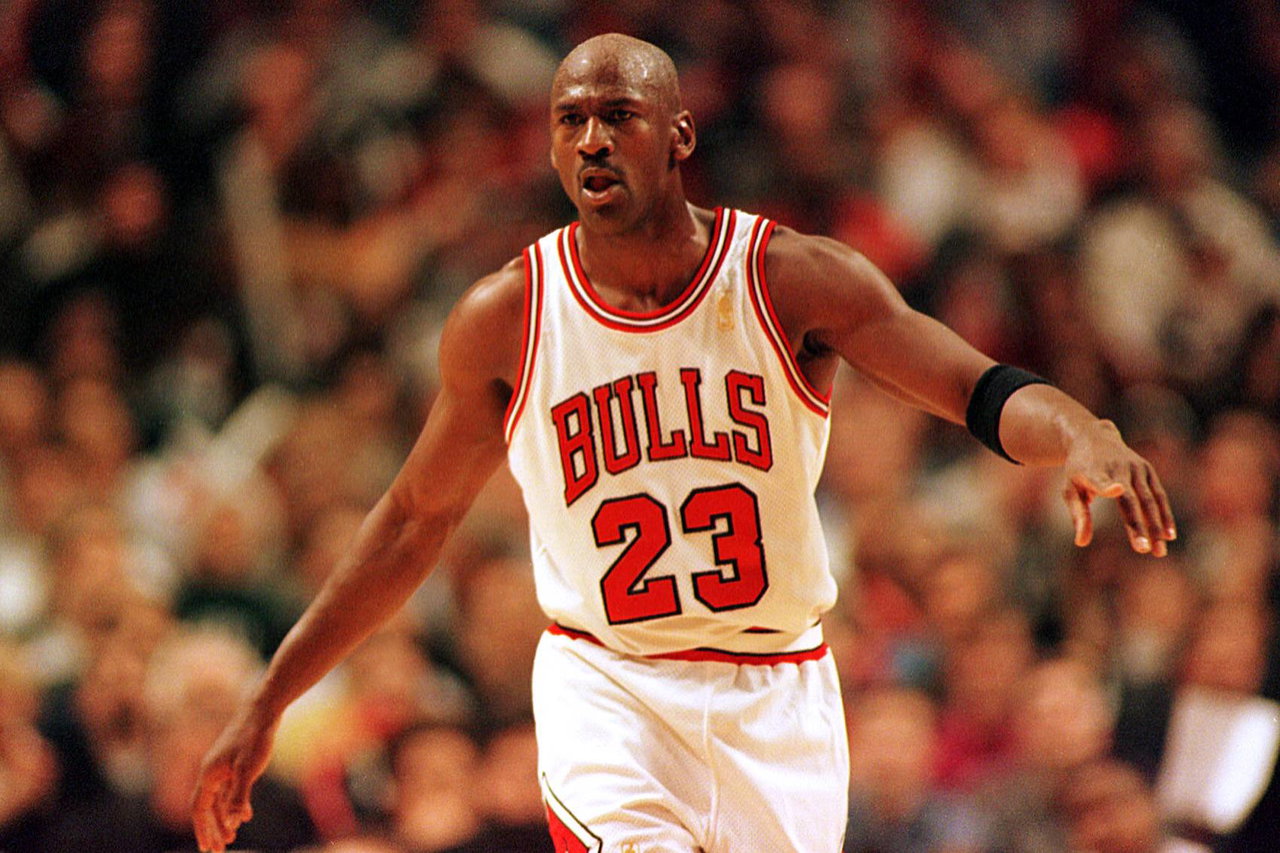
Jerry Sloan had just watched his Utah Jazz score 54 points in an NBA Finals game. Then, sitting inside the United Center press room on June 7, 1998, the Jazz head coach looked at the box score and could hardly believe what he was seeing.
Watch What’s Trending Now!
“Is this actually the score?… It seemed like they scored 196!”
Sloan’s disbelief made sense. The Chicago Bulls had just beaten Utah 96-54, handing the Jazz a 42-point loss in the NBA Finals. Almost three decades later, the white Nike jersey Michael Jordan wore that night has become the most expensive basketball jersey ever sold at public auction, bringing in $12.26 million through JOOPITER.
That is what makes this jersey different. It was not simply worn by Jordan during his final championship season. It came from one of the strangest and most dominant games of that championship run, carries documented authentication and provenance, and is the only publicly known white Jordan jersey from a Bulls victory during the 1998 Finals to have surfaced on the open market.
The Night the Bulls Turned the Finals Into a Rout
Chicago entered Game 3 with the series tied 1-1. Utah had won the opener 88-85 in overtime, while the Bulls answered with a 93-88 victory in Game 2. The series had already lived up to its billing, but the third game was nothing like the first two.
The Bulls led 17-14 after the opening quarter, then pulled away with a 32-point second quarter. Utah scored only 13 points in the third and 10 in the fourth as Chicago’s defense completely took over. The Jazz finished 21-of-70 from the field and committed 26 turnovers. Chicago, meanwhile, turned the game into a 42-point statement.
Jordan led everyone with 24 points, adding three rebounds, two assists and a steal and a block in 32:11. He shot 9-of-18 from the field, while Toni Kukoc added 16 points off the bench. Karl Malone scored 22 for Utah, but the rest of the Jazz combined for only 32 points. John Stockton finished with two points and five turnovers.
The 42-point margin remains the largest in NBA Finals history. Utah’s 54 points also remain the fewest scored by a team in an NBA Finals game in the shot-clock era, while Chicago’s 23-point second half stands as the lowest-scoring half in NBA playoff history.
So the jersey was already attached to something unusual before it ever became a collector’s item.
And the story around that Bulls team was just as unusual.
Even the Bulls’ Circus Couldn’t Stop Them
The 1997-98 Bulls were not simply chasing another championship. There was a sense that the team was approaching its end.
Jerry Krause had already announced that Phil Jackson would not return as head coach for the following season, regardless of how the Bulls finished. Jordan had publicly tied his future to Jackson, while Scottie Pippen entered the season dealing with contract issues and delayed ankle surgery that kept him out for the first 35 games.
Yet Chicago still finished the regular season 62-20, with Jordan playing all 82 games and averaging 28.7 points per game. He won his 10th scoring title and fifth regular-season MVP before leading the Bulls toward what would become their sixth championship.
There was also an almost unbelievable side story unfolding during the Finals.
After the Game 3 blowout, Dennis Rodman missed the Bulls’ film session and practice the following day. Instead, he flew to Michigan to appear alongside Hulk Hogan on WCW Monday Nitro. He returned in time for Game 4, was fined $10,000 by the NBA, grabbed 14 rebounds and helped defend Malone in the fourth quarter.
Jordan later summed up Rodman’s unpredictability perfectly:
“I can never figure this guy out. I won’t even start. One day he’s wrestling, the next day he’s defending… but somehow he’s always ready to play the game of basketball…”
Luc Longley was less amused.
“You get tired of it. It’s a shame something like this happens during the Finals.”
That was the world around the Bulls in 1998. The organization was dealing with major uncertainty, the roster was under pressure and one of its stars was literally leaving town to wrestle during the Finals.
On the court, though, Chicago kept winning.
And one of those wins happened while Jordan wore the white jersey that would eventually break an auction record.
Why This Jersey Was Different
The physical details matter because collectors were not bidding on an ordinary Bulls jersey.
The JOOPITER lot was a white Nike mesh pro-cut uniform with official NBA tagging, a size 50 with four inches of added length and a stitched 1998 NBA Finals patch on the right chest. It came with a MeiGray Group photomatching certificate and a Bill Thoma letter of provenance dated March 31, 2015. Rob Gough was identified as the consignor.
Then there is the detail that separates it from Jordan’s other 1998 Finals jerseys.
The auction materials described it as the only publicly known white Michael Jordan jersey from a Bulls victory during the 1998 NBA Finals to have surfaced on the open market. That wording matters. It does not mean no other white jerseys exist. Games 4 and 5 were also played in Chicago, and those jerseys may remain in private collections. It means this is the only publicly known example from a Bulls Finals victory to have surfaced publicly.
That scarcity becomes even more important when compared with the jersey that previously held the record.
Jordan Just Broke His Own Record
In 2022, Sotheby’s sold Jordan’s Game 1 jersey from the same 1998 Finals for $10.091 million.
That jersey came from a very different night.
Jordan scored 33 points in Game 1, but Chicago lost 88-85 to Utah in overtime in Salt Lake City. It was a red road jersey from the opening game of the series.
The new record-holder came from Game 3, a white home jersey worn during a 96-54 Bulls victory.
The difference is striking.
Jordan’s first record-setting 1998 Finals jersey sold for $10.091 million. The Game 3 jersey went for $12.26 million, a difference of $2.169 million, or roughly 21.5%.
The two jerseys also tell different stories from the same series. One represents the opening loss that immediately put the defending champions under pressure. The other represents a historic home victory that produced the largest margin in Finals history.
Now the second jersey owns the record.
The $12.26 Million Auction
JOOPITER opened bidding for the jersey on September 15 and closed the auction on September 29 at 8 p.m. EDT. The presale estimate was $10 million to $15 million.
The winning hammer price was $10 million. After the $2.26 million buyer’s premium, the final price reached $12.26 million.
There was another unusual detail.
The auction did not end with a long bidding war. The transaction involved a single irrevocable bid. A buyer had committed to purchase the jersey at a $10 million hammer price before the auction closed, and no higher competing bid was submitted.
That meant the jersey was already guaranteed to reach the previous record’s territory before the public auction officially ended. The final $12.26 million total then pushed Jordan’s own record higher.
But the jersey’s journey did not begin at JOOPITER.
From Jordan’s Locker Room Era to a $12.26 Million Sale
The documented chain of custody stretches back to the 1998 Finals.
Jordan wore the jersey during Game 3 at the United Center on June 7. It was then obtained by a close associate of Jordan before eventually reaching Evan LaManna, a sales manager and partner at Upper Class Collectibles in New Jersey.
Bill Thoma later acquired the jersey from LaManna around 2006 or 2007. He kept it in his private collection and provided a formal letter of provenance dated March 31, 2015.
Collector and actor Rob Gough eventually acquired the jersey from Thoma before consigning it to JOOPITER in 2026.
The winning bidder remains unidentified.
That long trail matters because a game-worn jersey is only as valuable as the evidence connecting it to the moment that made it important.
In this case, the jersey had the game, the photographs, the authentication and the documented ownership history.
Then there was the season itself.
The Final Chapter of the Bulls Dynasty
Jordan’s 1997-98 season ended with his sixth NBA championship and sixth Finals MVP. Chicago completed its second three-peat, while Jordan added his 10th scoring title and fifth regular-season MVP.
The season later became the focus of ESPN’s 10-part documentary The Last Dance, which brought the 1997-98 Bulls back into the center of public attention in 2020. The season that had once been the closing chapter of Chicago’s dynasty became one of the most recognizable periods of Jordan’s career.
That helped turn items from that season into more than old sports equipment. For collectors, they represent the final championship chapter of Jordan’s Bulls career.
And this particular item captures an especially strange piece of that chapter.
It was worn during a game when the Bulls destroyed the Jazz by 42 points. It came from a white home victory jersey that had not previously surfaced publicly. It carried the Finals patch and documented authentication. It could be traced through a chain of private ownership.
And Jordan’s other 1998 Finals jersey had already established what the market was willing to pay.
From $10 Million to $12.26 Million
The broader Jordan memorabilia market shows how valuable pieces from different points in his career have become.
A 1984 preseason debut jersey reportedly reached $4.2 million in 2024, while a 1997-98 regular-season jersey sold for more than $2.6 million in 2023. Then came the $10.091 million Game 1 Finals jersey in 2022.
The latest sale pushes that market even higher.
The $12.26 million Game 3 jersey also sits in the same conversation as some of the biggest sports memorabilia sales ever recorded. Babe Ruth’s 1932 “Called Shot” jersey sold for $24.12 million in 2024, while Diego Maradona’s 1986 “Hand of God” jersey sold for $9.28 million in 2022.
Jordan’s jersey did not become valuable simply because it carried No. 23.
It carried a moment.
A historic Finals blowout. A championship season coming to an end. A rare white home jersey from a Bulls victory. A documented trail of ownership. And a player whose final championship with Chicago has only grown in cultural importance with time.
On June 7, 1998, it was simply the uniform Jordan wore while the Bulls beat the Jazz 96-54.
On September 29, 2026, that same jersey became a $12.26 million piece of NBA history.