
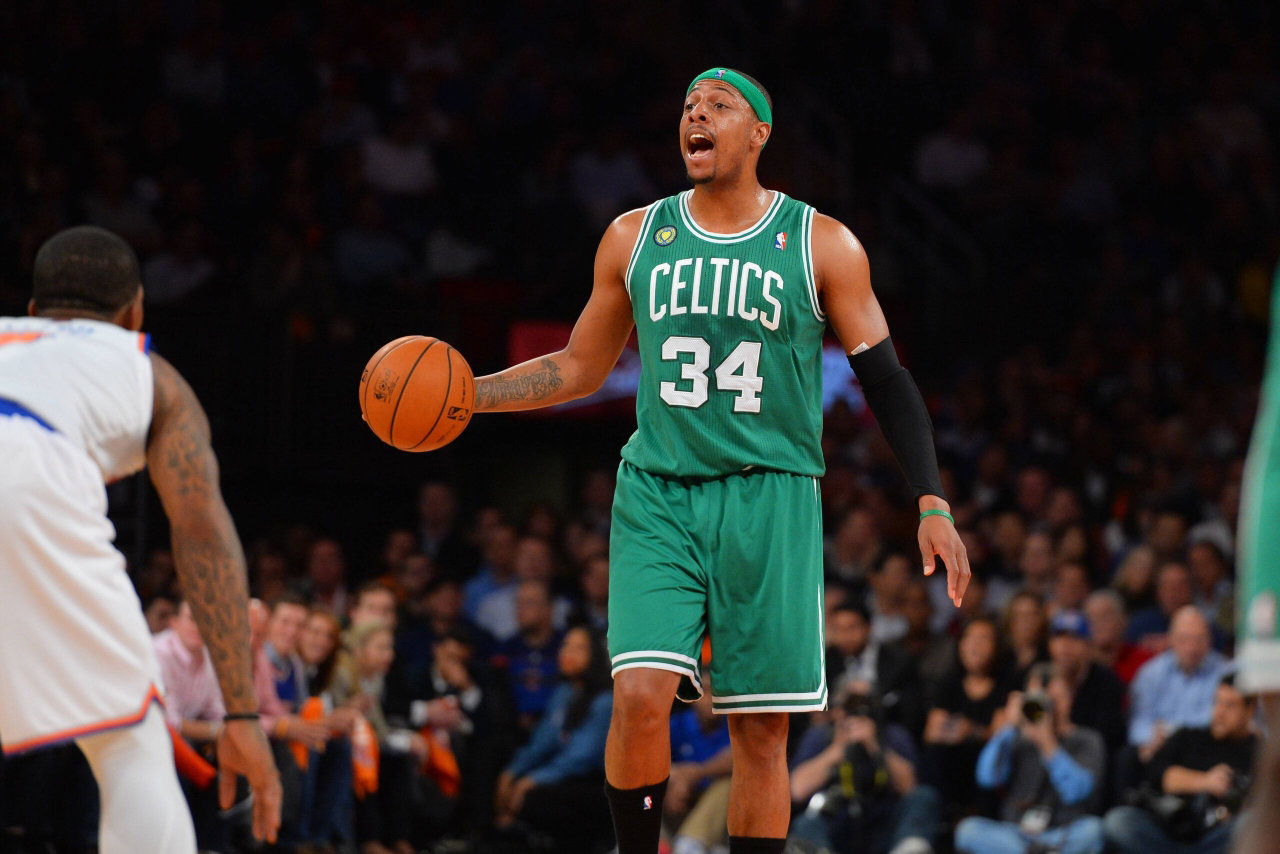
Paul Pierce built a reputation as one of the toughest players of his generation, but the Boston Celtics legend has revealed just how much he struggled away from the basketball court after surviving a near-fatal stabbing early in his career.
Watch What’s Trending Now!
The incident happened in September 2000, just before Pierce’s third NBA season. Although he made a remarkable physical recovery and returned to play all 82 games that year, the psychological effects followed him for much longer. Pierce opened up about the paranoia, sleepless nights, and difficulty discussing the experience that shaped his life.
The former NBA champion also recalled the Celtics arranging professional help for him. However, after only a couple of conversations, he realized he was not ready to continue.
“I remember the team got me a psychiatrist. I had to talk to him, and I remember him coming to my house. I had maybe two conversations with him, and I was like, ‘I really can’t do this no more,’” Pierce shared with Amare Stoudemire on the Amongst Legends and Playmakers podcast.
Instead, he found himself turning to the basketball court whenever the memories became too difficult to handle.
SHOULD LEBRON SPEAK OUT AFTER WHAT HAPPENED TO HIS FAMILY?
Pierce explained that talking about the stabbing was difficult for him for years. Rather than opening up about what happened, he leaned on the game that had become the biggest part of his life.
“I used basketball, ’cause it was tough for me to talk about it for a long time. I don’t even think I talked about it until I retired,” he recalled.
The former Celtics star said the aftermath left him paranoid and unable to sleep normally. Even in the middle of the night, he would head to the gym and spend hours playing basketball to keep his mind away from the incident.
“And so my therapy was just like the gym. I would go to the gym all times of night. If I can’t sleep, ’cause it was tough for me to sleep. I was paranoid,” Pierce explained.
He added that some of those sessions began around midnight and lasted two or three hours. “Twelve midnight, I’m probably at the gym for two or three hours, because for that time I didn’t even think about what happened,” he said.
His comments offer another glimpse into the personal cost of an incident that nearly ended his life. Pierce had previously spoken about experiencing anxiety, depression, and paranoia following the attack, including struggling in crowded places and requiring security around his home.
In a 2018 interview with ESPN’s Jackie MacMullan, he admitted that basketball was what helped him get through that difficult period. He also acknowledged that he wished he had opened up about his struggles sooner.
Pierce was attacked at the Buzz Club in Boston’s Theater District. He was stabbed 11 times in the face, neck, and back and suffered a collapsed lung that required emergency surgery.
The injuries were life-threatening, but Pierce recovered in time for the Celtics’ 2000-01 season opener. Remarkably, he did not miss a single regular-season game, starting all 82 contests and averaging 25.3 points, 6.4 rebounds, and 3.1 assists.
His return became one of the defining examples of his toughness, although his latest recollection shows that being available on the court did not mean he had fully recovered from the trauma.
Pierce went on to spend 19 seasons in the NBA, primarily with Boston, where he became one of the franchise’s greatest players. He earned 10 All-Star selections, won the 2008 NBA championship alongside Kevin Garnett and Ray Allen, and was named Finals MVP after leading the Celtics past the Los Angeles Lakers.
He was inducted into the Naismith Memorial Basketball Hall of Fame in 2021, cementing his place among the league’s all-time greats.
Yet beyond the championships and individual accolades, Pierce’s story is also a reminder that physical recovery and emotional healing do not always happen at the same pace. He returned to basketball just weeks after surviving the attack, but the nights spent alone in the gym showed how much he was still trying to overcome.