
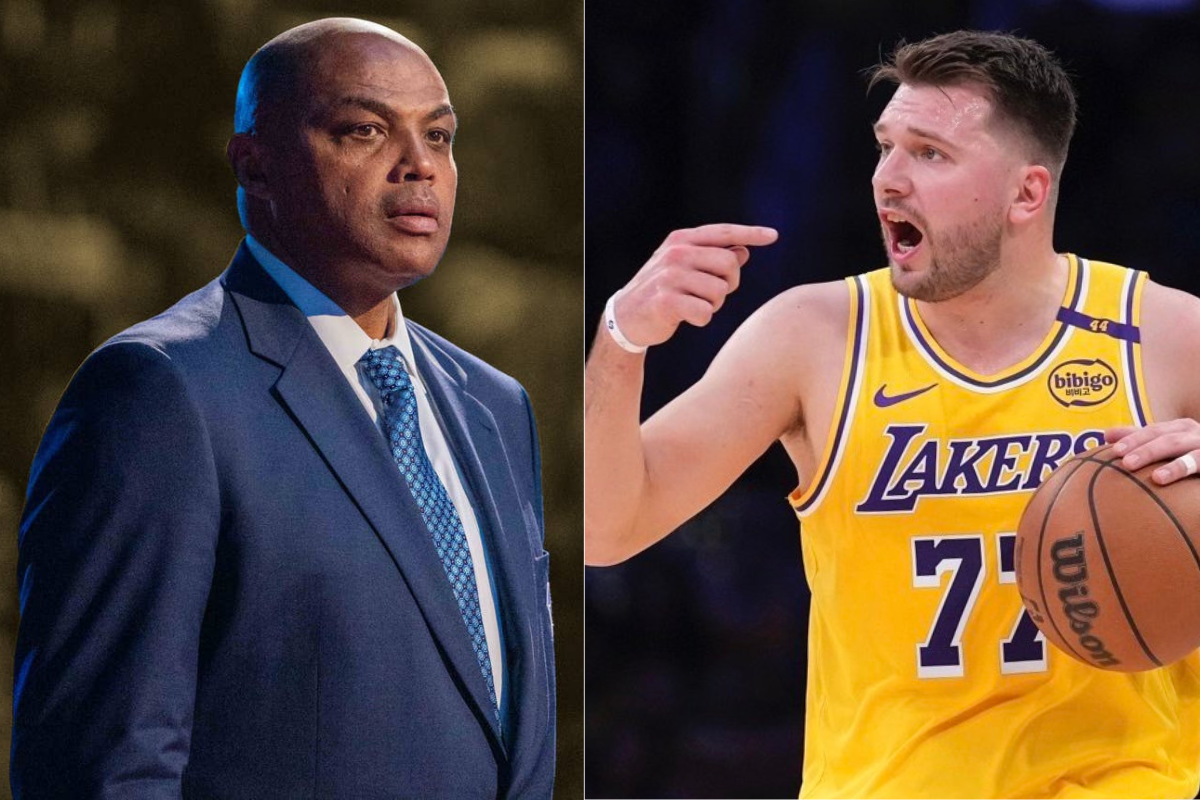
An NBA scout once told ESPN’s Tim MacMahon that he was “the worst transition defender in the history of basketball.” The Ringer’s Zach Lowe called his defensive effort “laughably bad.” Kendrick Perkins called him the worst defensive star of the modern era. Luka Doncic’s reputation has followed him for most of his career, and it has been built on genuine evidence. This season, largely without notice, he started dismantling it. Charles Barkley, appearing on the Sedano and Kap Morning Show, either missed the memo or chose to ignore it.
Watch What’s Trending Now!
The conversation began reasonably enough. Co-host Sedano offered Doncic credit for something he had not previously been known for: genuine defensive effort. “I think Luka’s actually shown effort defensively this year, Charles, in a way that he hadn’t in previous years,” Sedano said, referencing feedback he had received from Dallas personnel during Doncic’s time with the Mavericks.
“Guys were telling me, ‘Man, if he can just give us like two seconds of defense.’” Barkley acknowledged the change, then immediately capped its ceiling. “He has to, because people were calling him out,” Barkley said. “But is he ever going to be a great defender? Hell no. He’s never going to be a great defender.” The assessment was delivered with the confidence of someone who had not looked at the tracking data.
This kind of confident, backward-looking dismissal has a precedent worth examining. James Harden spent the better part of a decade carrying one of basketball’s most stubborn reputational anchors: that he was a defensive liability, a player who conserved energy on that end to fuel his offensive production.
The criticism was fair for stretches of his career, particularly during his Houston years, when film sessions could be genuinely painful viewing. But during several seasons, most notably his later Rocket years and his early Philadelphia tenure, Harden’s steal numbers were quietly elite.
He finished multiple seasons in the top fifteen league-wide, and his post-defense metrics at his best were legitimately above average for a guard.
Analysts who had locked in the “defensive sieve” narrative rarely updated it. The Harden case became a textbook example of how a player’s worst moments can calcify into a permanent identity in the minds of pundits, resistant to revision even when the numbers move in the opposite direction.
Doncic is now living through the same phenomenon.
The data tells a different story. This season, Luka Doncic posted a 0.84 points-per-possession allowed in isolation, a figure that places him among the better isolation defenders at the guard position in the entire league. He ranked in the 95th percentile in shots contested and the 87th percentile in rim contests, numbers that reflect not just positioning but active, consistent engagement on the ball.
He finished top 15 in steals among all players and top seven in charges drawn league-wide, the latter being one of the clearest possible indicators of willingness to take contact, sacrifice the body, and make a defensive play that has nothing to do with athleticism and everything to do with effort and IQ.
Dallas GM Nico Harrison cited the defence-wins-championships philosophy when he traded Doncic to the Lakers last season, and the version of Doncic that arrived in Los Angeles has spent 2025-26 making that justification look increasingly shaky.
Sedano’s framing on the show was more accurate. The improvement did not emerge from nowhere. Doncic was roundly criticized for his defensive output during the 2024 NBA Finals against the Celtics, and again during the 2024-25 season, with multiple analysts pointing to his conditioning and effort levels as core problems that had capped Dallas’ championship ceiling.
Whatever work he did over the summer between his final season in Dallas and his first in Los Angeles, the results are visible in the numbers. Barkley’s point, that external pressure drove the change, is not without merit. But “he only improved because people called him out” and “he’ll never be a great defender” are two separate claims, and only one of them is supported by what happened this season.
The Slovenian has been absent after he tweaked his hamstring late in the first half of a blowout loss to the Oklahoma City Thunder on April 2. He was cleared at halftime, returned, and then went down again midway through the third quarter, lying on the baseline in visible pain before leaving for good.
The Lakers confirmed a Grade 2 left hamstring strain shortly after, ruled him out for the remainder of the regular season, and Doncic flew to Madrid for specialized stem-cell injection treatment to accelerate his recovery.
The Numbers Barkley Overlooked: What Luka’s Defensive Metrics Actually Show
The number of steals is worth dwelling on. In analytical circles, steals and blocks are considered among the hardest defensive stats to fake; they require active engagement, anticipation, and positioning rather than passive presence. A player cruising through defensive possessions does not finish in the top 10 in steals.
A player in the 95th percentile for shots contested is, by definition, closing out on shooters rather than watching them from a distance. These are not vanity metrics; they are the fingerprints of genuine defensive activity, and they contradict the portrait Barkley painted on Thursday morning.

Imago
Credits: Imagn
The figure for charges drawn may be the most telling of all. One of the most persistent criticisms of Doncic during his Dallas years was that he would simulate contact and flop rather than take a real defensive stand, the exact opposite of drawing a charge, which requires stepping into the path of an oncoming player and absorbing the impact.
Finishing top 7 in the league in that category is not a coincidence. It is a choice, made on dozens of possessions across an 82-game season. Barkley is right that Doncic will never be Kawhi Leonard or Gary Payton.
No reasonable person is making that argument. But “never going to be a great defender” is a different claim to “is currently being a significantly better defender than he has ever been,” and the second one is what the numbers from 2025-26 actually support. One of those claims is an opinion. The other is a fact.