

The New York Knicks did not merely reach the NBA Finals. They detonated their way there. Their three series-clinching victories came by 51, 30, and 37 points. They ripped through the Eastern Conference with 11 consecutive playoff wins, ten by double digits, while outscoring opponents by nearly 24 points per game during the streak. Charles Oakley played through the Michael Jordan era, battled Magic Johnson’s Lakers, and lived inside the brutality of 1990s Knicks basketball. Yet after watching this run unfold, Oakley arrived at a conclusion he never expected to make: “I’ve never seen basketball like this.”
Watch What’s Trending Now!
Appearing on SiriusXM NBA Radio after the New York Knicks swept the Cleveland Cavaliers to advance to the NBA Finals, Oakley put the run in plain, unsparing terms. “I’ve never seen basketball like this,” he said. “You have the Mike, the Bulls era, the Magic era, the Bird era. Never seen a team just get swept. Not just get swept, but lose by 30, 40 points.” He left no ambiguity about how he read the series before it started. “Everybody asked me, I said, ‘The better team is 3-0. So why ask who I like?’” His answer had been the same since Game 1.
Oakley’s point was not simply that the Knicks were winning. It was how they were winning. The 1990s teams he played on survived games through attrition, rebounding, and half-court defense. This Knicks team overwhelms opponents with pace, spacing, depth, and relentless second-chance pressure. To Oakley, the contrast is so extreme that even the dynasties of Jordan, Larry Bird, and Magic Johnson no longer feel like the closest comparison.

“You had the Bulls era, the Magic era, the Bird era” @CharlesOakley34 tells @TheFrankIsola & @Scalabrine he’s never seen a playoff team run the gauntlet like the Knicks have. FULL SHOW HERE: sxm.app.link/TheStartingLin…
With 7:47 remaining in Game 4 and the Knicks leading by 35, Jalen Brunson walked to the bench after controlling another playoff game from start to finish. Thousands of Knicks fans inside Rocket Mortgage FieldHouse drowned out the Cleveland crowd with chants of “Knicks in four,” turning the arena into a road version of Madison Square Garden.
Brunson finished the series averaging 25.5 points and 7.8 assists to claim Eastern Conference Finals MVP, but the defining line of the night belonged to Karl-Anthony Towns: “I feel like the word ‘hope’ has been gone from the New York Knicks name for a long time, and for me to be part of this team that revives hope is something special.”
Oakley believes Brunson has already entered territory reserved for franchise immortals. On SiriusXM, he called Brunson “the best thing since Walt Frazier,” while arguing that neither Patrick Ewing nor Carmelo Anthony elevated teammates the way the current Knicks star has during this run.
“Brunson’s the best thing since Walt Frazier,” Oakley said. “I know somebody gonna say, ‘What about Patrick and Carmelo?’ OK, they ain’t do this.”
Why Oakley Thinks This Knicks Team Breaks Historical Comparison
While the broader basketball world debated whether Cleveland could recover after Game 1, Oakley treated the series like it was already finished. By the time Donovan Mitchell scored 31 points in the closeout game and still lost by 37, his confidence looked almost understated. Individual excellence was irrelevant against a team operating at this level of collective dominance.
The numbers support Oakley’s disbelief. The Knicks became just the fifth team in NBA history to win 11 consecutive playoff games in a single postseason, joining the 2017 Warriors, 2001 Lakers, 1999 Spurs, and 1989 Lakers. Their +19.25 average margin against Cleveland was the second-most lopsided Conference Finals sweep ever, trailing only the 2001 Lakers against San Antonio.
More remarkably, no team in NBA history had ever produced three playoff series-clinching wins by 30 or more points before this postseason. The Knicks did it three times in a single month.
The contrast with the Knicks’ last Finals team makes the transformation even more striking. The 1999 Knicks fought through defensive wars and won playoff games with scores that barely crossed 80 points. Their entire postseason run was built on survival, physicality, and razor-thin margins.
Mike Brown’s system has amplified every strength on the roster. In the closeout game against Cleveland alone, the Knicks generated 65 combined points from offensive rebounds and fast breaks, dominated the glass 60-33, and turned 22 Cavaliers turnovers into transition avalanches. Their two-big lineup featuring Karl-Anthony Towns and Mitchell Robinson has produced a +26.9 Net Rating this postseason, giving New York both spacing and overwhelming interior control.
This version operates like the opposite extreme. Under Mike Brown, the Knicks have weaponized pace, offensive rebounding, and transition scoring to produce an absurd +18.4 playoff point differential. Their postseason offensive rating of 130.8 ranks among the highest ever recorded.
Imago
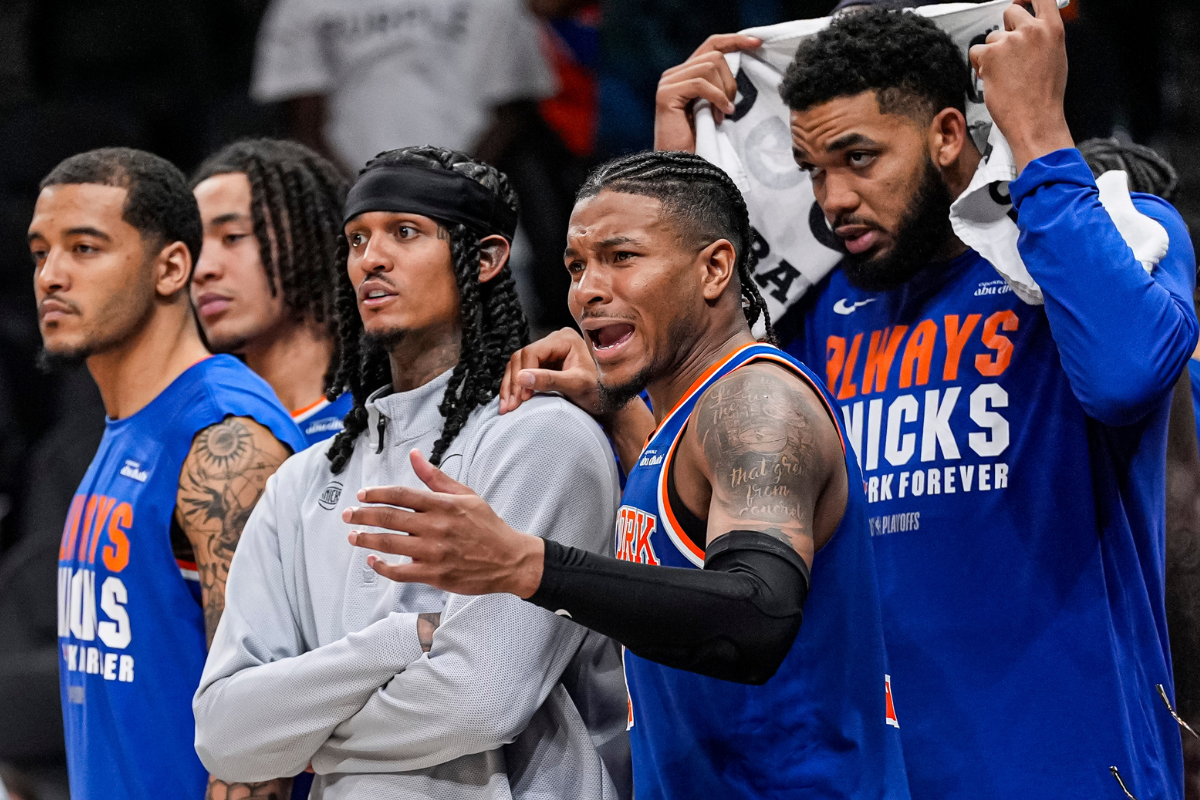
Apr 25, 2026; Atlanta, Georgia, USA; New York Knicks players react on the bench against the Atlanta Hawks during the second half during game four of the first round of the 2026 NBA Playoffs at State Farm Arena. Mandatory Credit: Dale Zanine-Imagn Images
The Knicks are now four wins away from completing one of the most statistically dominant playoff runs the league has ever seen. For a franchise whose modern identity was built on survival, toughness, and close-game suffering, this version feels almost unfamiliar: fast, deep, explosive, and historically cruel to opponents.
The franchise that once defined itself through grinding survival now looks closer to a modern avalanche. Charles Oakley spent decades believing he had already seen the highest form of playoff basketball during the Jordan, Magic, and Bird eras. This postseason forced him to reconsider that entirely.