
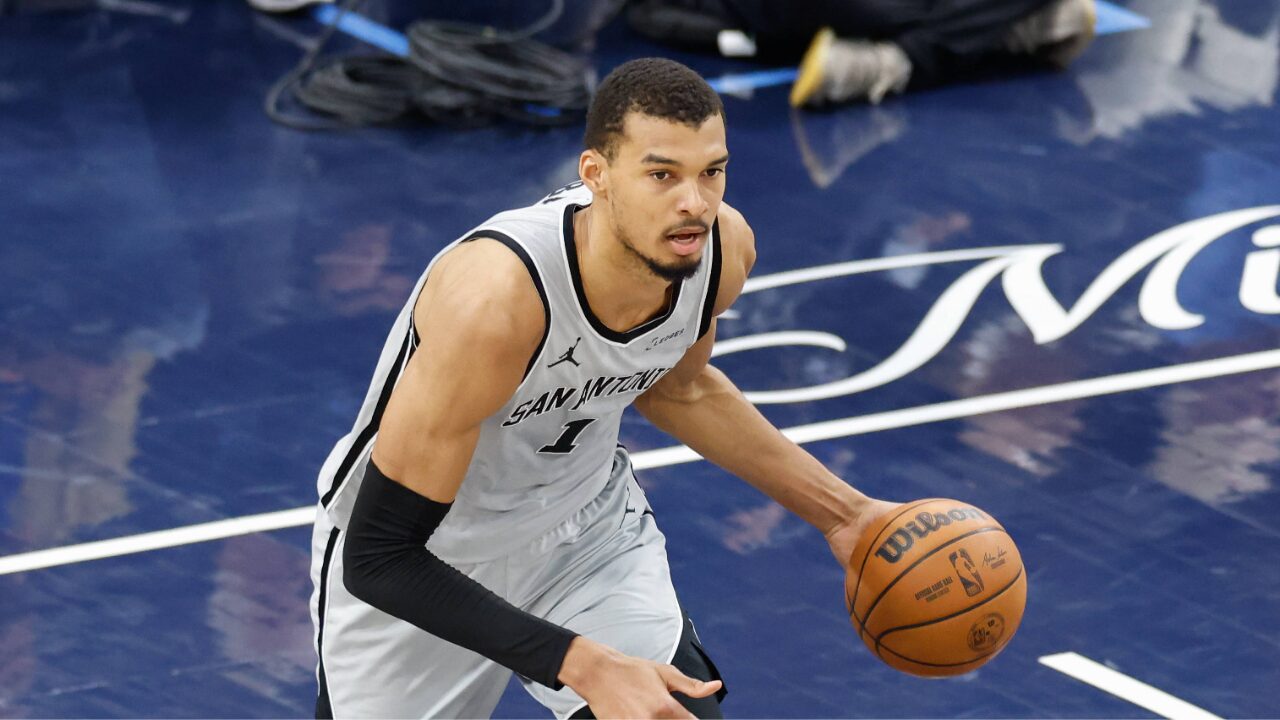
In February 2015, one of the most skilled big men of his generation felt unusual fatigue during All-Star weekend in New York. Tests revealed that Chris Bosh had blood clots in his lungs, a pulmonary embolism that required immediate hospitalization. He was 30 years old, a two-time NBA champion and at the peak of his powers. He played one more season. Then the clots came back, and the career was over.
Watch What’s Trending Now!
Chris Bosh at a charity 3×3 basketball event in Ladera Ranch gave a piece of advice to Victor Wembanyama, who also suffered the same health scare.
“Take your medicine,” Bosh said to HoopsHype. “Make sure that he’s staying on top of his regimen to make sure that doesn’t happen again, because it only takes one more time. It happened one more time for me; it happened twice, and I couldn’t play anymore.”
On Feb. 20, 2025, the San Antonio Spurs announced that Wembanyama had been diagnosed with deep vein thrombosis (DVT) in his right shoulder after returning from the All-Star Game in San Francisco. Wemby had lacked energy leading into All-Star weekend and noted afterward that his arm “didn’t feel completely normal,” a signal his medical staff acted on immediately.
Coach Mitch Johnson said at the time that “there is no concern for Victor’s long-term health personally or his basketball activities.” The Spurs were proven right as Wembanyama cleared all hurdles before training camp opened last fall and went on to lead San Antonio to the NBA Finals, the franchise’s first Finals appearance since 2014.
While many awaited his words on what was going on, the forward didn’t give much away.
“I’m not going to expand on my medical record,” Wembanyama said to the press in April 2025. “I’m over this problem.”
Meanwhile, he had already begun his training with weights and his game in a controlled setting. He maintained his tight-lipped stance on the matter, neither revealing too much about recovery nor about any procedure he may have undergone at the time.
“There’s many more things than surgery when you go to the hospital for a blood clot,” he said. “We’re taking our time and I’m neither late or early [in recovery], but it’s a process and there are definitely steps for me to reach. At the time, I definitely didn’t know [the extent of the condition]. But looking back I did feel a certain way. I wasn’t in the best shape ever at the All-Star Game. By no means was it easy to learn and process.
“I think I did and I’m still doing the best we can do, taking care of my body and trusting the incredible work of the medical staff. I’m sure it’s something I’m going to use to grow and be better.”
Taking a deeper look: Venous thromboembolism, or VTE, strikes roughly 900,000 Americans each year and claims as many as 100,000 lives, according to the National Blood Clot Alliance. That toll translates to one death every six minutes, making VTE the leading cause of preventable hospital mortality. The condition does not discriminate. It can hit athletes, young adults, and people who appear perfectly healthy, often without warning.
Height itself raises the odds. Research published in the Journal of Thrombosis and Haemostasis shows that for every additional 10 centimeters of stature, VTE risk climbs by roughly 27 to 45 percent. The taller a person is, the harder the heart must work to pull blood back from the extremities against gravity, increasing the risk of pooling and clot formation. For someone built like Wembanyama, 7 ft 4 in (2.24 m), that extraordinary frame becomes a built‑in risk factor.
Victor missed the final 36 games of San Antonio’s season, yet he still finished 2024-25 as the NBA’s leader in blocked shots with 176. That resilience positions him to remain among the league’s elite even after the setback, and it’s exactly the kind of trajectory Chris Bosh likely hopes the 22-year-old protects by staying disciplined with his health. Because Bosh knows firsthand how this condition can end a career.
Chris Bosh was diagnosed with DVT after returning from All-Star weekend in New York, with several of the clots breaking free and lodging in his lungs. He was hospitalized, returned for the following season, and then developed a second DVT.
At that point, he required permanent anticoagulant medication. Blood thinners don’t match with playing contact sports professionally, and his career was over at 31. Bosh believed that extensive league-related travel, with its long stretches of sitting in airports and on planes, was the primary cause. The same travel schedule awaits Wembanyama every season.
For a better understanding: Blood thinners make pro contact sports unsafe because they slow the body’s ability to stop bleeding, turning routine collisions and falls into potentially catastrophic events. In the NBA, where players routinely get slammed, trip hard, and take hits to the head, a normal clotting system quickly limits damage. But on anticoagulants, even a single bad hit can cause a severe internal or brain bleed that’s life‑threatening.
That’s why doctors and major medical guidelines tell athletes on long‑term blood thinners to avoid contact sports altogether. For Bosh, needing permanent anticoagulation after his second clot meant there was no safe way to keep playing at that level.
“I had an episode in January,” he revealed. “I almost dropped dead, pretty much, and came back to life. I’m not joking. I had another pulmonary embolism. You just got to deal with it for the rest of your life. I thought I was past it. I am not.”
NBA insider Alex Kennedy, who disclosed that he has personally dealt with DVT in the shoulder, wrote at the time of Wembanyama’s diagnosis:
“Victor Wembanyama is very fortunate that this was discovered before becoming a life-threatening pulmonary embolism.”
At just 22, he has already faced a medical challenge that most NBA players never encounter. He took the Spurs to the Finals in his third season, led all postseason players in blocks, and will enter 2026-27 as one of the three or four most physically dominant players in the world. Not to mention, he’s lucky to have recovered so far.