
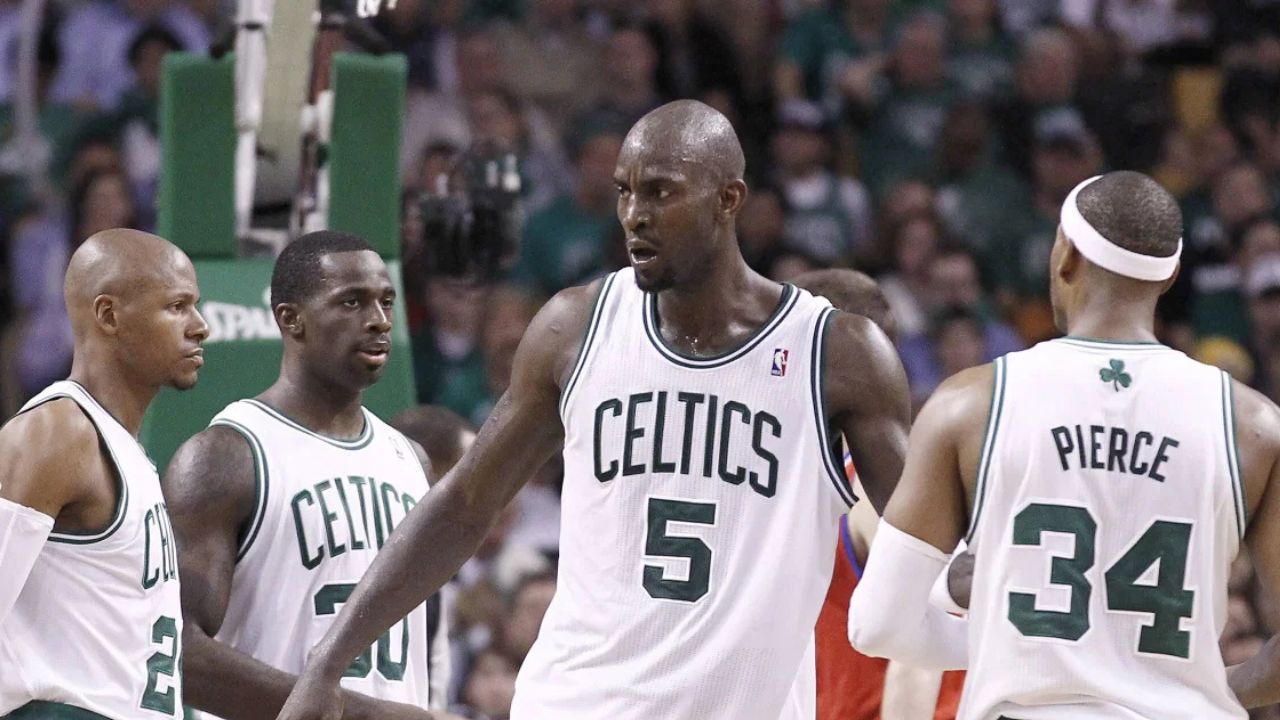
Kevin Garnett had just won an NBA championship when he noticed something that had nothing to do with basketball.
Watch What’s Trending Now!
The Celtics were visiting the White House after their 2008 title, and strength coach Bryan Doo showed up wearing a suit he had owned since his high school graduation in 1991. Garnett took one look at it and asked, “You just met the President of the United States in that? We can’t have you wearing that anymore.”
That moment said plenty about Garnett away from the court. Glen “Big Baby” Davis recently offered another example, and when asked to name his favorite teammate, he did not hesitate.
“Obviously KG is my favorite player, and the reason why he’s my favorite player is because he just took care of, like, the younger people so much,” Davis said on FunnyMarco’s Open Thoughts. “Like, I used to get, like, a lot of money, like, you know what I mean? He used to take us on shopping sprees and all that, but it was the little things.”
Those “little things” included a bizarre rule during Celtics gambling sessions that Davis still remembers years later.
KG had a rule for the young players
Davis joined Boston in 2007 as a 21-year-old second-round pick out of LSU. At the same time, Garnett arrived from Minnesota as the biggest name in a new Celtics team built around him, Paul Pierce and Ray Allen.
The gap between the two players was hard to miss. Garnett was already a 12-year NBA veteran and one of the league’s biggest stars. Davis was just trying to find his place.
That difference became especially clear when the Celtics players started gambling on team planes and road trips.
Davis remembered the veterans putting serious money into the games while younger players would sometimes join with smaller bills. A $20 bill could look harmless at first. It did not stay that way for long.
Davis recalled Garnett stepping in and telling him, “Glenn, get all those 20s out the game, right?”
The reason was simple. Those small bills could quickly become a much bigger problem.
According to Davis, the pot could climb from hundreds of dollars into $1,000, $2,000 or even $6,000. Garnett did not want the younger players throwing their money into a game that could suddenly become far too expensive.
FunnyMarco tried to imitate Garnett’s delivery, asking if he basically said, “wrap the 20s, Lord.”
Davis immediately confirmed it.
“That’s exactly what he said, ‘Lord, Lord, get those 20s out the game.’ That was like his thing.”
There was a reason Davis remembered that moment. Garnett could have let the young players learn the hard way. Instead, he was apparently paying attention to how much they were putting on the table.
And that was only one part of what Davis remembered.
The shopping trips told another story
Davis also said Garnett would take younger teammates shopping.
It was not just about getting expensive things. Davis stressed that Garnett’s impact went beyond the obvious gifts.
“Like, I used to get, like, a lot of money, like, you know what I mean? He used to take us on shopping sprees and all that, but it was the little things.”
That detail matters because the Garnett most fans remember was not exactly known for being soft.
He was the player who demanded more from teammates, talked constantly on the court and brought an almost uncomfortable level of intensity into practices. That side of Garnett was very real.
But so was the side that noticed when a young teammate needed help.
And Davis was not the only former Celtic to describe that version of Garnett.
Garnett could be brutally honest with his own teammates
Kendrick Perkins’ relationship with Garnett did not begin smoothly.
Perkins recalled that the two did not speak for the first three weeks after Garnett arrived in Boston. Their relationship had started with tension, but it eventually became one of the strongest bonds in the Celtics locker room.
Years later, Perkins recalled one night that showed exactly how Garnett approached his teammates.
After a three-game losing streak during the 2009-10 season, the Celtics returned to Boston late at night. Garnett did not simply wait for the next practice to address what he saw.
He called a team meeting on the charter plane at around 3 a.m.
Perkins was trying to make his first All-Star team, and Garnett believed that pursuit was starting to affect the way he played.
“Perk, you my dog and all, but I feel like, bro, you’re playing selfish basketball. You’re trying to make the All-Star game. That’s how it’s looking, B.”
It was not exactly a gentle conversation.
But that was Garnett’s way. He pushed teammates because he expected something from them.
The interesting part is what happened when that same mentality reached the younger players.
Davis had already seen both sides of KG
There is perhaps no better example than Davis himself.
In December 2008, during a game against Portland, Boston’s lead had dropped from 25 points to 13. Garnett was furious with the reserve unit’s defense and went after Davis during a timeout.
Davis eventually walked to the end of the bench, pulled a towel over his head and broke down in tears.
That moment became one of the lasting images of Garnett’s Celtics career.
But there was another side of their relationship that did not make for the same kind of viral clip.
When Garnett went down with a knee injury in 2009, Davis suddenly had to take on a much bigger role. He became a starter and averaged 15.8 points per game during Boston’s playoff run, including a buzzer-beating winner against Orlando.
Davis later credited Garnett’s demanding practices with preparing him for that moment.
That makes his latest comments more interesting. Davis is not remembering Garnett only as the superstar who screamed at him. He remembers the teammate who also looked out for him.
And there is more evidence that this was not unique to Davis.
The younger Celtics kept hearing KG in their heads
Jared Sullinger experienced Garnett’s mentorship several years later.
During Sullinger’s rookie season, Garnett was constantly coaching him from the bench and trying to get him to see the game differently.
Sullinger explained just how much that voice stayed with him.
“I can always hear him in the back of my head. He’s always trying to mentor me, tell me what I can do, what he sees. Trying to make me see what he sees.”
Garnett did not deny the role.
“I try to be there for the guy. You’re going to go through enough things as a young guy, as a rookie, so I try to be there for the guy… Practice every day is not a cupcake practice. We push the young guys here. Our practices are hard, they are emotional, they are filled with passion.”
That sounds much more like the Garnett fans knew.
He was not trying to make things easy for young players.
He was trying to make them ready.
The suits were not just for the stars
The White House story involving Bryan Doo gives another glimpse into that mindset.
After seeing Doo’s old suit, Garnett arranged for a Ralph Lauren tailor to come to Boston and measure nearly 20 members of the Celtics’ support staff.
The people being fitted were not the team’s biggest stars. They included trainers, equipment managers and video staff.
Garnett paid for the custom suits himself.
Doo later remembered what that gesture said about Garnett.
“That was just the kind of guy that KG was.”
Years later, Doo also recalled another Garnett line about looking good and feeling good:
“You know, B-Doo, you look good, you feel good. You feel good, you do well.”
It fits with Davis’ story because the details were different, but the idea was similar.
Garnett noticed people.
Sometimes that meant stopping a rookie from losing thousands of dollars at a card table. Sometimes it meant making sure a staff member did not walk into the White House wearing a suit from high school.
And sometimes it meant pushing a young player until he was ready for the moment he would eventually have to handle on his own.
That makes Davis’ timing especially interesting
Davis is telling these stories during a very different chapter of his life.
The former Celtics big man was convicted in the federal health care fraud case involving the NBA Players’ Health and Welfare Benefit Plan. He was sentenced to 40 months in prison, along with three years of supervised release and restitution, and served approximately 17 months.
Since returning to the public eye, Davis has appeared on podcasts and spoken openly about his prison experience, his NBA career and former players.
Some of those comments have created controversy, particularly his claims about other former NBA players allegedly being investigated in connection with the fraud case.
Those claims remain separate from the court record. Official records do not list Matt Barnes, Stephen Jackson, Gilbert Arenas, Kendrick Perkins, Corey Maggette or Cuttino Mobley among the indicted defendants, and some of those players have publicly denied Davis’ claims.
That controversy has become part of the conversation around Davis’ recent interviews.
But when he was asked about the teammate he remembered most fondly, he did not focus on the controversy, the championship or even Garnett’s basketball ability.
He remembered the little things.
For Davis, that was the KG that mattered
Kevin Garnett’s Celtics legacy will always include the screaming, the intensity and the championship.
It will include the 2008 title and the culture he helped build around Pierce, Allen and the rest of the roster.
But Davis’ story adds something else.
It shows why a player could see Garnett as much more than the intimidating superstar everyone else saw.
For a young player, Garnett was also the veteran watching the table when the $20 bills came out.
“Lord, Lord, get those 20s out the game.”
That might sound like a small moment compared with everything Garnett accomplished in Boston.
For Davis, it was not.
That was his favorite Celtic.