
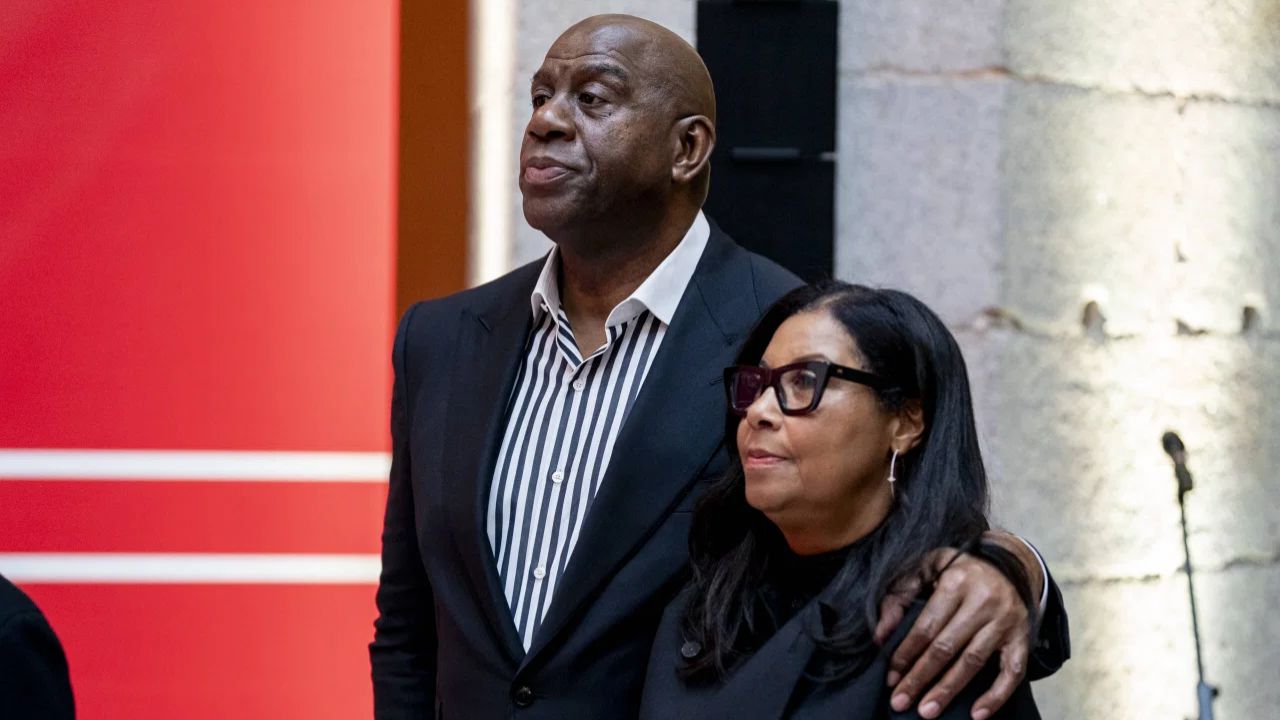
NBA Hall of Famer and Michigan State University alumnus Earvin “Magic” Johnson is one of those mourning a profound loss to the Spartan community. He expressed grief following the passing of legendary MSU track and field head coach Jim Bibbs. The Spartan icon passed away on Saturday, October 10 at the age of 97.
Watch What’s Trending Now!
Not just in MSU, Bibbs made history across the collegiate athletics landscape as the first Black head coach in program history and the first Black head track and field coach in the Big Ten Conference.
Taking to social media, Magic Johnson, who led the Michigan State Spartans to their iconic 1979 NCAA Men’s Basketball National Championship victory before capturing five NBA titles with the Los Angeles Lakers, paid an emotional tribute to his alma mater’s pioneering sports icon.
“I am deeply saddened to learn of the passing of my friend, the legendary former Michigan State Track & Field head coach Jim Bibbs,” Johnson posted on X. “Coach Bibbs was a giant in the state of Michigan and a true trailblazer. As the first Black head coach in MSU history and the first Black head coach in the Big Ten, he opened doors that so many have walked through since. But anyone who knew him will tell you his greatest impact wasn’t measured in wins or records. It was in the lives he touched. He was a mentor, a role model, and someone who genuinely cared about the people around him, on and off the track and throughout the entire Lansing community. Cookie and I will be praying for his family during this difficult time 🙏🏾”
Bibbs’ tenure in East Lansing spanned nearly three decades and partially overlapped with Magic’s time as a Spartan. Joining Michigan State as an assistant coach in 1968, he broke historical barriers when he was promoted to head coach of the men’s track and field program in 1977. Over 27 seasons (18 at the helm as head coach) before his retirement in 1995, Bibbs developed 52 Big Ten individual champions, 26 All-Americans, three NCAA individual champions, and two world record holders.
Before shaping generations of collegiate athletes, Bibbs was a world-class sprinter in his own right. While competing at Eastern Michigan University, he clocked a world-record time of 6.1 seconds in the 60-yard dash in 1951, matching the mark set by Olympic icon Jesse Owens.
Bibbs later mentored legendary Spartan sprinters Marshall Dill and Herb Washington, who broke indoor world records in the 300-yard and 60-yard dashes, respectively, at the 1972 Michigan State Relays.
Following news of his passing, figures across the Michigan State athletic department joined Magic in honoring Bibbs’ monumental contributions. Longtime Spartans men’s basketball head coach Tom Izzo recalled leaning on Bibbs for guidance when he first arrived in East Lansing.
“Jim Bibbs is truly one of the icons of Spartan Athletics,” Izzo said in an official statement. “He cared deeply about Michigan State University and even more passionately for the hundreds, if not thousands, of young men and women he impacted… Coach Bibbs was one of the first people I met when I got to Michigan State, and as a young coach, I would walk up the stairs at Jenison many times each week for advice and perspective. The meaningful conversations we had still guide me today.”
Former MSU Athletic Director Alan Haller, who competed under Bibbs as a multi-sport student-athlete in football and track, reflected on his coach’s personal impact: “Coach Bibbs was so much more than my track coach—he was a mentor who helped guide me through every major point in my life.”
Inducted into the MSU Athletics Hall of Fame in 2010 and the USTFCCCA National Hall of Fame in 2015, Bibbs leaves behind a legacy of athletic excellence, social progress, and community service across the state of Michigan.