
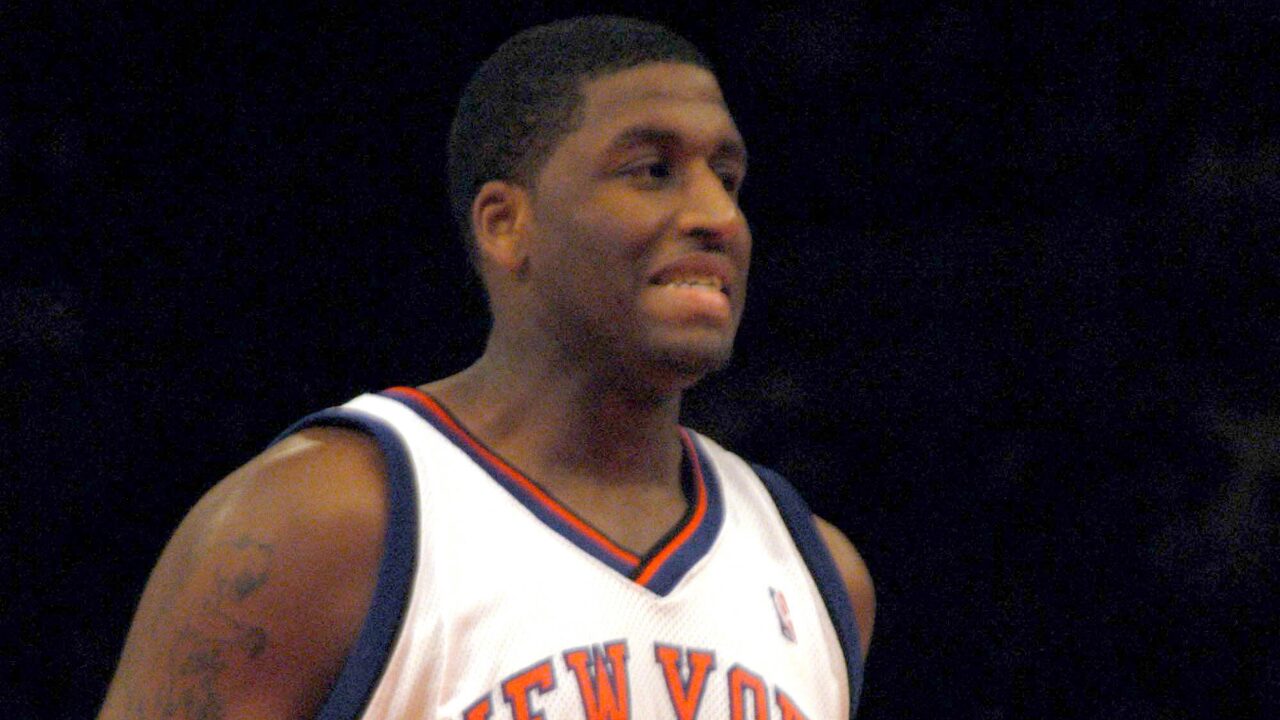
On April 10, 2005, the New York Knicks had already endured nine straight losses. Their game against the Indiana Pacers was headed for overtime, and with the clock running out, Stephon Marbury drove toward the basket. His attempt missed, but Michael Sweetney was there.
Watch What’s Trending Now!
The Knicks forward grabbed the offensive rebound and tipped the ball in at the buzzer. New York won 113-112, ending its nine-game skid. Sweetney finished with 20 points and nine rebounds, giving Knicks fans one of the most memorable moments of his NBA career.
More than two decades later, Sweetney’s passing has brought attention back to a career that began with major expectations but eventually became much more than a basketball story. The former Georgetown star and ninth overall pick in the 2003 NBA Draft died on Wednesday, September 16, at Newark Beth Israel Medical Center in Newark, New Jersey. He was 43. His cause of death had not been publicly announced.
His wife, India, announced his death on Thursday, September 17, in a Facebook post.
“With the heaviest hearts, we are deeply saddened to announce the passing of our beloved Michael. To know Mike Sweetney was to love him. No one loved him more and he loved no one more than his family. His children were the light of his life, and he lived every day to give them the best life possible. He’s been my best friend for 30 years and my husband for almost 20. I’m not sure what we or I will do without him. He was the best son, brother, family member, friend, father and husband ANYONE could ask for.”
That statement offered a glimpse of the person his family knew away from the basketball court. But to understand why his passing has resonated with Knicks fans, it helps to go back to the beginning of his basketball journey.
From Georgetown star to ninth overall pick
Sweetney arrived at Georgetown after being named the Washington Post’s All-Met Player of the Year at Oxon Hill High School in Maryland. Over three seasons with the Hoyas, he averaged 18.2 points, 9.2 rebounds, and 1.9 blocks per game while shooting around 55% from the field.
By his final college season, he had become one of the most productive big men in the country. In 2002-03, Sweetney averaged 22.8 points, 10.4 rebounds, and 3.2 blocks per game. He recorded a double-double in each of his final two seasons and never scored in single digits during his senior year.
His production earned him honorable mention All-America recognition from the Associated Press, a second-team NABC All-America selection, and a place among the finalists for the Naismith College Player of the Year award.
The Knicks selected him ninth overall in the 2003 NBA Draft, a class that also featured LeBron James, Carmelo Anthony, Dwyane Wade, and Chris Bosh. New York was not simply drafting a player with college numbers. It was selecting a physical, 6-foot-8 forward who was expected to bring rebounding, interior scoring, and a strong presence in the paint.
Sweetney’s first two NBA seasons came with the Knicks. He averaged 4.3 points and 3.7 rebounds as a rookie before making a bigger impact in his second season, when he averaged 8.4 points and 5.4 rebounds in 77 games, including 28 starts.
That 2004-05 season included the Indiana game-winner that Knicks fans still remember. But the promise of a top-10 pick did not turn into a long NBA career.
The difficult chapter Sweetney later chose to discuss
Sweetney played four seasons in the NBA, spending his final two with the Chicago Bulls after New York traded him in October 2005. He finished his career with 6.5 points and 4.5 rebounds per game across 233 games.
The numbers alone, however, do not explain the personal challenges he later described. In a 2017 interview with New York Daily News reporter Stefan Bondy, Sweetney spoke about the pressure of playing in New York, the loss of his father, and the depression and anxiety he experienced during his NBA years.
“I can say it was one of the hardest things ever. New York is the top media market and being under that microscope playing for the New York Knicks and being the ninth pick in the draft — a lottery pick — a lot is expected of you. If you don’t live up to it, the hatchet comes down on you pretty hard. On top of going through issues behind closed doors, there was really no good outlet. And it broke me.”
Sweetney also spoke about the death of his father, Samuel, who died of a heart attack at 52. He learned about the loss on the first day of the NBA’s Rookie Transition Program, with his father’s funeral taking place shortly before training camp.
“I didn’t really have no time to digest it… And it just started to be a snowball effect and I just started being really depressed and started gaining weight and things just started going in a bad way. I think at that time, nobody really talked about it. You were looked at as crazy… So I was just one thing I was scared to talk about it.”
He later described food as a way of coping with what he was going through.
“Food was my drug. That was my cure.”
Sweetney did not present his story as something that had happened to him without reflection. He spoke about seeking counseling, receiving a diagnosis, and eventually reaching a better place. He also discussed how much he wished he had asked for help earlier.
“I went from a top-10 pick to being out of the league in four years. So it was one of those things where it sucked but it was one of those things where I wish I talked to somebody and let them know, ‘Look, I need help. I’m not okay.’”
That honesty became an important part of his life after the NBA. Instead of allowing his career to be the only way people understood him, Sweetney began speaking about mental health and sharing his experience with young people, athletes, and others who were struggling.
His basketball story continued after the NBA
Leaving the NBA did not mean Sweetney stopped playing basketball. He continued his professional career overseas, with stops in places including China, Puerto Rico, Venezuela, and Uruguay. He also played in the G League and later appeared in the BIG3.
He received training-camp opportunities with the Boston Celtics in 2009 and 2011, but neither led to a return to regular-season NBA play.
The next chapter of his career took him into coaching. Sweetney joined Yeshiva University’s men’s basketball staff in 2019 and became part of a program that made national headlines in Division III. During his time there, the Maccabees won Skyline Conference titles, put together a 50-game winning streak from 2019 to 2021, and made NCAA Tournament appearances.
His work at Yeshiva also gave him a chance to help younger players navigate challenges that extended beyond basketball.
In a tribute following Sweetney’s death, Yeshiva head coach Elliot Steinmetz described him as much more than a former NBA player.
“The world lost a giant today… I lost a close friend… Our Jewish community lost an ally and someone who knew exactly how to show up. Mike Sweetney wasn’t just a friend. He was family. When you needed him, he was there. Always…”
Steinmetz also highlighted Sweetney’s work with student-athletes and his willingness to speak openly about mental health.
“He was there for our student-athletes… day in and day out… His dedication to mental health awareness and his willingness to share his story… was the work of a selfless human being with a huge heart.”
That description helps explain why Sweetney’s post-NBA life deserves attention in its own right. His career was no longer about trying to prove he belonged in the league. It was about using what he had experienced to help others.
A Knicks connection that never really faded
Sweetney’s relationship with New York also remained intact long after his playing days ended. He attended the Knicks’ alumni night at Madison Square Garden on January 17, 2026, when the team hosted the Phoenix Suns.
After the event, he expressed his appreciation for being back around the franchise and the players who had been part of his basketball life.
“Thank you New York Knicks for having me at alumni night. It was a fun and amazing night being around all the legends I grew up watching. Also it was great to see my brothers that I played with and against…”
The Knicks also released a statement after his passing.
“The Knicks are saddened to hear about the passing of Michael Sweetney. Michael was an incredible person who will be missed by many. Our thoughts are with his family.”
The Chicago Bulls, Georgetown, and the NBA’s history account also shared condolences.
Fans celebrate Michael Sweetney’s legacy
One fan prayed for the family. They even shared a photo of Sweetney in a personal tribute, teaching their kids.
“My boys went to the YI basketball clinics that he ran. He was a gentle giant and so kind and patient with the little kids.”
Reporter Stefan Bondy noted that Sweetney was excited when the Knicks invited him back for three games last season, despite his NBA career lasting only four years. He was also in attendance at Madison Square Garden in January, showing that his connection with the franchise remained strong long after his playing days were over.
That connection was reflected in the reaction from one Knicks fan, who wrote, “Once a Knicks always a Knicks. RIP and condolences to his family.”
Another shared a similar sentiment: “RIP, Knicks forever Legend!”
A netizen also recalled his buzzer-beating tip-in that gave the Knicks a 113-112 overtime win over the Indiana Pacers in April 2005. He finished with a then-season-high 20 points and 9 rebounds. The victory ended a nine-game Knicks losing streak. “Still remember his game winner in Indiana.”
Before his NBA career, Sweetney’s accolades also included being a Naismith College Player of the Year finalist. A tribute from a fan was, “RIP to a legend🕊️🙏🏾💙🧡.”
While the NBA career did not pan out as planned, Michael Sweetney never had excuses. He spoke about the importance of mental health and even coached the next generation.