
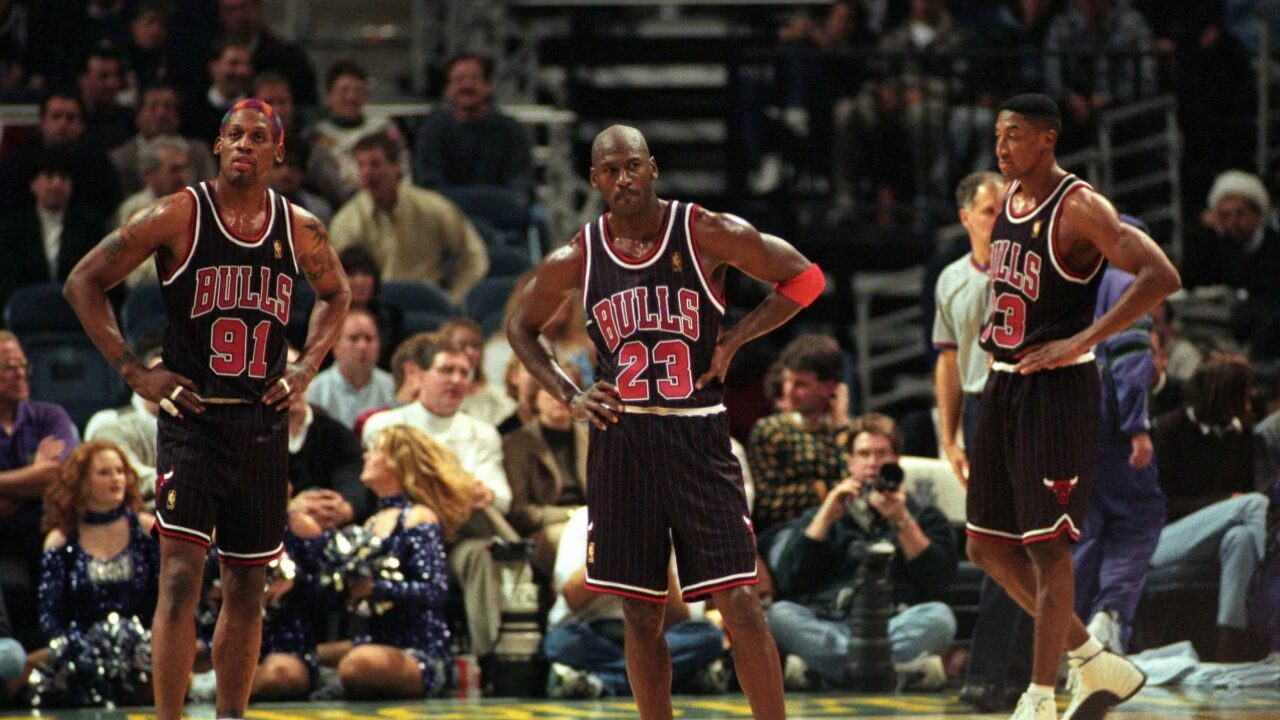
The Michael Jordan-Scottie Pippen feud has lingered for years with little sign of reconciliation. So when Dennis Rodman, who won three championships alongside both stars and later built an unlikely reputation as a freelance “basketball diplomat,” the same instinct that has sent him to Pyongyang for face time with Kim Jong-un on multiple occasions since 2013, sat down for an interview, one question was almost unavoidable: could anyone actually bring the two Bulls legends back together?
Watch What’s Trending Now!
“When I get off this stage, I’m going downstairs. Dwight Howard is over there hanging out with Scottie Pippen while he’s signing autographs. I gotta meet him again because he answered me yesterday,” Rodman shared at the Fanatics Fest. “I said, ‘Oh, Scottie, I see you all the time.’ But it’s a Michael Jordan thing. Michael is Michael. I don’t know. He may do it one day. He may do it.”
It’s a telling answer, because Rodman is arguably in one of the best positions to know. He spent the late 1980s trying to physically stop Jordan and Pippen as one of Detroit’s “Bad Boys,” and his history with Pippen in particular was ugly before it was warm.
In Game 4 of the 1991 Eastern Conference Finals, Rodman shoved Pippen into the basket stanchion, opening a cut on his chin that needed stitches. When the Bulls later considered signing Rodman in 1995, Phil Jackson pulled him aside and told him the deal only worked if he apologized to Pippen first. Rodman has told that story publicly several times since. It’s a strange footnote for two men who are now closely enough linked that Rodman calls Pippen “my brother.” But as for the other two parties…..
During their playing days (1987-98), Michael Jordan and Scottie Pippen had immense respect for each other on the court. Jordan frequently called Pippen “the best teammate of all time.” And in The Last Dance, Jordan also said that “whenever they speak Michael Jordan, they should speak Scottie Pippen. I never won without him.”
Pippen later admitted those words meant a lot to him. But respect on the floor never really translated into a friendship off it, and multiple people who were in the locker room have made a point of separating the two.
Despite their dominance together, Pippen has repeatedly said they were never particularly close away from basketball, Jordan spent his downtime golfing and gambling with a tight inner circle, while Pippen mostly kept to himself and his family. They traveled and won together for eleven seasons; they didn’t really live together in any social sense.
Although MJ praised Pippen numerous times, the documentary also highlighted several controversial moments. He insisted there was no issue, telling the Associated Press: “Why would I be offended by anything that happened 30 years ago?”
That calm didn’t last, and it’s worth being precise about what actually triggered the shift, because the documentary gets blamed for starting something that had been building for closer to three decades. The real root of the friction traces back to 1991, when Pippen, coming off the Bulls’ first championship and still just 25, signed a seven-year, $18 million extension.
It looked reasonable at the time; long-term deals were common, and Pippen, who’d grown up in a large family in rural Arkansas after his father suffered a disabling stroke, wanted the security. Nobody could have predicted what the NBA’s television and merchandising boom was about to do to player salaries.
By the 1997-98 season, Jordan was earning roughly $33 million on one-year deals his agent negotiated specifically to keep pace with the market, while Pippen, an All-Star, a perennial All-Defensive pick, and arguably the league’s best two-way player, was making about $2.8 million and had actually fallen to sixth-highest paid on his own roster. Jordan wasn’t blind to it.
In an interview with Bulls reporter Cheryl Raye-Stout before the 1995-96 season, he said Pippen was “totally underpaid” and that he wished there were some way to fix it. But sympathy from Jordan didn’t change Pippen’s paycheck, and by 1997 the frustration boiled over: Pippen delayed ankle surgery into the start of the season, a decision widely read as a quiet protest and a push toward a trade.
That delay is what actually put Jordan and Pippen at odds on camera. In the documentary, Jordan said flatly that he felt Pippen “was being selfish,” accusing him of putting his own situation ahead of what he owed the team. Pippen didn’t let that sit.
In his 2021 memoir Unguarded, he fired back by pointing to Jordan’s own abrupt 1993 retirement, which forced general manager Jerry Krause to scramble for replacement bodies on short notice, asking, in effect, how Jordan got to call anyone else selfish. That’s the exchange that hardened into the modern feud, not any single scene in the documentary itself. A year after downplaying the rift, while promoting Unguarded, Pippen’s tone had changed for good.
He wrote that Jordan deserved a large share of the blame for how the documentary turned out, arguing that Jordan effectively had editorial control over a project that was supposed to be about the whole team, not just its most famous member.
He wasn’t the only Bulls veteran making that argument. Horace Grant, who won three titles alongside both of them before leaving Chicago in 1994, went even further in a Chicago radio interview shortly after the series aired, saying he believed the documentary wasn’t real in a lot of places and that a large share of it had been shaped to protect Jordan’s image. Toni Kukoč pushed back on the credit imbalance from a different angle, saying Pippen quietly carried defensive and playmaking loads that never showed up in a box score. Ron Harper mostly stayed above the fray, framing both men as simply necessary to each other rather than picking a side.
Rodman’s comments echo what multiple former Bulls teammates have said publicly over the past year: that the path to reconciliation runs through Jordan, not Pippen, and that until Jordan decides to extend the olive branch, the feud stays exactly where it is. Randy Brown put it bluntly: “Michael is the wild card in this. He’s the only one who can fix it.”
Pippen himself hasn’t given much indication he’s looking to make the first move, either. He still speaks proudly about the on-court partnership; six championships in six Finals trips is hard to argue with, but that pride has consistently been about the basketball, not about wanting to sit down and clear the air. There’s been no public apology offered on either side, and no sign of a phone call.
The Toughest Matchup Rodman Ever Faced, and It Wasn’t Jordan
When asked which opponent gave him the most trouble across his entire career, Rodman’s answer surprised the room.
“I’d say James Worthy,” Rodman said. “You probably think I’d say Michael Jordan, huh? … Michael Jordan really couldn’t score on me. If you look at the tape, he couldn’t score on me. Scottie Pippen couldn’t score on me. A lot of people couldn’t score on me back then. I was very agile. … James Worthy was one of those athletes that I could not figure out because he’d get my [expletive] on that right or left wing.”
It’s a fitting way to end, honestly, Rodman spent this same conversation defending Jordan’s greatness and vouching for how deeply the two of them trusted each other on winning nights, and then, asked who actually gave him fits, skipped both of his own Hall of Fame teammates for a Laker from the Showtime era. That’s more or less how Rodman has always talked about Jordan and Pippen: full of respect for both, unwilling to flatter either.