
Few players in NBA history had a more iconic go-to move than Hall of Famer Tim Hardaway Sr., making his crossover a lethal weapon in his offensive arsenal, which star players in the league that followed him tried to emulate and incorporate into their own games.


The NBA legend, who made a name for himself with the Golden State Warriors and Miami Heat, recently reflected on his life off the court as well as his accomplishments on the hardwood, writing an epic biography with Jake Uitti fittingly named Killer Crossover.
Watch What’s Trending Now!
Hardaway spoke with EssentiallySports about his new book as well as several current and past NBA topics, from his unforgettable moments sharing the floor with Chris Mullin and Mitch Richmond on the “Run TMC” Warriors to who reminds him of himself in today’s NBA and what he would change about the league right now, along with much more.
Your book, Killer Crossover, what was the inspiration behind putting it together?
“So check this out. Everybody’s been asking me for 20 years. ‘Hey, Tim, you should do a book, you got a great story to tell.’ The way you tell your stories, how you tell your stories, what you have to say, how you grew up, what made you who you are, how you had to fight, how you had to face adversity, how you went through a lot of pain and just growing up in your life.’ They said, ‘Hey, man, you need to write a book.’
And for 20 years, I’m just like, ‘Okay, right.’ So, Jake [Uitti] got in touch with Tim Donovan, because he just got through right now. Michael Cooper’s book. And Tim Donovan from PR, the head PR guy from the Miami Heat, called me up and said, ‘Hey, Tim, Jake Uitti, I want to talk to you about writing a book. And I think this would be good for you to talk to him.’ I said, ‘Alright, cool.’
We just started talking, and next thing you know, for three weeks, we’re talking and talking. And at that particular point, I didn’t even know I was writing a book, man. And he was like, ‘I’ll call you same time next week.’ And he asked me questions. ‘I want to talk about your upbringing, I want to talk about your dad.’ I’m like, ‘Okay, cool.’
And I’m talking, I’m talking. Next thing you know, man, I’m writing a book.”
What’s something you would want the younger generation of basketball fans and players to take away from your book?
“Listening is a skill. It’s not an art. Listening is a skill. And you’ve got to listen to people who are trying to help you. And that’s what I did. I listened to people. And I understood what they were saying to me. And that’s why it helped me in my life and in my career. But if you don’t listen to people, then you just run off at the mouth. And you just keep talking and blaming this person and blaming that person. And not really looking at yourself in the mirror and saying, ‘I can do this. They don’t know me. They don’t know how I tick. They don’t know where I come from. I’m better than that.’
And that’s what I want to get through to the kids in my book, because when a kid tells me that, ‘I can’t work on my game by myself, I can’t work on the game by myself.’ That’s BS. I worked on my game by myself, and I didn’t have nets. I was outside.
So, you’ve got to know how to play a game within the game in your mind. And that’s what’s wrong with these kids. We give them too much now, and they can’t create in their minds how to approach and overcome adversity. That’s just a slap in my face when you say you can’t work on your game by yourself. I did it, and that’s why I’m in the Hall of Fame right now, because I worked on my game when people were going out and going out to parties. I was at the park working on my game. That’s what I want kids to take away from this. And I want them to understand that coming from a family like the one I came from, when you read the book about being abused. My dad, being a domestic violence dad and alcoholic, that’s tough, but you gotta have a strong mind and go talk to somebody. We didn’t have anybody to talk to. Talk to somebody. I say that all the time, go talk to somebody. We couldn’t talk to anybody. If we talk to somebody, we get hurt. You don’t say what’s going on in this household.”
Different time, huh?
“Yeah. Different time. That’s why I tell them, ‘Go and talk to somebody and get that sh-t off your chest, get it off your mind.”
I grew up when you were playing, so it was a totally different mindset. They don’t use anything as motivation. They use it as a shot.
“Yeah. They use it as a crutch or negative toward them instead of using it. Instead of saying, ‘No, that’s not me. I’m going to show you. That’s not me. I’m going to come out here and play the way the game’s supposed to be played. And I’m going to put my own little twist on it, too.'”
When you look back at your “Run TMC” days, what do you think made that trio? So like electric and ahead of its time, cause it was definitely ahead of its time.
“Basketball IQ. All three of us have high, high, high basketball IQ. We always want to learn from one another. We always wanted to learn from other teams. We always talked in practice. If this team is playing us this way or this team they like to play us that way, this is what we’re going to do. I’m on reverse pivot. You’ll know when I want to go back on this guy, one more set of fake back screen and cut. I’m going to set this back pick.
USA Today via Reuters
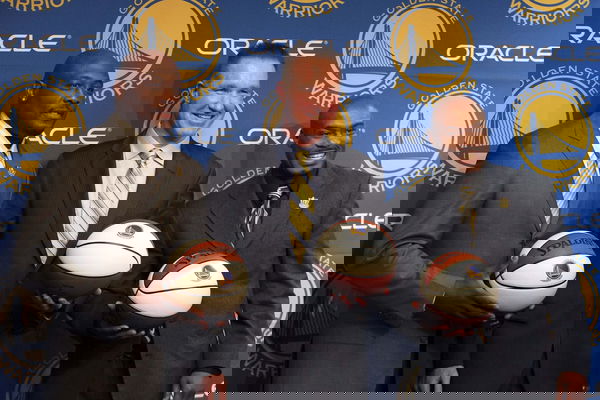
March 19, 2012; Oakland, CA, USA; Golden State Warriors former players Mitch Richmond , Chris Mullin and Tim Hardaway smile for the media before Mullin’s #17 jersey is retired before the game against the Minnesota Timberwolves at Oracle Arena. Mandatory Credit: Kelley L Cox-USA TODAY Sports
It was just communication all the time. We communicated on the floor, communicated in the locker room, and communicated in a time-out, something that these kids don’t do. They are scared to talk to one another.
I’m going to tell you this: I’m hot. I’m hotter than fish grease. I hit five in a row: layups, mid-range jump shots, a couple of threes. We weren’t shooting threes like that. Maybe a couple of threes here and there, but you know, I’m hot. I hit five in a row. My team is looking for me, but you know what? I’m not going to shoot a bad shot. I’m not going to shoot a heat check. That doesn’t mean you shoot for 40 to 45 feet out. What it meant to us was giving us the ball. If I don’t have a shot, make a shot for somebody else. Kids don’t understand that now.
They’re like, ‘I’m hot. I’ve made three, four in a row. I’ve got to shoot the next one. I don’t care if I’m on the other side of half court. I got to shoot, just see if I’m still hot.’ That’s BS. And the coaches accept that sh-t. That’s BS. Instead of telling them, ‘Look, you really don’t have to shoot that shot. There’s two m—–f—-rs on you. If you pass it over there, he can make a shot, too.’
And that’s what teams get dissension because they’d be like, ‘Yeah, even though he hot, I’m still open.’ Make a pass and make a play. That’s what you’re supposed to do.”
Coaches scared of players now?
“No question. No question. They’re scared of players. No f—ing question. They’re scared of players, and it’s ridiculous. You can’t talk to a player, so you are just gonna get fired. You’re just gonna let a player just do what’s wrong, and you know what’s wrong, and it’s gonna hamper him from playing or hamper his skills. So yeah, I don’t like it.”
Run TMC versus Splash Brothers plus Draymond [Green]. Who wins in 3-on-3?
“We win in 3-on-3. So this is why I say that: who’s gonna stick Mitch [Richmond] can take you outside and inside, and a lot of people don’t understand Mitch, and I can take you inside. But Mitch is a 3-and-D guy. He can hurt you in many ways. And you got somebody like Chris Mullin, if he gets a wide open jump shot, just like Klay [Thompson] or Steph, they money. But our defense was different than their defense. We could put some hands on you. We can push you around, and we get up on you and do things differently.
I think that our team beat their team. We took pride in playing 3-on-3, too. We took pride. We used to play 3-on-3 in practice all the time. 3-on-3, 2-on-2. We made up a thing where if you steal a ball at half court, you can’t make a layup until everybody gets across half court. You had to bring it back out and work 3-on-3. We love playing 3-on-3 because that’s how you are supposed to play.”
It’s the purest form of the game, I think.
“Yeah. If you look at it, that’s the way the game is played now.”
Which defender gave you the toughest matchup during your prime?
“Oh man. I’m going to tell you this, man. It was steady defenders out there. You got John Stockton, steady defender, Gary Payton, of course, steady defender. Kevin Johnson, we used to have brutal battles against each other. Rod Strickland, brutal battles against each other.
Back in the day, if you had handles and you got past your guy, nobody could stick you, but you just wanted to contain them at the end of the game when it counted. During the course of the game, sometimes he fast breaks and all that. It was kind of tough. So during the course of the game, you know what they like to do. If you can contain them here and there at times, you were winning, but most of the time, it was tough to contain a guy to get to where he wanted to go and want to make a play.”
What was your welcome to the NBA moment?
“Kevin Johnson. He f—ed me up. Kevin Johnson. I didn’t go to sleep that night. It was tough.
He f—ing crossed me over. He had like 30 and 10 on me or something like that. But I bowed after that. That was it. He wasn’t gonna f–k me up like that no more. He was a beast.”
Kevin Johnson doesn’t get talked about as much anymore.
“No, he doesn’t. That’s a shame, just like Strickland doesn’t get talked about a lot.”
When you watch today’s guards, who reminds you the most of yourself?
“Of myself? Oh man. That’s tough. Jalen Brunson.
Jalen Bronson got the crossover. He could take over. He can get to the lane. He makes his team go. They’re behind him 100%. So yeah, somebody like Jalen Bronson, but I was a little bit quicker than him.”
I was going to say there’s a big speed difference there.
“Yeah. It’s a big speed difference in there.
Oh, Tyrese Maxey.”
He’s balling right now.
“Yes, he is.”
What do you think are the biggest differences between the modern game and when you played in the nineties?
“The defense. The defenses are different. We used to put our hands on people. We used to put our forearms on people. We could steer them. No zone. Defenses are totally different than what they are today, from what they were back then. Physicality. No question.
Back then, flagrant foul? Sh-t. You have to throw that m—–f—ing a third row.”
How would prime Tim Hardaway fit in today’s NBA?
“I can fit in any game that is in today’s game. I pride myself on being able to play in any style. Slow down, fast. Controlling the tempo, making things happen on both the defensive and offensive ends, and making it easier for my team.
We can score 50, we can score 40. We can do this. We can do that. I’m just saying that I made it easy for myself and my team.”
What current team or player do you enjoy watching the most right now?
“Oh, of course, Denver [Nuggets]. With Nikola Jokic, of course, Denver.
When the Golden State Warriors are whole, when they whole teams together and they all healthy, I like watching them play.
Oh, OKC [Thunder]. No question. I love watching them play. Oh man. They play beautifully. Yeah. I love watching that.
And now, I’m going to tell you another team. I like watching them play. Detroit Pistons. Love watching them play, man. Cade Cunningham is having an MVP-caliber year.
And, of course, the Miami Heat – I like how they move the ball. I like how they stretch the court. I like how they play the game the right way. All the teams I’m talking about play the game the right way.”
What’s the most meaningful piece of advice that you’ve ever given your son, Tim Hardaway Jr., as he’s navigating his career?
“First of all, the piece of advice I gave my son was that he gave me a piece of advice, you know, he’s like, ‘ Leave me alone. Let me play.’
USA Today via Reuters
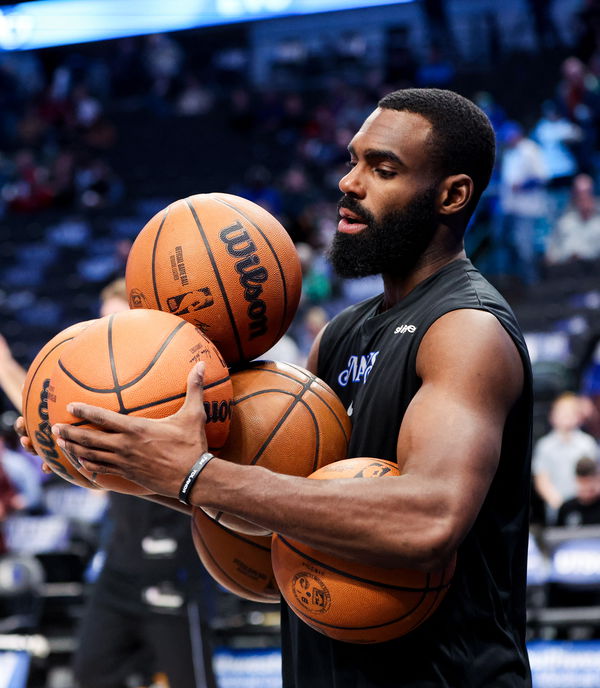
Dec 6, 2023; Dallas, Texas, USA; Dallas Mavericks forward Tim Hardaway Jr. (10) carries basketballs before the game against the Utah Jazz at American Airlines Center. Mandatory Credit: Kevin Jairaj-USA TODAY Sports
I had to shut up and let him learn, let him go out there and do what he needs to do and learn how to play the game the way he’s supposed to play the game. He’s not like me. His demeanor is not like mine. His game is not like my game. So I had to leave him alone.
That’s the first thing. Second thing is, we really don’t talk about basketball. If we talk about basketball, he asks me questions, and I’ve talked to him about it and let him know what he needs to do out there, what I see out there on the basketball court.
It’s all about him and what he has done because of coach [Chris] Brown from high school, and being coached by coach [John] Beilein from college, and being coached by coach Bud.
Coach Bud really taught him with the Atlanta Hawks how to move without the ball, how to really play in the NBA, and what it takes to be an NBA player. So, all three of those coaches really helped his career.”
What’s a great behind-the-scenes Run TMC story?
“I tell you this, Run TMC was special, but we had guys on that team that were special, like Tom Tolbert.
Tom kept the locker room loose. When Don Nelson was mad or really upset or whatever, he’d come in there, and he’d say something. He’ll say something and talk and say something crazy. And we all laugh, and he’ll break the ice and break the tension in there, even in a playoff game or a really tough game.
It was about team to us. I mean, we weren’t crazy. We went out to eat dinner. We went out there like that. You know what I’m saying? We had fun with each other, we love being around one another, and love playing with each other on the court.”
Your crossover is iconic, obviously. Who did you use it on that you were most proud of?
“First of all, I get anybody. That’s how hard I worked on my game in practice, or at practice, more than most people worked in practice. So I knew I could get to anywhere I wanted to go during the course of the game, because I worked on my game constantly. So that wasn’t a big factor.
It wasn’t like, ‘Oh, I finally got him,’ or ‘Oh, I got to get him.’ It was just a confidence that when I go and play against anybody, I can go and do whatever I want to do out on that basketball court. And it was hard for you to guard me. Simple as that, point blank. That’s what my confidence was.”
What’s a part of your journey, whether it’s early life, college, NBA, that you don’t think is talked about enough?
“Probably how I grew up. A lot of people don’t know about how we grew up in Chicago. We had to grow up tough. You had to grow with a lot of confidence. You had to grow with grit. You had to grow with understanding not only how to play basketball, but also life at an early age; it started early.
Whoever came out of Chicago and played in the NBA, their game started early. We talk about sixth, seventh and eighth grade. That’s when people could see how good they were then. Now, from there on out, you had to compete and stay above the rest, or go out there and show that you were better than everybody. And that’s what we did. That’s what Chicago is about, because it’s a lot of naysayers, but it’s also a lot of guys who are positive, too. And you’ve got to take the good with the bad and understand that you, you, you can’t rest on your laurels. You’ve got to bring it each and every day because it’s always somebody ready for you to f–k up or mess up or not do what you expected to do because they want you not to succeed. You can feel the tension, you can see it, but you never say nothing. You just go out there and do what you’re supposed to do. Nobody ever knows. You just say, ‘Thank you’ and just keep it moving.”
It reminds me of Isiah Thomas talking about Chicago and how tough it was. I think he spoke about it in the Bad Boys documentary.
“You had to fight every day. I want to say World War II or World War III. It was just back in them days, you had to really be on your P’s and Q’s. When I say P’s and Q’s, you had to look around, know where your surroundings were, who was who. You had to know everything about everybody in different neighborhoods. You had to keep your mouth closed. If you want to talk smack, you have to know who to talk smack to. It was just a lot of different elements that you had to be aware of in Chicago. And if he wasn’t aware of it, you’re falling into the trap.”
What’s one change that you would make in the NBA right now if you were commissioner for a day?
“Wow. Commissioner for the day. I would tell them nobody can have podcasts. Nobody in the NBA can do a podcast until their career is over.”
Does it bother you that there are documentaries that come out with guys who are still playing, or they’ve only played for like a few years?
“Yeah, it bothers me. You gotta wait until you’re done playing basketball to have a documentary. Finished product. You’re not finished, and you’re trying to say, ‘Will be continued.’
Yeah, wait until you’re done. Then you come out with documentaries, and we want to see the finished product of everything that you’ve done. But you haven’t even finished anything yet.
They feel left out. I’m going to tell you this. So, Chris Paul said that this was going to be his last year, right? At the beginning of the season, when he went to training camp or before he signed with the LA Clippers, he said, ‘This is going to be my last year.’
But a lot of people, I guess, didn’t understand that or realize that or whatever. And now he has to say it again. Yeah. He said that before the season started.
I mean, you don’t have to announce that you retired twice. You’ve got to reiterate it again. I didn’t like that, but nobody really said anything after he said it again.”
USA Today via Reuters
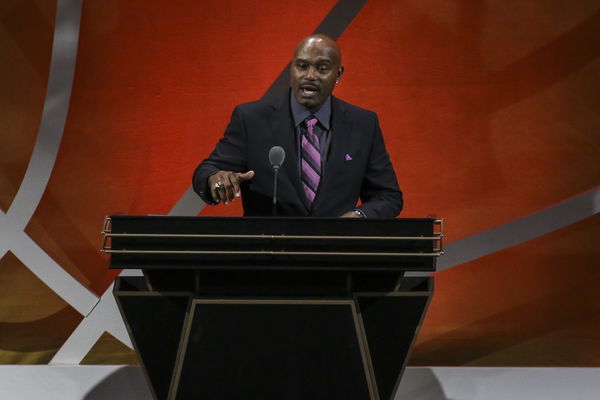
Sep 10, 2022; Springfield, MA, USA; 2022 Basketball Hall of Fame inductee Tim Hardaway gives his speech at Symphony Hall. Mandatory Credit: Wendell Cruz-USA TODAY Sports
Will Chris Paul go down as one of the greats?
“No question. He will. He is one of the greats. No question.
We already recognize you. If teams don’t want to recognize you, if teams don’t want to do this, you can’t force them to do that. I think that’s what he was saying.
That’s what he wanted, but I think LeBron [James] will be like, yeah, ‘I’m done.’ I don’t think he’s going to be like, ‘I want a farewell tour,’ or anything like that.”
You don’t think so? I think so. I’ve covered him for six or seven years. And I see the way he works, man. He’s very calculated. He wants that.
“So that means that he gonna play one more year?”
I guarantee that he’ll play at least one more year. I’d be shocked if he just said I’m done and walks away. Just no way.
“But I will say this. The way he’s playing and how he’s playing, he’s going to keep going another year—what he’s doing, how he’s doing it, man. I mean, to score 25 and to do this.
Another thing. Me personally, when a guy was 40 years old or 38 years old, 39 years old back in our day, he wouldn’t be able to compete like that on the court with us.
We will pick his a-s up full court, pushing him. We’d be shoving him. We’ll make his a-s play defense on the other end, but then again, the offenses and the defenses are different now. You can switch. You can switch all the time.
So we would have ran his a-s to death. We would have made him play defense. We made him do a lot of things.”
Do you think taking hand-checking away changed everything in the NBA?
“Oh yeah. You know that was because of Don Nelson? Don Nelson did that because of Dirk Nowitzki.”
Really?
“Dirk Nowitzki couldn’t play defense. He couldn’t play one-on-one defense. So if you look at it, when they won a championship, they disguised him all over the court.
When they won, he really wasn’t sticking nobody.”
You played against MJ in the ’97 playoffs, right? At what point is he clearly off his athletic prime?
“When he went to Washington.”
He still had it in Chicago, though?
“Oh, he definitely had it in Chicago. They won that last championship, and then they said, ‘Alright, everybody disperse.’ I think he stopped working on his game. I think he stopped working on this. I think he stopped working on that and wanted to see where he wanted to go, and this and that, and that’s when his body really didn’t react to him being in shape again or being him in that superb shape.
I think because when he went to Washington, I think a lot of things declined, but when he was with the Bulls, when he had that team with the Bulls that last year, he was still athletic.
He changed his game completely. He became a back-to-the-basket guy rather than jumping all over you and using his athleticism, which is remarkable. Kobe kind of did the same thing, right?
I mean, up until that last year, before he went to Washington, he was still athletic. He was still hooping hard.
After that last year they won, I think he stopped working out like he used to. He was always in shape, but I just think he was like, ‘Alright, this is my last couple of years. Alright, cool. Let me just have some fun.'”
What was it like facing Michael Jordan?
“It was great. I love facing him. I wish I was 6’6″ so I could guard his a-s. But I’m going to tell you this. Somebody that was nice, that was nice like him or could play, I think could really do something with him.
If Penny Hardaway didn’t get hurt, I think Penny Hardaway would have been right there, neck and neck with him. That’s all I say.
Oh, man, Penny Hardaway was… Oh, sh-t. Yeah, he was good. Before he got hurt? Oh, my God.
I’m going to tell you three people who were outstanding before they got hurt and just diminished their careers.
Tracy McGrady.”
How about Brandon Roy?
“Oh, him, too. I forgot about him before. Yeah, him, too. Oh, my God. I was going to say Grant Hill, Tracy McGrady and Penny.
But yeah, Brandon Roy, no question. You’re absolutely right. No question. Brandon Roy was a beast. Oh, my God. And didn’t say nothing. He just went out there and played. Didn’t say a word.”
He didn’t really have that kind of personality, right?
“You know what he said? He said, ‘I want to keep all that energy to myself, so I go out there and do what I need to do.'”
Did you ever want to play for the Bulls?
“I did. I thought they had a chance to get me, but good thing I didn’t go. I did what I was supposed to do with the Golden State Warriors.”
So before Miami, then?
“Yes. Way before Miami. Way before the Golden State Warriors. This is when I got drafted by them. They drafted Stacey King. They won three in a row.”
They needed role players, right?
“Right. They needed role players. Their point guard was Scottie Pippen. The point guard wasn’t BJ Armstrong, John Paxson or Craig Hodges. The point guard with Scottie Pippen.
He was amazing.”
Pippen doesn’t get enough credit.
“He should get all the credit, but he doesn’t. Don’t talk about him enough, and what he brought to the Bulls, and what he brought to the Portland Trail Blazers.”