
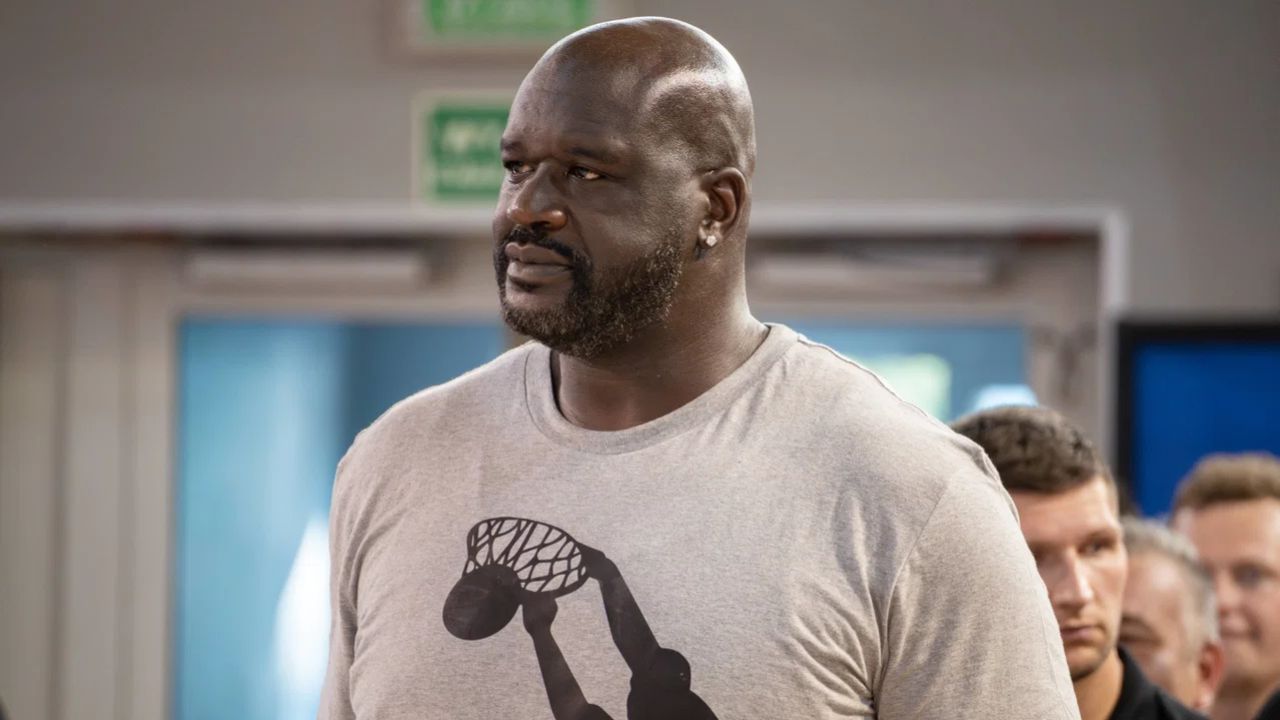
In 1985, Dale Brown walked into an army base in West Germany and mistook a 13-year-old for a soldier. This interaction sparked a father-son bond that lasted more than four decades. It made saying goodbye an emotional affair for Shaquille O’Neal, after the legendary LSU coach passed away at 90. Standing before mourners, Shaq turned his grief into an earnest plea.
Watch What’s Trending Now!
Speaking during Brown’s Celebration of Life at LSU’s Pete Maravich Assembly Center – nearly three weeks after the 448-game winner passed away on October 23 – O’Neal urged fans not to put off reaching out to the people they love. Battling through his emotions, Shaq recalled two prior incidents when he was too late.
“If you have a person you haven’t talked to, that you haven’t seen. Make sure you reach out. Because for me, this is the third time this has happened to me,” O’Neal said.
“My sister passed away, and I forgot to tell her I love her. Kobe Bryant passed away, I forgot to tell him I love him. And now my daddy Dale is gone, and I forgot to tell him I love him.”
Brown was more than just a simple coach to Shaq. He was the person who helped O’Neal discover his talent and helped foster it when Shaq didn’t believe in himself.
When Brown first met O’Neal at the military base in West Germany, the future NBA superstar was already 6-foot-9 at just 13 years old.
However, Shaq lacked confidence in his abilities and even considered following his stepfather into the Army. Brown saw something different in the towering teenager and immediately took an interest in his future. He stubbornly advised Shaq through it all.
The LSU coach began writing to O’Neal every week, sharing basketball advice and encouragement. This tradition continued even after Shaq returned to the United States. When Shaq was at his lowest, Brown continued to advise him and eventually offered him a scholarship to play basketball at LSU.
Recalling that life-changing first meeting, O’Neal once said, “He put his arms around me like he found gold.” It wasn’t a small gesture; that one moment changed the course of Shaq’s life.
At Brown’s Celebration of Life, O’Neal summed up the significance of Brown’s guidance.
“He was the first person in my life who believed in me.”
Playing under Brown at LSU helped shape O’Neal into one of the most dominant college basketball players and a top center. During those three college years, he showed continuous development.
He averaged 13.9ppg, 12rpg and 3.6 blocks per game as a freshman, 27.6ppg, 14.7rpg and 5 blocks per game as a sophomore, and 24.1ppg, 14rpg, and 5.2 blocks per game as a junior.
O’Neal entered the 1992 draft as the unanimous top player and was selected No. 1 overall. From there, Shaq’s star only continued to rise, winning four NBA championships and cementing himself as one of the greatest centers of all time.
His relationship with Brown didn’t end after he entered the NBA. In fact, Shaq continued to describe Brown as a father figure years into his NBA career. In a letter he wrote to Brown in 1999, Shaq made that abundantly clear.
“You are one of my heroes, one of my idol, one of my good friends,” O’Neal wrote, according to the LSU website.
And while Brown’s legacy at LSU is defined by much more than his relationship with Shaq, the numbers tell their own story. Across 25 seasons as head coach from 1972 to 1997, he recorded a school-best 448 victories, led the Tigers to two Final Four appearances and won four SEC regular-season championships. He also coached several notable players, including Mahmoud Abdul-Rauf and O’Neal.
For Shaq, however, one personal regret remained. Despite everything he achieved under Brown’s guidance and the decades of friendship that followed, he wished he had told his mentor how much he loved him before it was too late.
To O’Neal, the legendary coach would always be “Daddy Dale.” His final plea was not about basketball, championships, or fame. It was a reminder for people to share love with the ones who shaped their lives while they still can.