
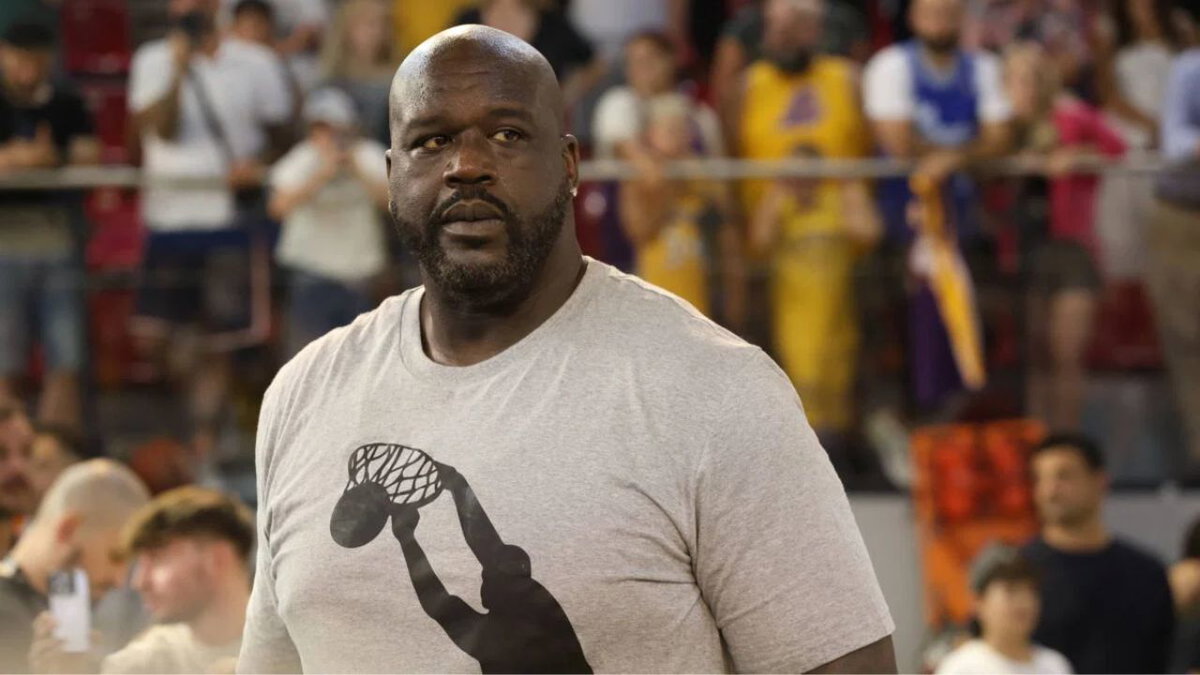
Shaquille O’Neal’s ties to law enforcement span decades, from reserve officer roles in California and Florida to serving as a sheriff’s deputy in Georgia. So when FBI Director Kash Patel presented him with an honorary FBI Special Agent designation at the National Academy’s graduation ceremony, the honor only added to a long-standing connection. But it soon drew a different kind of attention when NFL Hall of Famer Terrell Owens publicly addressed O’Neal over the badge.
Watch What’s Trending Now!
“We ALL make mistakes or just have poor judgment at times, ME included. BUT….” Owens wrote taking to his X account. “It’s not too late to give that badge back!!”
Owens’ post came after he discussed the controversy on the “Get To the Point Podcast,” where he questioned both the timing of O’Neal’s recognition and the way the NBA legend responded to an early critic. The criticism had started with content creator Matthew Chappelle, known online as “OG Matt,” who publicly threw away a Shaq jersey after objecting to the Hall of Famer accepting an honor from Patel. But the reason Chappelle focused on Patel, rather than Shaq’s long history with law enforcement, is what gives the story its political edge.
Chappelle posted a video on September 18 in which he pulled an old Orlando Magic No. 32 O’Neal jersey from his closet and tossed it into a garbage bin. His objection was directed at Shaq accepting the recognition from Patel, rather than simply at O’Neal’s support for police. The reaction reached Shaq, who responded to Chappelle privately: “I hear you broke boy. Have a great time in your apt with your family.”
That exchange added another layer to the controversy. What had initially been a disagreement over a ceremonial FBI honor was now also about how O’Neal had chosen to answer someone protesting it. And for Owens, that distinction mattered.
“He saw that Shaq took this honorary… badge or whatever from Kash Patel,” Owens said on the podcast, referring to Chappelle’s reaction. Owens argued that O’Neal’s response to Chappelle only intensified the situation, particularly because of the reference to his financial status.
The timing of the honor also became harder to separate from the controversy surrounding Patel himself.
Just two days before the September 17 ceremony, the FBI director faced a lengthy Senate Judiciary Committee hearing in which lawmakers questioned him over changes to FBI hiring standards, personnel decisions and the Bureau’s handling of politically sensitive investigations. Patel defended a hiring-policy change that removed some conduct from the list of automatic disqualifiers, including bestiality and pr–titution, saying the policy was intended in part to avoid automatically excluding people who had been victims of trafficking or se-ual abuse. The policy drew criticism from lawmakers across party lines.
That does not establish that Shaq agrees with Patel’s politics or with every decision made under his leadership. But it helps explain why the identity of the person presenting the badge became central to the backlash. To O’Neal, the designation could be viewed as recognition from a federal law-enforcement agency for work he has been associated with for decades. To critics, accepting that recognition directly from Patel at a politically contentious moment carried a different symbolism.
Owens went further in explaining why the source of the honor mattered to him personally. He argued that accepting recognition from Patel, given the current political climate and its impact on Black and brown communities, was something O’Neal should have thought through more carefully. “Shaq, you’re wrong in this one, big guy, big fella, you’re wrong,” Owens said. “You may be mad at me. You can be mad at me all you want.”
Owens was not questioning whether Shaq had a history of working with law enforcement. His criticism was about the decision to accept this particular honor from Patel at this particular time.
“There’s timing to everything. There’s a time and a place for everything,” Owens said, arguing that O’Neal could have received such recognition at another point.
What made Owens’ comments stand out is the way he framed them. It was not an attack, but a difficult conversation between two people who respect each other. “This is a very touchy subject for me because Shaq is my guy,” Owens said before he laid out his criticism, making it clear that he saw this as a moment worth addressing publicly despite the friendship.
The relationship between the two extends beyond their shared place in the sports world. Owens and O’Neal have appeared together at celebrity and charity events, including the Pump Foundation’s 25th-anniversary event in 2025 alongside Magic Johnson and Byron Scott. That makes Shaq’s own history with law enforcement particularly relevant to understanding the other side of the story.
His connection to police departments did not begin with Patel and is not limited to ceremonial appearances. While playing for the Los Angeles Lakers, O’Neal went through the Los Angeles County Sheriff’s Reserve Academy and became a reserve officer with the Los Angeles Port Police. After joining the Miami Heat, he trained before becoming a Miami Beach reserve officer in 2005. He later served as a reserve officer in Doral, Florida, and was sworn in as a sheriff’s deputy in Clayton County, Georgia, in 2016.
His involvement continued after his playing career. O’Neal appeared in a Los Angeles Port Police recruitment campaign in 2023 and has worked with Georgia’s Henry County Sheriff’s Office in community-relations roles. That history gives Shaq a longstanding reason to view recognition from law enforcement differently from someone encountering the FBI honor solely through the lens of current politics.
There is also a personal origin to that interest. O’Neal has previously credited his stepfather, Army drill sergeant Philip Harrison, with teaching him to respect police officers. That background, combined with the reserve and deputy roles he actually held, makes it difficult to characterize the FBI designation as a completely new association for Shaq.
The distinction is important because the honorary title itself does not make O’Neal a sworn FBI agent. The September 17 event was the graduation of Session 299 of the FBI National Academy, which included 265 law-enforcement officials from around the country. Shaq attended the ceremony and received the honorary designation; he did not complete the National Academy’s training as one of its law-enforcement graduates.
O’Neal has not directly responded to Owens’ comments as of this writing. He has continued to defend the honor itself, pointing to his long-standing law enforcement work as reason enough for the recognition.