
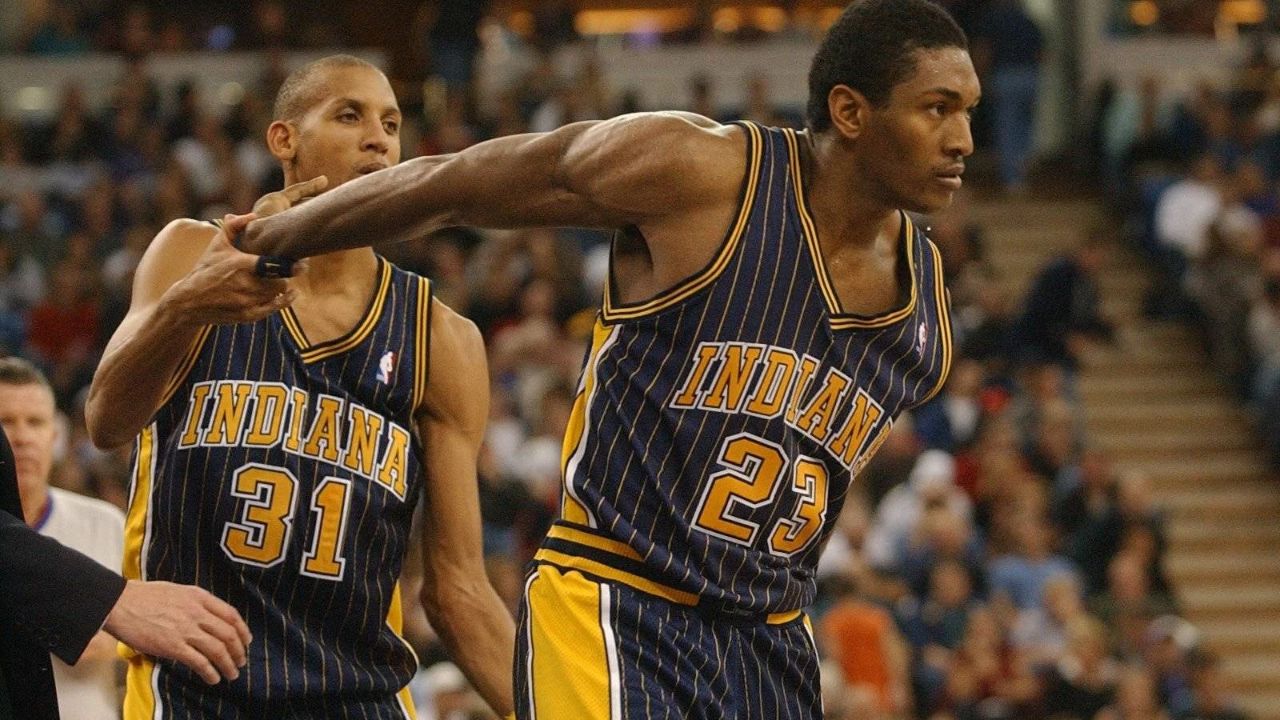
For some, the horrors of the Malice at the Palace were confined to what they watched on television. Once the cameras stopped rolling, the broadcast ended, and life moved on. But for the people directly affected, the aftermath was far from over. Ron Artest’s eldest son, Ron Artest III, recently opened up about that period, vividly recalling what happened to his family in the days after the infamous brawl, when he was just five years old.
Watch What’s Trending Now!
The former Indiana Pacers star lost endorsement opportunities, faced an 86-game suspension, and saw his reputation take a severe hit. And there’s more to it.
“The next day for him, the second he woke up, all his deals was gone, I think he was,” Artest III recalled the experience on Episode 9 of the Silver Spoons Podcast, hosted by Jae’Won and CJ Wallace.
Ron Artest III described how quickly his father’s career collapsed after the incident.
“He was like a Jordan athlete at the time, so he was trying to get his own shoe and stuff; he was close. next morning, all the deals gone; he had a big vitamin water deal that I think 50 Cent might have ended up getting. But it was an equity deal. They was gonna give him equity. He don’t know what equity is just because, like, they don’t teach us that.”
The Vitamin Water equity opportunity Artest later discussed publicly came years afterward, around 2007, rather than the morning after the 2004 brawl.
The 27-year-old also remembered his father struggling emotionally with the sudden collapse of his professional opportunities.
“But other than that, the next day, kind of everything’s off the table right now, kind of depressed. He wanted to retire. Like, he went to the gym, he was just like, Yeah, like I’m done. Like, I quit, whatever.”
The impact did not stop with his father’s career.
Ron Artest III said the family began receiving death threats, with callers targeting their home. Police officers remained outside the house throughout the day. And occasionally, he went to school in a police car.
“The next day, I remember. I remember this. It’s crazy to say you remember something as a four-year-old, but I remember the energy shift a little bit, going to school, just, like, interacting with even kids, because, like, if I don’t know if you ever played the game telephone, you say something, it gets to the next person, and it’s, like, something else. So then it gets to all the kids; now the kids are looking at me crazy, talking, and they don’t know what’s going on. But yeah, so we were getting a lot of death threats at the time. So people were calling the crib, threatening us. So yeah, we had cops, like, just all day outside the house, taking to school a couple times in a cop car. And then, like, both my parents.”
For a child who was barely old enough to understand the controversy, the change in how people treated him was difficult to process. He recalled classmates looking at him differently and spreading distorted versions of the incident. Some children even tried to bully him.
His mother, however, had a different response. Ron Artest III recalled that both his parents came from New York neighborhoods.
“My dad’s from Queensbridge, my mom’s from around down the street. My mom was like, Hey, like, if kids are messing with you, you got the green light to do what you got to do. So kids that were, like, trying to, like, bully me, I’m like, why are y’all even, like, trying this with me right now? Like, you’re half my size.”
The incident that triggered the family’s ordeal took place on November 19, 2004, during a game between the Pacers and Detroit Pistons at The Palace of Auburn Hills. A confrontation between Artest and Pistons forward Ben Wallace escalated into the stands. A fan threw a drink at Artest, prompting him to enter the stands.
Players and spectators then became involved in a chaotic brawl that spilled across the court.
The NBA suspended Ron Artest (Metta Sandiford-Artest) for the remainder of the 2004–05 season. A punishment that covered 73 regular-season games and 13 playoff games. He returned in October 2005 before eventually moving from Indiana to Sacramento. The consequences, however, extended well beyond the suspension and lost salary.
His son’s recollection offers a glimpse into the fear and instability that followed the family away from the arena.
For a five-year-old, the aftermath meant police escorts, threatening phone calls, and a childhood suddenly shaped by an incident he could barely understand.