
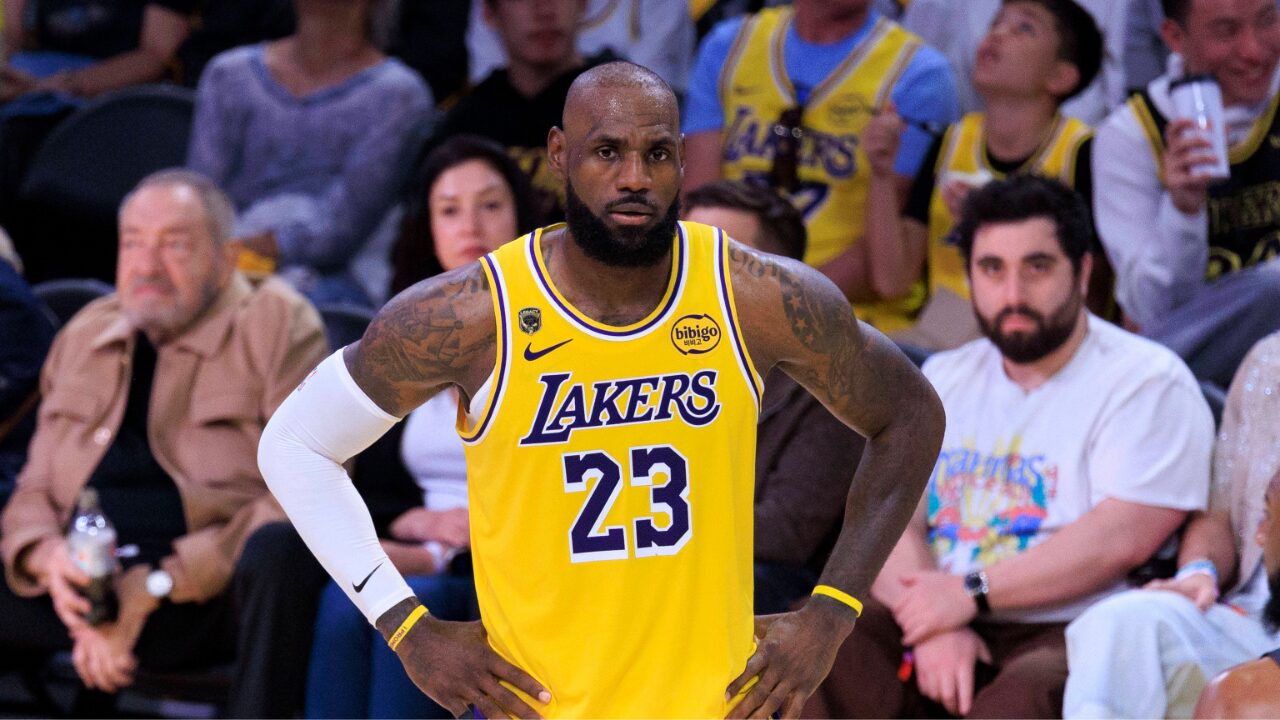
LeBron James has always been confident and outspoken. Two decades and four rings later, he still gets criticized for his style of play. And on the Byron Scott Fast Break podcast, two men who watched both eras up close gave their take.
Watch What’s Trending Now!
Host Byron Scott and Olden Polynice talked about basketball misconceptions, starting with Kobe Bryant. Both agreed that the idea that Kobe was selfish or difficult was overstated, before turning the same question toward LeBron James. Scott didn’t hesitate.
“I think the biggest misconception is that people think he’s not selfish,” Scott said. “Everybody thinks that, because he passes, because he does it, that he’s not selfish. No, he’s selfish. He wants to win. He’s got some selfishness in him.”
“He wants to win,” he added. “Now, will he make the right plays? Absolutely. I mean, he’s the most criticized player we’ve ever seen, right? But he’s been criticized for games where they double-team him, he throws it to somebody, they miss a wide-open shot for the game winner, and then it’s like, ‘Why didn’t you shoot it?’ So he’s been criticized for stuff like that. So I think—people think because he makes those right plays that he’s not selfish. No, he’s selfish, he wants to win.”
Scott isn’t speaking as an outsider – he won three NBA championships as a player during the Lakers’ Showtime era (1985, 1987, 1988) and later returned to coach the team through the final two seasons of Kobe Bryant’s career.
The public narrative has long pitted LeBron and Kobe against each other. Kobe the ruthless killer, who would rather shoot 9-of-30 than pass to an open teammate, a reputation borne out by his career-high 38.7 usage rate in 2005–06, still one of the highest single-season marks in NBA history, and LeBron James, the willing facilitator who trusts his teammates almost to a fault.
The willingness to make the right basketball play, the extra pass, the read of the double team, is not the absence of a competitive hunger to win. It is, in Scott’s framing, exactly what that hunger looks like when it’s disciplined by two decades of championship-level decision-making.
LeBron passing out of a double team for a game-winning attempt is not generosity for its own sake. It’s a selfish man’s most efficient path to the outcome he actually wants.
Why Scott’s Take Reflects a Broader Shift in How LeBron Is Understood
What Scott and Polynice described on the podcast reflects what’s happening across NBA media as LeBron’s career enters its final stretch – he’s 41, soon to play in his 24th NBA season, and left the Lakers in the 2026 offseason as an unrestricted free agent in hopes of a 5th ring.
For years, the “selfless” label functioned as faint praise. A way of acknowledging LeBron’s basketball IQ while suggesting he lacked the killer instinct that made Jordan and Kobe legendary.
Scott’s take suggested that the opposite is true. That the selflessness itself is a form of ruthlessness, made for winning rather than personal statistics or highlight-reel moments.
A player who has assists on wide-open threes that his teammates miss is not sacrificing his own greatness. He is maximizing the odds of the outcome he wants most, even when the box score doesn’t reward him for it the way a difficult contested jumper would.
The criticism LeBron has absorbed throughout his career, the “farm the assist” jokes, the questions about clutch shot volume compared to Jordan and Kobe, have always missed this distinction.
Scott, who coached against and around both eras of superstar as an NBA head coach, facing LeBron’s teams across four different head-coaching jobs between 2000 and 2016, offered the insider’s version of the argument.
That the selflessness was never a sacrifice. It was a strategy.
And Polynice’s answer about the self-proclaimed king comment, he’s used similar language before, once calling James the “king of narcissism” over how he framed his own exit from the Lakers, suggested that the loudest criticism against LeBron has always come from LeBron himself.