
USA Today via Reuters
NBA, Basketball Herren, USA Playoffs-Toronto Raptors at Cleveland Cavaliers, May 1, 2017 Cleveland, OH, USA Cleveland Cavaliers center Tristan Thompson 13 and forward LeBron James 23 celebrate a play in game one against the Toronto Raptors of the second round of the 2017 NBA Playoffs at Quicken Loans Arena. Mandatory Credit: Ken Blaze-USA TODAY Sports, 01.05.2017 19:05:44, 10038683, NPStrans, Quicken Loans Arena, LeBron James, Toronto Raptors, Tristan Thompson, NBA, Cleveland Cavaliers PUBLICATIONxINxGERxSUIxAUTxONLY Copyright: xKenxBlazex 10038683
USA Today via Reuters
NBA, Basketball Herren, USA Playoffs-Toronto Raptors at Cleveland Cavaliers, May 1, 2017 Cleveland, OH, USA Cleveland Cavaliers center Tristan Thompson 13 and forward LeBron James 23 celebrate a play in game one against the Toronto Raptors of the second round of the 2017 NBA Playoffs at Quicken Loans Arena. Mandatory Credit: Ken Blaze-USA TODAY Sports, 01.05.2017 19:05:44, 10038683, NPStrans, Quicken Loans Arena, LeBron James, Toronto Raptors, Tristan Thompson, NBA, Cleveland Cavaliers PUBLICATIONxINxGERxSUIxAUTxONLY Copyright: xKenxBlazex 10038683
In a sporting world that has largely stayed quiet on one of its most divisive issues, Tristan Thompson stepped forward with a blunt and personal perspective. The 2016 NBA champion addressed the IOC’s latest decision on transgender participation, framing it not just as a policy debate, but as something that directly connects to his role as a father.
Tristan, on The Katie Miller Podcast, which aired on Tuesday, had this to say when asked about the Olympics’ move to ban transgender athletes from women’s events: “Banning transgender athletes. Yeah. I think for me as a father … and I have daughters and nieces, I think a man’s genetic makeup is totally different.” Those who have come to speak against the inclusion of transgender individuals argue that biological males have physical advantages due to greater muscle mass, higher bone density, and higher oxygen capacity, even after hormone therapy.
Tristan Thompson on whether he agrees about the Olympics (committee) decision, banning transgender in the upcoming 2028 Olympics: “Banning transgender athletes. Yeah. I think for me as a father, and I think it’s more so.
You know, for me as a father, and I have daughters and… pic.twitter.com/S0TkCDHJuW— MrBuckBuck (@MrBuckBuckNBA) April 4, 2026
Regardless of how they identify, Tristan insisted that: “For me, as a competitor, it wouldn’t be fair for me to go play in the WNBA. That wouldn’t be … and it wouldn’t be fair for me to jump in their sport.” He added, “So, I think, you know, obviously very controversial, but, you know, for me as a parent, I would love for my daughter, if she wanted to be an Olympic athlete, to compete with others that are born very similar to where she was. But I understand both sides.”
Introduced in March 2026, the IOC’s new eligibility policy will take effect at the 2028 Los Angeles Olympics and fundamentally reshapes participation rules. The framework restricts the female category to “biological females” and removes the previous sport-by-sport approach, replacing it with a unified standard across all Olympic events.
IOC President Kirsty Coventry justified the move by pointing to performance margins at the highest level of sport. She emphasized that allowing biological males in the female category would compromise fairness, a position reinforced by the introduction of mandatory one-time genetic testing for eligibility verification.
The policy is expected to impact athletes with differences in sex development, including cases like Caster Semenya. Supporters argue it safeguards competitive integrity in women’s sports, while critics push back, calling it discriminatory and questioning whether the science fully supports such restrictions. Notably, the rule applies strictly to Olympic-level competition and does not extend to grassroots or recreational sports.
Previously, individual sports federations set their own eligibility rules. Now, the IOC has centralized that authority under one unified framework, aligning with a broader global shift. In fact, similar regulatory momentum has been building elsewhere, including a February 2025 executive order signed by Donald Trump that tied federal funding to restrictions on transgender participation in women’s sports.
Why Thompson’s WNBA Analogy May Be the Most Honest Argument in the Debate
If you strip away the political noise surrounding the transgender sports debate, Thompson’s argument stands out for its simplicity. Unlike many voices in this space, he didn’t lean on legal frameworks or political positioning — instead, he grounded his perspective in lived experience and competitive reality.
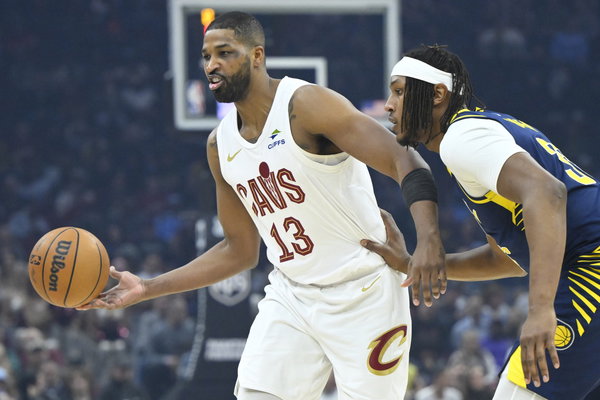
Instead, Tristan Thompson invoked himself, a 6-foot-9, 254-pound center, as a physical case study for what competitive category displacement looks like.
Imago
Apr 13, 2025; Cleveland, Ohio, USA; Cleveland Cavaliers center Tristan Thompson (13) passes the ball beside Indiana Pacers center Myles Turner (33) in the first quarter at Rocket Arena. Mandatory Credit: David Richard-Imagn Images
The IOC’s decision also reflects a wider shift across elite sports governance. World Athletics had already introduced mandatory genetic testing for female-category eligibility in September 2025, while multiple U.S. states have enacted laws restricting transgender participation in school sports. Although the Olympic policy includes rare exceptions for specific conditions such as Complete Androgen Insensitivity Syndrome, its primary focus remains clear — protecting competitive integrity in women’s sports.
Thompson is not speaking into a hypothetical future. Rather, he spoke about an environment that has already moved substantially in the direction of the biological-category distinction he described.
Written by

Edited by

Ved Vaze