

At North Carolina, players dreamed of Senior Night almost as much as they did of championships. It was the moment every Tar Heel waited for – walking to center court with family beside them, soaking in one final ovation inside Chapel Hill after years in Dean Smith’s program. And according to Kenny Smith, that moment mattered deeply to Michael Jordan, too. Smith recalled being blindsided when he first learned that Michael Jordan was considering leaving North Carolina early for the NBA.
Watch What’s Trending Now!
“Michael did not want to leave early. I was a freshman — the morning of — I get a call from the basketball office, after the season. They’re like, ‘Hey, are you coming to the Press Conference?’ I’m like, ‘What Press Conference?’ Kenny remarked. “They’re like, ‘Michael may announce that he’s going pro.’ And I was shocked. And I was like — I didn’t even go.”
Part of Smith’s disbelief stemmed from Jordan’s attachment to a longstanding North Carolina tradition reserved for graduating seniors.
“Cause I didn’t even think he was leaving. Cause he had this whole thing about he wanted to have this senior speech. Cause we had this thing at North Carolina that every senior gets to talk for like 30 minutes in front of all the alumni — it was a big deal. So I was like, ‘Mike’s coming back — I didn’t even go, and I’m looking on TV that ‘Michael Jordan is going pro’. He never said nothing to us, he said ‘I decided on the walkover’,” Kenny added, “On the walkover he was like, ‘I’m gonna do it.’ Cause Coach Smith forced him out.”
Instead, Jordan quietly walked away from college basketball forever. And according to Kenny Smith, the decision was ultimately made for him. “He said, ‘Coach Smith made the call,’” Smith explained. “Like, ‘No, you gotta go. You’re too good.’”
Four decades later, Smith’s recollection has reopened one of the most fascinating turning points in basketball history: the moment Dean Smith realized Michael Jordan had outgrown college basketball before Michael Jordan himself fully accepted it.
In modern basketball language, saying a coach “forced” a player into the NBA sounds almost hostile. Inside Dean Smith’s North Carolina program, it meant something very different.

Classic photo of Dean Smith coaching Michael Jordan.

It meant protection. By the spring of 1984, Jordan had nothing left to prove at the collegiate level. He had already transformed from a skinny freshman known simply as “Mike” into the consensus National Player of the Year. He won both the Naismith and Wooden awards as a junior and had become the most electrifying athlete in college basketball.
But behind the scenes, Dean Smith saw something else: risk.
North Carolina’s roster had been battered physically during the 1983-84 season. Kenny Smith broke his wrist. Brad Daugherty battled hand injuries. Jordan himself carried an exhausting workload deep into the NCAA Tournament. During one tournament game against Temple, Jordan reportedly became so physically drained attacking Temple’s relentless defense that he asked Dean Smith for a breather — something almost unheard of for him.
Dean Smith understood the reality immediately. Jordan’s draft stock could not rise any higher. Returning for another unpaid college season only exposed him to injury and financial catastrophe. So the Hall of Fame coach handled the process himself.
According to archival interviews and Jordan’s later reflections, Dean Smith personally contacted NBA front offices to verify where Jordan would land in the draft. Once he confirmed Jordan was locked into the top three, the conversation changed from possibility to obligation.
“It was Coach Smith’s call,” Jordan later admitted in a 2005 interview. “I relied so much on his knowledge. My parents weren’t knowledgeable about the NBA. Once Coach Smith researched where I would go in the draft, then I started weighing the pros and cons.”
Jordan’s natural instinct had reportedly been to stay in Chapel Hill another season alongside teammates like Sam Perkins and Kenny Smith. Even his mother, Deloris Jordan, reportedly preferred him to remain in school.
Dean Smith saw the bigger picture before anyone else did. The coach who built his reputation on discipline, patience, and four-year development was also progressive enough to understand when a player had outgrown college basketball entirely.
So he made the decision Jordan could not make for himself.
Kenny Smith Saw Jordan Become “Michael Jordan”
Long before six championships, global superstardom, or Nike empire mythology, Kenny Smith saw Jordan in the rawest possible environment imaginable: pickup basketball at Chapel Hill.
And according to Smith, the signs were already terrifying.
One of the clearest memories he shared involved the legendary summer pickup runs at North Carolina, where college players routinely challenged NBA veterans. Jordan had already completed his rookie season with the Chicago Bulls and returned to campus looking different.
Smith remembered Jordan standing at half court after wins instead of grabbing water like everyone else. “I said, ‘What are you doing?’” Smith recalled.
Jordan’s answer stayed with him forever. “I want them MFs to know that I’m never leaving this court.”
That mentality shocked even teammates who had already watched him dominate for years. Smith admitted nobody inside the UNC locker room fully understood what Jordan would eventually become. “No,” Smith said flatly when asked if he foresaw Jordan becoming the greatest player ever. “He’s the only player who came into the league where his weaknesses became his strengths.”
At North Carolina, Jordan’s handle was considered loose by elite guard standards. Smith and other teammates openly teased him for it. “Your handle is whack,” Smith remembered telling him. “I could guard you because your handle was whack.”
Jordan never forgot it. After the 1984 Olympics and his rookie NBA season, he returned to Chapel Hill with an entirely rebuilt dribble package specifically to show teammates how much he had improved.
Smith later realized that Jordan processed criticism differently from everyone else. Most stars protected their weaknesses. Jordan hunted them. That obsession eventually became the defining trait of his career.
The UNC Environment That Created Jordan
Part of what makes Kenny Smith’s stories so revealing is the glimpse they provide into the culture surrounding North Carolina basketball in the early 1980s.
By then, Dean Smith’s program demanded discipline and hierarchy from everyone who entered it. Freshmen carried equipment bags, media access was carefully managed, and players were expected to put the team above themselves. Yet even within that environment, Jordan’s presence carried unusual weight.
Kenny Smith recalled one incident that illustrated just how much influence Jordan had inside the North Carolina program. During a team trip to a local barbershop, Duke players attempted to walk in while the Tar Heels were getting haircuts. Jordan quickly made his position known.
“Duke guys are coming in to get their haircut. Michael’s like ‘If you let them in, we’ll never come back.'” Kenny added, “He’s like, ‘Man, they got…’ He’s like, ‘Mike, if you let them in, we’ll never come back.’ So they didn’t let the Duke guys in.”
“I’m a freshman, I’ll get my haircut, and I was looking at like Johnny Dawkins and looking through the mirror… knocking on the window. He’s like, ‘Come back later. Come back later.’ We… That’s the type of juice we had. We had the juice.”
Jordan’s celebrity exploded after his game-winning jumper against Georgetown in the 1982 national championship game. According to people around the program, that was the moment he stopped being “Mike” and became “Michael.”
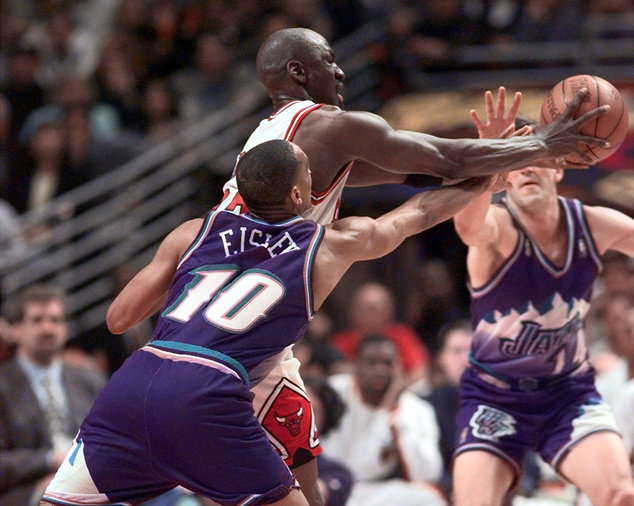
USA Today via Reuters
Jun 1, 1997; Chicago, IL, USA; Chicago Bulls guard Michael Jordan drives to the basket between Utah Jazz players Howard Eisley (left) and Jeff Hornacek during the first half in game one of the 1997 NBA Finals at the United Center. Mandatory Credit: Robert Hanashiro-USA TODAY
But Dean Smith never allowed the mythology to completely consume the locker room. In fact, one of the funniest details Kenny Smith revealed years later was his belief that Jordan’s legendary motivational quotes were basically stolen from Dean Smith himself.
“It’s plagiarism,” Smith joked. “Everything Coach Smith said to us, Mike said later in interviews. He just added expletives.” The line was funny because it was true. Jordan’s relentless professionalism, obsession with accountability, and psychological warfare all carried traces of Dean Smith’s influence.
Even after becoming the most famous athlete on Earth, Jordan kept echoing the man who pushed him out of Chapel Hill before he was emotionally ready to leave it.
Jordan entered the 1984 NBA Draft and became the third overall pick behind Hakeem Olajuwon and Sam Bowie. History remembers the draft now as the moment Portland passed on the greatest player ever.
But inside Chapel Hill, the story felt smaller. More personal. Michael Jordan left before the ending everyone expected. He never got the final season. Never stood at center court on Senior Night. Never gave the speech Kenny Smith thought he had been waiting years to deliver.
Dean Smith made sure Jordan secured his future before sentiment could interfere with it. And forty-two years later, Kenny Smith still remembers the moment North Carolina lost “Mike” and basketball got Michael Jordan.