
Imago
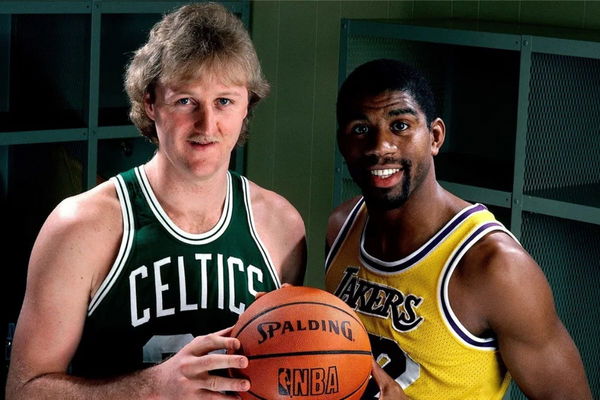
Larry Bird (re.) und Earvin Magic Johnson (beide USA) im Vorfeld des 30j
Imago
Larry Bird (re.) und Earvin Magic Johnson (beide USA) im Vorfeld des 30j
Some rivalries define eras, and then some rivalries refuse to age. Nearly five decades after they first crossed paths, Magic Johnson and Larry Bird are still commanding packed rooms not because of nostalgia alone, but because their story still resonates in places far removed from a basketball court.
Watch What’s Trending Now!
On Tuesday, that story resurfaced in an unlikely setting. Johnson and Bird shared the stage at a company-wide kickoff event hosted by Axon Enterprise in Phoenix, Arizona, speaking to an audience of roughly 4,000 people. The event, led by Axon CEO Rick Smith and president Josh Isner, turned into something closer to a basketball history seminar, one fueled by rivalry, respect, and shared legacy.
Johnson later acknowledged the moment on social media, noting how the crowd “ate up” stories from their competitive past. For a company valued at roughly $46.65 billion, the appearance wasn’t about spectacle. It was about symbolism, two rivals who reshaped professional basketball now being used as real-world case studies in leadership and sustained excellence.
Top Stories





Larry Bird and I spoke to an amazing audience of 4,000 at the Axon Company Kickoff today in Phoenix, Arizona. We had the crowd going crazy and they ate up all the stories about our rivalry! Thank you to Axon Enterprise CEO Rick Smith and Axon President Josh Isner for having us… pic.twitter.com/wtSIAcLLU9
— Earvin Magic Johnson (@MagicJohnson) January 7, 2026
That appetite hasn’t faded by accident. Their competitive arc began in 1979, when Johnson’s Michigan State Spartans defeated Bird’s Indiana State Sycamores in the NCAA championship game. That night remains one of the most-watched basketball broadcasts in American television history, often cited for its unprecedented Nielsen rating and cultural impact.
What followed only amplified the intrigue. Both entered the NBA that same year, drafted by franchises that already despised each other, the Los Angeles Lakers and Boston Celtics. Over the next decade, their individual excellence and team success became inseparable from the league’s growth. They met three times in the NBA Finals, with Bird winning the first battle in 1984 before Johnson responded with championships in 1985 and 1987.
Those matchups didn’t just decide titles. They helped pull the NBA out of a ratings slump and into mainstream relevance. That context still matters today. When Bird and Johnson speak, audiences lean in—because their rivalry wasn’t manufactured. It built the modern NBA.
Rivals on the court, allies everywhere else
What often gets overlooked is how quickly competition turned into mutual respect. Despite their fierce on-court battles, Bird and Johnson never carried animosity beyond the hardwood. One oft-repeated anecdote shared in various retrospectives captures that dynamic perfectly: during a visit to Bird’s family home, Bird’s mother reportedly told Johnson he was her favorite player.
Whether framed as lore or lived experience, the underlying truth remains consistent. Their rivalry never crossed into personal bitterness, which is precisely why it endured.
That same dynamic reappeared years later when USA Basketball assembled the 1992 Olympic “Dream Team.” Johnson, already retired due to his HIV diagnosis, was invited back. Bird, battling chronic back issues at age 35, was uncertain. In multiple interviews over the years, Johnson has recalled personally calling Bird, pitching the opportunity not as another grind but as a shared moment.
The pitch worked. Bird joined. The rest became Olympic history.
Imago
Larry Bird of the Boston Celtics and Magic Johnson of the Los Angeles Lakers | Courtesy: Imago
Axon is not the first organization to bring the two together off the court. In November, they were featured speakers at a private session hosted by Nuveen CEO Bill Huffman, addressing hundreds of top global clients on themes of teamwork and competitive mindset.
The pattern is clear. Bird and Johnson aren’t booked to reminisce; they’re invited to translate elite competition into leadership lessons. Few figures can credibly speak about rivalry, collaboration, sacrifice, and sustained excellence without sounding rehearsed. They lived it.
And that may be the most compelling reason their rivalry keeps getting “reignited.” Not because it needs reviving, but because it never really ended.
Decades after transforming basketball’s biggest stages, Bird and Johnson are still drawing audiences by simply telling the truth about how greatness is built together and against one another. For fans, it’s a reminder of how the NBA became what it is today. For corporations like Axon, it’s a masterclass in competitive leadership delivered by the rarest of pairings.
As long as those lessons remain relevant, don’t expect this rivalry to fade quietly. It’s still too valuable on every stage it touches.
Written by

Edited by

Ved Vaze