
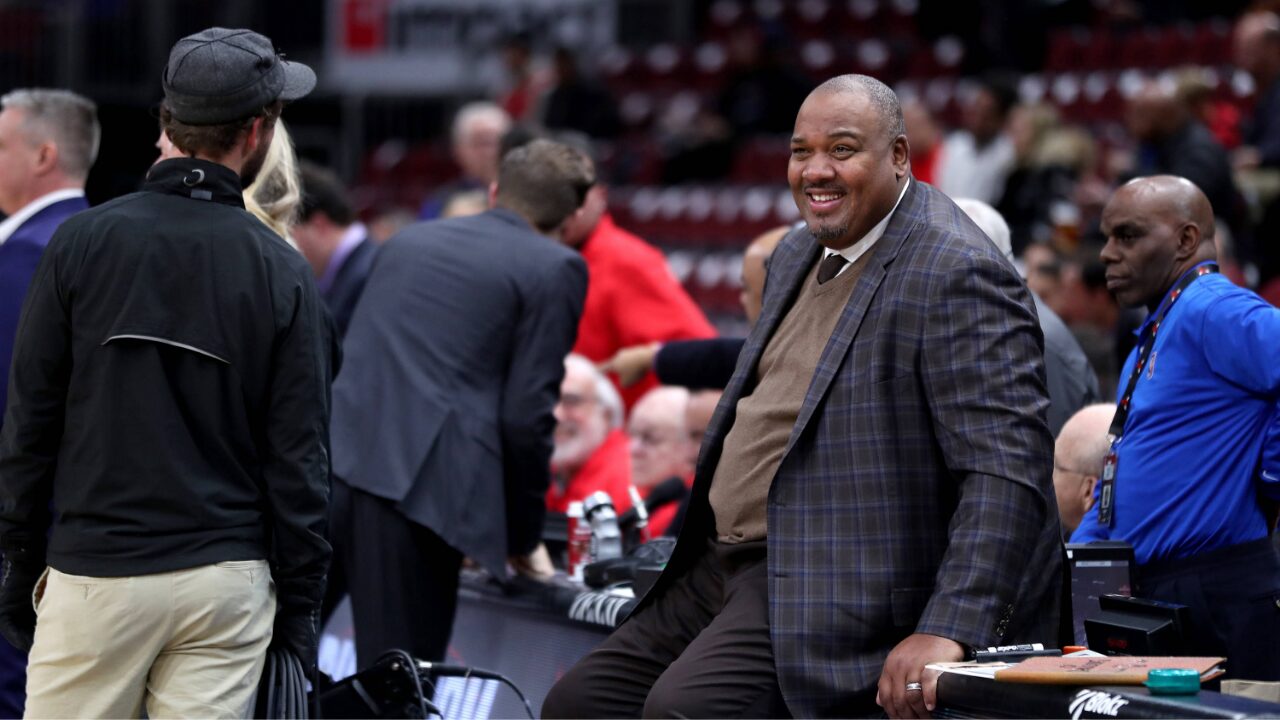
Back in June, a sudden death left a huge void in Chicago, one that sparked a lot of unanswered questions. Stacey King, a 3x champion with the Bulls, suffered a fall at home and lost his life at 59. After an autopsy and a medical examiner’s office warning that results could take weeks, the answer has finally arrived.
Watch What’s Trending Now!
The Cook County Medical Examiner’s Office, on Monday, determined that Stacey King died of hypertensive cardiovascular disease, according to the New York Post. A spokesperson confirmed long-term high blood pressure caused it, with obesity listed as a contributing factor. The manner of death was ruled natural.
King was found dead at his River Forest, Illinois, home on the morning of June 7 after what was reported as a fall. The medical examiner’s office ordered additional testing at the time, while tributes poured in from across the basketball world.
The news hit the Bulls organization and the wider NBA hard. Bulls chairman Jerry Reinsdorf called King “a cherished member of the Bulls family and one of the truly unique personalities in our organization’s history.”
Michael Jordan, King’s teammate on all three championship runs, said the two “shared some special years together” during an era that helped define the Chicago franchise.
President and CEO Michael Reinsdorf added that “Stacey loved being a Bull” and he “had a unique gift for bringing people together and making every game feel personal.”
The NBA also issued its own statement honoring King’s two decades as “the unmistakable voice” of Bulls broadcasts, and Chicago Sports Network president Michael McCarthy remembered him as someone with “a unique ability to connect generations of Bulls fans.”
King’s legacy didn’t end with his stint as a player with the Bulls. After coaching for a few years, he began a new journey as a broadcaster to be closer to home and spend more time with his family. That decision gave him a brand-new identity, forever engraving him in Bulls history as a ‘cult figure’ broadcaster.
More than a decade ago, his commentary partner, Neil Funk, admitted, “the one thing Stacey has is the ability of not only being entertaining but informative, and he’s able to articulate that, which is a rare combination.”
Here’s some of his best work.
“Stop it! Stop it! What are you doing, Dragić! Did you not get the memo? Oh my goodness! Dragić. Do you know who this kid is? He is from Chicago!” King said when D-Rose dunked on Goran Dragic in January 2010.
King really admired Rose, and over the years, King’s most widely quoted line about the 2011 MVP was “too big, too fast, too strong, too good.”
Another iconic piece of work came last season when Josh Giddey’s clutch half-court shot won the Bulls a game they were destined to lose against the Lakers.
“Oh. My. God. I cannot believe this!” King shouted. “Elizabeth, I’m coming, baby! Oh lord!”
The “Elizabeth” comment was a reference to a line that Redd Foxx’s character would always say in the ’70s sitcom Sanford and Son.
King’s arguably biggest catchphrase was his trademark sendoff after a Bulls game. “Drive home safely, Chicago. Beep. Beep,” he said.
The Chicago Tribune credits him with “breathing life into ragged seasons” because, aside from the brief success they enjoyed with Rose, the Bulls made the playoffs only twice in King’s final decade with the team.
King never ever felt his job was actual work. “Every night, I go to work: win, lose, or draw, I’m having fun,” he said a month before his tragic death.
During his playing career, King’s most notable contribution came in the Bulls’ 15-point final-quarter comeback in Game 6 of the 1992 Finals.
“Stacey continuously reminded me to look at the good in life,” former teammate Bill Cartwright wrote in his tribute. “His presence brought pure happiness and joy to all.”
Scottie Pippen also said he was “sad to hear” about King’s tragic death, admitting that his impact on the city and team will “be remembered for generations.”
King was drafted sixth overall by the Bulls in 1989 out of Oklahoma, where he was a consensus first-team All-American. He then spent five seasons in Chicago, winning three consecutive titles alongside Jordan and Pippen from 1991 to 1993.
His playing career continued with stops in Minnesota, Dallas, Boston, and Miami, closing out an eight-year run in which he averaged 6.4 points and 3.3 rebounds across 438 games.
That combination, a title-winning player turned beloved broadcaster, is why the news of his sudden death felt hard to comprehend in June, and why the confirmation of a natural cause months later now offers the city something it didn’t have: an actual answer.