

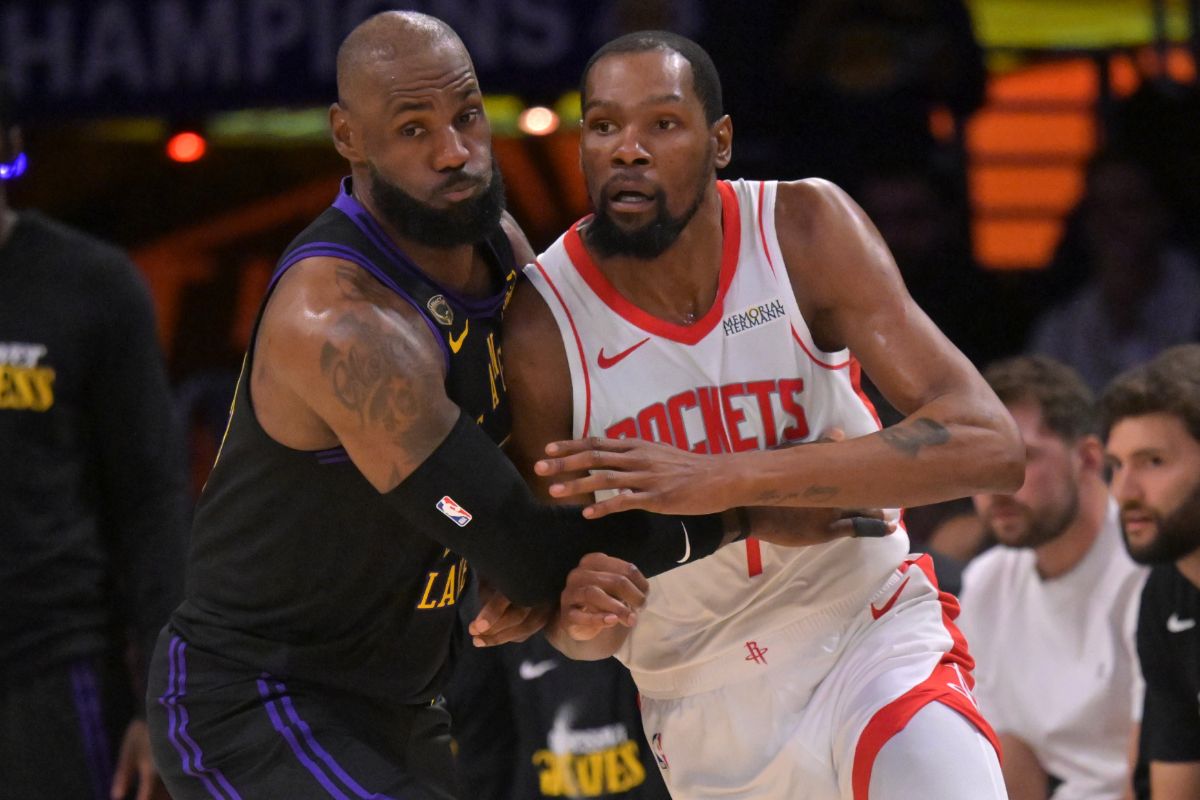
LeBron James conveniently took the role of the third option for the Los Angeles Lakers. He vacated the first two spots for Luka Doncic and Austin Reaves. Now, when both players sat on the bench with injuries, the Houston Rockets must have thought that they solved half their problems. But James stood his ground like he was back in 2018. And that wasn’t in the Rockets’ bingo cards for the playoffs!
Watch What’s Trending Now!
Carmelo Anthony explained the math on the 7 pm in Brooklyn podcast. “This is why people should pay attention. Look at LeBron for a whole season. It’s the same buildup. He knows this sh**. He knows what’s his mark for October, what’s his mark for November, December, January, February. By the time March comes, he is in peak,” James’ former teammate said.
Now, when LeBron James didn’t play to his full potential or sat out for injury management, fans turned noisy, questioning every dip. First, the noise rises in November. Then December piles on with doubts, load-management chatter, and trade whispers. Meanwhile, criticism grows louder, harsher, almost personal. However, beneath that chaos, the narrative ignores his long-game rhythm. So the outrage becomes predictable, almost ritual, as people rush to write him off far too early.
Maybe the Houston Rockets made the same mistake. “He’s just following his strategy, following his plan, sticking to his script. And now look at him. So now you’ve got your two guys out, two of your top hitters,” Melo added. “Now I gotta go back and put the cape on because I ain’t got no choice. This game plan may not be the same game plan as with Luka and AR out there, but this game plan is for LeBron and the team that he got out there. And Houston ain’t know this game plan. They knew the Luka and AR game plan. They ain’t know this game plan.”
Imago
Credits: IMAGN
Why does Carmelo Anthony think that the Rockets misread LeBron? That’s simply because he opened the 2025-26 campaign quietly. October passed with 0 games, a blank slate. Then November teased the rhythm in just 4 appearances: 16.5 points, 4.5 rebounds, 8.3 assists. The scoring log—11, 17, 25, 13—felt restrained. Meanwhile, 1.5 threes per game hinted the perimeter engine was still idling, as he leaned into facilitation over firepower.
By December, the gears clicked louder. Across 11 games, he posted 21.8 points, 4.6 rebounds, 6.2 assists, shooting 50.8% from the field. Yet the month danced between extremes: 36 on Dec. 20, but also 10 on Dec. 1 and 8 on Dec. 4. January turned authoritative. His averages jumped to 23.5 points, 6.7 rebounds, and 6.7 assists over 15 games, but the real story was his consistent dominance. He began posting all-around stat lines like 31/9/6 and 26/7/10, signaling he was no longer just facilitating but taking full control.
Then February shifted the tone again. Over 11 games, he averaged 20.9 points, 5.8 rebounds, and 8.5 assists, even with a DNP on Feb. 10 against the Spurs. Moreover, repeated 10-assist nights versus the 76ers, Warriors, and Thunder underlined intent. So the arc feels deliberate: 0 to 4 to 11 to 15 to 11 games, evolving from quiet entry to full orchestration.
LeBron James let Luka Doncic and Austin Reaves take over while he took the role of a playmaker, or as many now call him, an orchestrator. And this is where Ime Udoka & Co. fumbled. Because James came out of the syllabus, elevating the Los Angeles Lakers in the absence of both Doncic and Reaves.
LeBron James’ role in the first two games vs. the Houston Rockets
The Los Angeles Lakers changed the narrative early against the Houston Rockets, grabbing Game 1, 107-98, and Game 2, 101-94, for a 2-0 edge. Meanwhile, Luka Doncic and Austin Reaves stayed out, forcing a rethink. LeBron James entered the scene, toggling between control and calm. He posted 19 points and 13 assists in Game 1, then 28, 8 rebounds, and 7 assists in Game 2, steering nearly every possession with purpose.
However, the numbers reveal more than scoring bursts. LeBron became the engine, dictating tempo and cracking Houston’s defense open. Consequently, the offense flowed through reads, kicks, and timing rather than isolation-heavy sets. He kept the structure intact, ensuring the Lakers never stalled, while still leading or hovering near the top in scoring both nights.
Moreover, the plan leaned towards collective. Marcus Smart added defensive bite and playmaking, Luke Kennard poured in 27 and 23, and Rui Hachimura and Deandre Ayton cleaned inside. The Lakers drilled 23 threes across two games, hit 46% in Game 2, while Houston slumped to 7-for-29. As a result, Los Angeles controlled the math and kept both games under 100.
So, the Rockets read LeBron James wrong, and Carmelo Anthony saw it coming. The silence was never declining; it was designed. However, once the moment demanded, Bron seized control and rewrote the plan. Meanwhile, Houston stayed stuck in old expectations. So the shift felt sudden to them, yet it followed a script he had been building all season.