
Imago
Bildnummer: 03841269 Datum: 25.07.2008 Copyright: imago/Icon SMI Dwyane Wade (li.) und Kobe Bryant (beide USA) – Hymne – PUBLICATIONxINxGERxSUIxAUTxHUNxRUSxSWExNORxONLY (Icon4647757); Dwayne, Vdig, quer, close, Nationalhymne Freundschaftsspiel 2008, Test, Testspiel, Nationalteam, USA Las Vegas Basketball Länderspiel Herren Mannschaft Gruppenbild Randmotiv Personen Image number 03841269 date 25 07 2008 Copyright imago Icon Smi Dwyane Calf left and Kobe Bryant both USA Anthem PUBLICATIONxINxGERxSUIxAUTxHUNxRUSxSWExNORxONLY Icon4647757 Dwayne Vdig horizontal Close National Anthem Friendly match 2008 trial try out National team USA Las Vegas Basketball international match men Team Group photo Rand motive Human Beings
Imago
Bildnummer: 03841269 Datum: 25.07.2008 Copyright: imago/Icon SMI Dwyane Wade (li.) und Kobe Bryant (beide USA) – Hymne – PUBLICATIONxINxGERxSUIxAUTxHUNxRUSxSWExNORxONLY (Icon4647757); Dwayne, Vdig, quer, close, Nationalhymne Freundschaftsspiel 2008, Test, Testspiel, Nationalteam, USA Las Vegas Basketball Länderspiel Herren Mannschaft Gruppenbild Randmotiv Personen Image number 03841269 date 25 07 2008 Copyright imago Icon Smi Dwyane Calf left and Kobe Bryant both USA Anthem PUBLICATIONxINxGERxSUIxAUTxHUNxRUSxSWExNORxONLY Icon4647757 Dwayne Vdig horizontal Close National Anthem Friendly match 2008 trial try out National team USA Las Vegas Basketball international match men Team Group photo Rand motive Human Beings
In the hierarchy of all-time shooting guards, Kobe Bryant is almost always placed ahead of Dwyane Wade. That order has rarely been questioned at a serious level. However, a fresh take from Max Kellerman has forced that conversation back into the spotlight with a very specific lens.
Watch What’s Trending Now!
During an appearance on the Game Over podcast with Rich Paul, Kellerman broke down why he still ranks Bryant higher, despite believing the gap between the two is far smaller than commonly perceived.
“The only reason Kobe Bryant is greater than Dwyane Wade is he’s two inches taller. Wade is 6’4 and almost as good as Kobe Bryant at his best. Between Jordan’s finals and when LeBron started taking over in the finals, the best finals anyone had was Dwyane Wade against Dallas in 2006.”
Max Kellerman says Kobe Bryant is only better than D Wade because he’s taller:
“The only reason Kobe Bryant is greater than Dwyane Wade, is he’s two inches taller. Wade is 6’4 and almost as good as Kobe Bryant at his best. Between Jordan’s finals and when LeBron started taking… pic.twitter.com/VFXk0icXjn
— NBA Courtside (@NBA__Courtside) April 2, 2026
That framing instantly shifts the debate. Not rings. Not accolades. A physical edge. And if that is the separator, then the conversation is no longer about careers. It becomes about peak.
Kellerman’s case starts and ends with 2006, and the numbers back him up. Wade averaged 34.7 points and 7.8 rebounds per game in the Finals, leading Miami to a comeback from 0–2 down against Dallas. More importantly, the way it happened matters just as much as the numbers.
Games 3, 4, and 5 saw Wade drop 42, 36, and 43 points. That stretch didn’t just flip the series. It defined it. John Hollinger’s 2011 all-time Finals rankings placed that performance first overall, ahead of even Michael Jordan’s best runs. That context is critical. This is not revisionist hype. It has been historically validated.
At the same time, the timeline Kellerman referenced holds up. Jordan’s last Finals appearance came in 1998. LeBron James did not win his first title until 2012. In that gap, multiple legends won Finals MVPs. None matched Wade’s statistical dominance across a full series. Because of that, Kellerman’s argument is clearly a peak argument. It isolates the best version of both players rather than their total body of work.
That said, the moment the discussion expands beyond peak, Bryant’s advantage becomes difficult to ignore. He finished with five championships to Wade’s three. He also secured a regular-season MVP, two more Finals MVPs, seven additional All-NBA selections, nine more All-Defensive team nods, and five more All-Star appearances.
However, the gap is not purely about volume. It is about sustainability. Bryant’s 6’6” frame allowed him to maintain versatility both in the post and on the perimeter. Because of that, he extended his prime in ways that were harder for a 6’4” guard built on explosiveness.
Meanwhile, Wade’s style, built on relentless rim pressure and athleticism, carried more physical wear over time. Because of that difference, the “two inches” Kellerman pointed to becomes more than a throwaway line. It becomes a structural advantage tied directly to longevity.
Head-to-Head and the Allen Iverson Parallel
If the debate returns to on-court production, the numbers tighten again. In 20 regular-season head-to-head matchups, Wade led 11–9. He also posted better shooting efficiency, more assists at roughly 5.0 compared to 4.7, more steals, and nearly double the blocks at around 0.9 to Bryant’s 0.5. Bryant, however, maintained the scoring edge.
That split reinforces the core idea. At their best, the gap was minimal. This is where a broader historical pattern comes into play. The league has seen this before with Allen Iverson.
Iverson’s skill, production, and impact were never in doubt. Yet his size was consistently framed as the limiting factor when compared to bigger guards like Bryant. Even Bryant himself acknowledged that reality over the years, reinforcing how physical dimensions can subtly shape legacy conversations.
Because of that precedent, Kellerman’s argument does not exist in isolation. It fits into a long-standing NBA evaluation trend where height and frame influence how greatness is sustained, not just achieved.
USA Today via Reuters
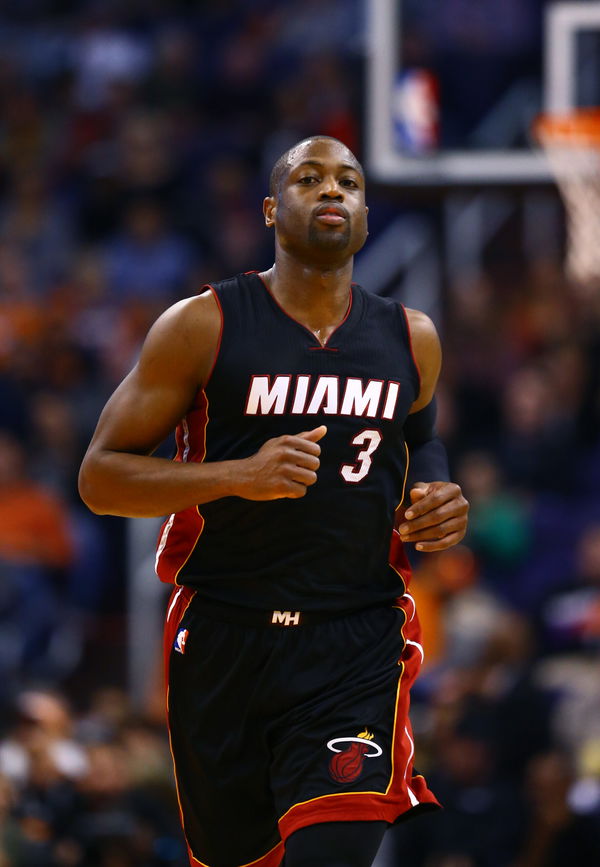
Jan 8, 2016; Phoenix, AZ, USA; Miami Heat guard Dwyane Wade (3) against the Phoenix Suns at Talking Stick Resort Arena. The Heat defeated the Suns 103-95. Mandatory Credit: Mark J. Rebilas-USA TODAY Sports
Ultimately, Kellerman is not arguing that Wade had the better career. The résumé gap is too large to ignore. Instead, he is isolating a very specific question. If both players existed in the same physical mold, how different would this conversation look?
That question does not rewrite history. However, it does reframe it. Bryant’s legacy remains built on sustained excellence, adaptability, and longevity. Wade’s case leans on one of the highest peaks the league has ever seen.
And if the difference truly comes down to two inches, then the margin between them might be far thinner than the accolades suggest. That is what makes this debate stick. Not because it overturns the hierarchy, but because it forces a closer look at how that hierarchy was built in the first place.
Written by

Edited by

Ved Vaze