
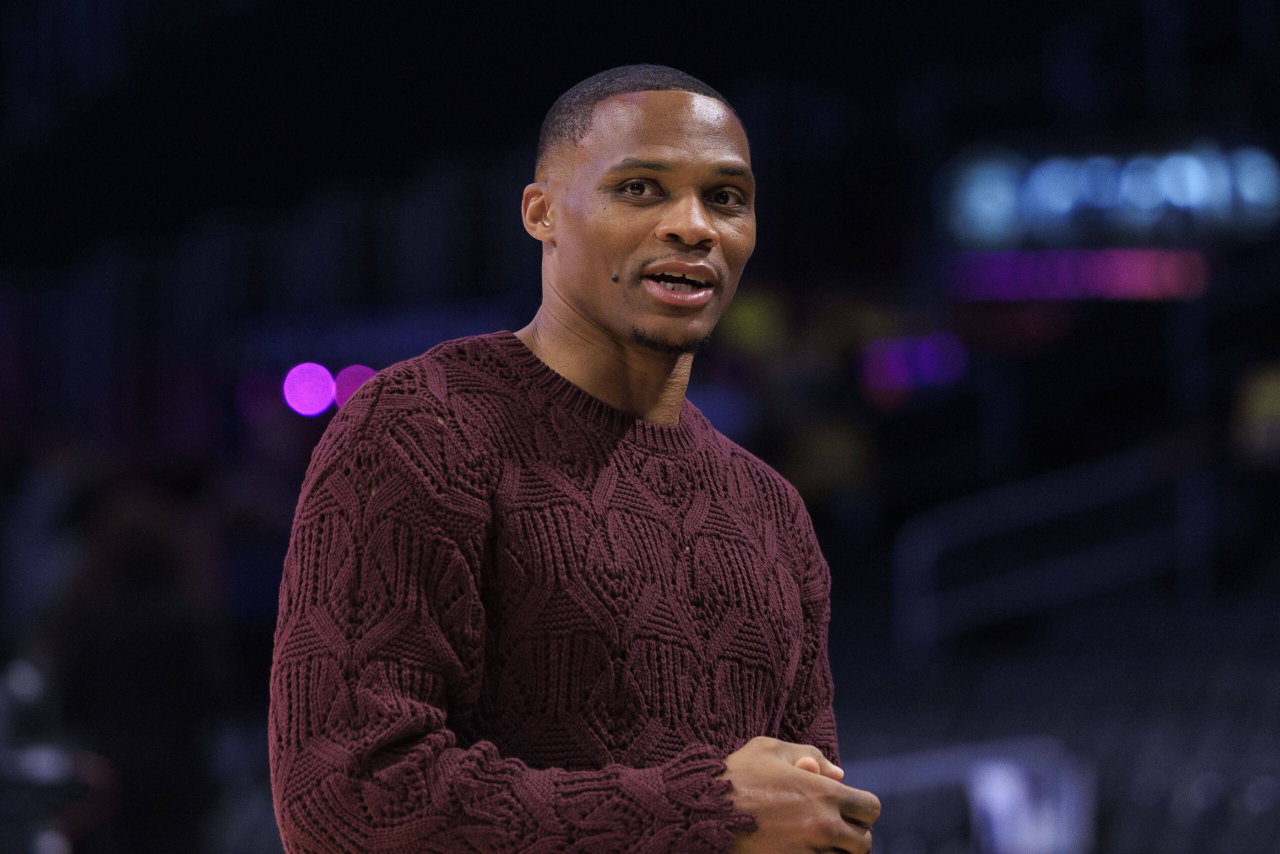
Russell Westbrook may have heartbreakingly stepped away from the NBA, but retirement has not taken him far from basketball. The 2017 MVP has now joined a rival league that has raised more than $5 billion and has superstar investors like Steve Young and Novak Djokovic. Brodie will play a more than ceremonial role.
Watch What’s Trending Now!
Like Westbrook’s “Why Not?” mantra, Project B, an ambitious international league, also intends to break the mold and reimagine how pro basketball operates. Brodie joins the new league as a co-founder, chief strategy officer, and equity holder, giving him a direct voice in how the venture develops.
“At every step of my career, what was most valuable to me was making sure everyone had a seat at the table,” Westbrook said in a statement. “With Project B, we’re challenging the norm and bringing a new vision to the intersection of premium sport, culture, and entertainment. We’re reimagining the experience with players not only as key value drivers, but also as shareholders and decision makers.”
But what makes Project B different from all the other basketball leagues?
The upstart league founded by two top tech executives has already attracted backing from institutional venture capital firms in the billions. Its leadership brings experience from tech and global sport, including Skype co-founder Geoff Prentice and former Meta executive Grady Burnett. Athletes like Candace Parker, Novak Djokovic, Steve Young, and Sloane Stephens have also joined as investors.
Rather than building a conventional domestic league around permanent arenas, Project B plans to take basketball across continents. The league is scheduled to debut in early 2027 with six teams and 11 players each. It intends to operate through seven two-week tournament hubs across major cities in Asia, Europe, and South America.
The concept resembles Formula 1 more than the traditional NBA/basketball schedule. Teams would travel between international festival-style events rather than playing an 82-game concentrated calendar, with painstaking travel plans. But that global approach is only part of the challenge to the existing system…
At Project B’s core, this is an attempt to fundamentally rewire the relationship between athletes and the institutions they play for. How?
Rather than operating as limited salaried employees, players would hold equity and a seat at the table for major decisions, functioning as true shareholders. The bigger player contracts offered have reportedly exceeded $2 million per year, against the WNBA’s roughly $102,000 per-season cap. That distinction alone would set Project B apart.
The women’s division has attracted a rich mix of young and experienced WNBA players like Azzi Fudd, Nneka Ogwumike, Alyssa Thomas, Jonquel Jones, Jewell Loyd and Awa Fam. Crucially, in this case, the calendar mostly aligns with the WNBA’s offseason, so those participating might be able to play in both leagues.
But the men’s division might run into a slight roadblock because the NBA season runs through early 2027 and into June. That means professionals will likely have to choose between the NBA and Project B. That’s where Westbrook comes in.
How can Russell Westbrook contribute to Project B?
Brodie now finds himself at the center of an experiment immediately after ending an 18-year NBA career. He officially retired in August, closing a playing career during which he became the NBA’s all-time triple-double leader and one of the most recognizable point guards of his generation.
Just days before the Project B announcement, Brodie was spotted living out retirement the way most people only dream about, cruising the Italian coast on a luxury yacht alongside fellow retired point guard Chris Paul. A video of the two hooping on deck circulated quickly, the kind of moment that signaled both men had well and truly stepped away from the grind of professional basketball.
Or so it seemed… within days, Westbrook traded the yacht for the boardroom.
The move makes a certain kind of sense for someone who’s never been content standing on the sidelines. Now, as chief strategy officer and a board member, Westbrook will have a genuine hand in shaping how Project B courts players for its men’s circuit, structures its business, and how it positions itself as an entertainment product as it pushes into new markets around the world.
Grady Burnett, one of Project B’s co-founders, told The Athletic earlier this year that they’ll be “applying the same blueprint” from the women’s to the men’s circuit with the aim of “developing the best young talent in the world and extending the careers of established players.”
But they still haven’t cracked a deal with any NBA or men’s basketball player yet. Burnett did mention he expected movement on this across the summer, but instead of players, Project B is focusing on putting the correct leadership in place first. Before Westbrook, Landry Fields (former NBA player and Atlanta Hawks GM) joined the fold as the Head of Men’s Basketball.
Both of them fit the project in their own way. Westbrook has enough credibility in the basketball world to pitch longevity and the need to reinvent oneself, whether to a youngster or a veteran star. Meanwhile, Fields will scout for the best talent. He’s known for acquiring French phenom Zaccharie Risacher with the No. 1 overall pick and bringing Dyson Daniels and Dejounte Murray while with the Hawks.
If Project B succeeds, Westbrook will not merely have joined another basketball league. He will have helped build one. For a player who spent his career refusing to operate quietly and going against the grain, this may just be the most fitting next chapter for Brodie.
Meanwhile, even though LeBron James’ links to Project B via business partner Maverick Carter were squashed, with sources claiming he had “zero” involvement in the rival league, the hoops legend has always maintained an interest in owning an NBA franchise. And with the Las Vegas/Seattle NBA ownership expansion looking bleak for LeBron to be a part of, he might soon turn his interests toward Project B in the coming years.