
Something had to give on draft night. A franchise had the No. 1 pick, a consensus top prospect on the board, and a clean path forward. However, one voice inside the building changed everything. That voice belonged to Shaquille O’Neal.


Before the 1993 draft, while working on the movie Blue Chips, Shaq built a connection with Penny Hardaway. That part is known. What changed the Magic’s direction was what came next. “We were down at the gym just working out. Shaq got to know Penny really well and made a few calls to his agent. Like, I wanted to play with this guy. I don’t want to play with Weber.”
That insight came from actor Rob Ryder. It reframed the draft as more than a front office decision. It became a player-driven pivot. And that pivot did not sit well in Orlando.
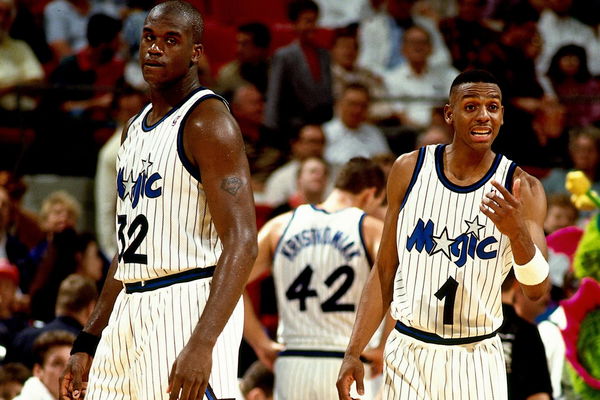
At the time, the Orlando Magic were expected to select Chris Webber. He was the consensus No. 1 pick, a 6-foot-10 forward averaging 17.0 points and 10.4 rebounds. Pairing him with Shaq looked like a dominant frontcourt on paper.
However, Shaq saw something else. “The Magic was going to take Chris Webber, but I went in to talk to Orlando general manager and flexed my Superman muscles.”
“I told him, ‘Listen, I understand you want Webber, but this cat Penny Hardaway is the answer. If you put us together, we could be like Magic and Kareem. If you don’t bring Penny I’m here, then maybe I’ve got to think about doing something else.’”
That is not a suggestion. That is leverage. Because of that, Orlando traded the No. 1 pick. Webber was sent to the Golden State Warriors. In return, the Magic got Hardaway and future first-round picks.
The backlash came immediately
Draft night told the real story. Fans initially reacted one way. Then everything flipped. “I tried to explain it to our fans. They didn’t want to hear anything. They drowned me out.”
“The best I could do was, ‘Fans, you’re booing tonight, but Penny is going to turn your boos to cheers.’” That was former GM Pat Williams describing the moment. The reaction was not mixed. It was hostile.
Meanwhile, the players involved experienced it differently. “I knew (about the trade), and I don’t think Chris knew about the trade. I think it was more of a shock to him.” That was Hardaway. And it added another layer to the situation. Webber expected Orlando. Instead, he was rerouted instantly.
On paper, a Shaq-Webber frontcourt looked unstoppable. Size, rebounding, interior dominance. That version of the Magic could have controlled the East physically. However, Shaq pushed for fit over projection.
He wanted a guard who could handle, create, and complement him. He wanted partnership, not overlap. That distinction matters. Because the Shaq-Hardaway pairing reached the NBA Finals in just their second season. The decision that fans rejected in the moment produced results quickly.
At the same time, this is where the larger pattern comes in. Franchise players influencing roster decisions is not new. Shaq’s move in Orlando fits that mold. A star identified his ideal running mate and forced alignment. That said, the risk was real. Orlando passed on a can’t-miss prospect to follow a second-year player’s vision. Because of that, the reaction was always going to be emotional.
Shaq did not just make a preference clear. He shifted a franchise’s direction. The quotes prove it. The outcome validates it. The backlash explains it. Still, the key detail holds everything together. This was not a quiet suggestion behind closed doors. This was a bold call backed by leverage.
And in the moment, Orlando fans hated it. In the long run, the results made it harder to argue against.
Written by

Edited by

Ved Vaze