
Imago
Credits: IMAGO
Imago
Credits: IMAGO
There is a reason some NBA legends transition seamlessly to the sidelines while others never consider it. In today’s league, coaching is less about enforcing a singular vision and more about adapting to trends that change every season. That reality has pulled former stars like Jason Kidd and JJ Redick back into the game. It has pushed Shaquille O’Neal even further away.


That divide became clear during Shaq’s appearance on The Jawn Podcast in January 2026, when the Hall of Famer delivered a blunt decision on whether he would ever coach in the NBA. His answer was not layered or diplomatic. It was definitive, and it shut the door entirely. “No, because I’ll end up smacking one of these cats because I was a great. So, which means I know what the f–k I’m talking about.”
Watch What’s Trending Now!
That statement was not a joke or a throwaway line. It was Shaq explaining, in his own words, why modern NBA coaching is incompatible with how he sees the game.
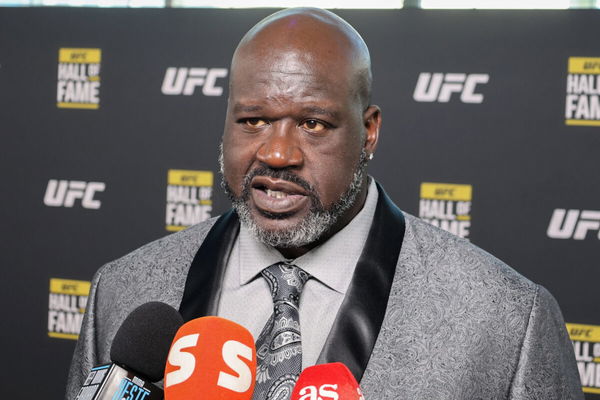
Imago
Sport Bilder des Tages Former American basketball player Shaquille O Neal speaks to the press during an event at the UFC Hall of Fame in Las Vegas, USA, 26 June 2025. Shaquille O Neal at the UFC Hall of Fame ACHTUNG: NUR REDAKTIONELLE NUTZUNG PUBLICATIONxINxGERxSUIxAUTxONLY Copyright: xOctavioxGuzmánx AME8987 20250627-55017248027_1
Shaq’s resistance starts with how today’s basketball looks and feels. Despite working as a longtime television analyst, he admitted on the same podcast that watching games has become more frustrating than enjoyable.
“I don’t love watching it because everybody’s doing the same thing. I hate it. People say it’s more advanced. I don’t think it’s more advanced. I don’t know what I’m looking at if everybody’s doing the same thing.”
That frustration matters. NBA coaches are expected to teach spacing, embrace positionless basketball, and live with high-volume three-point shooting. Teams like the Boston Celtics have built elite systems around those principles. Shaq, however, built his career on the opposite end of the spectrum.
He dominated the paint, punished defenders physically, and forced opponents to adjust to him. Asking him to coach a style rooted in repetition and perimeter efficiency would require abandoning the very instincts that made him great. From his perspective, that adjustment is not realistic.
Shaquille O’Neal doesn’t like the current culture
The disconnect goes beyond X’s and O’s. Shaq has long argued that the league’s culture has shifted in ways he does not respect. He believes criticism once fueled greatness and that today’s environment encourages players to push back instead of internalize it.
In a 2021 interview, he explained how harsh feedback from Kareem Abdul-Jabbar changed his own career trajectory. Rather than complain, Shaq used it as motivation to elevate his game. He has repeatedly contrasted that mindset with what he sees now, labeling modern players as too sensitive to public scrutiny.
That criticism lands louder today because social media amplifies every comment. When Shaq challenges a star like Nikola Jokic, it does not stay contained. It dominates discussion cycles, magnifies flaws, and invites backlash in ways that did not exist during his playing days.
This context explains why Shaq’s coaching answer was so final. He does not want to soften his voice, dilute his expectations, or negotiate with trends he fundamentally dislikes. Coaching would require all three.
Even as former players continue to return to the league in leadership roles, Shaq’s path remains separate. He is comfortable analyzing the game from a distance, offering critique without compromise. The moment he steps into a locker room, that distance disappears, and so does the filter.
For that reason, his decision is unlikely to change. The NBA will keep evolving toward spacing and versatility. Shaq will keep advocating for dominance and accountability. Those two paths no longer intersect, and he made it clear why.
As long as the modern game looks the way it does, Shaquille O’Neal will stay far away from the sidelines.
Written by

Edited by

Ved Vaze