
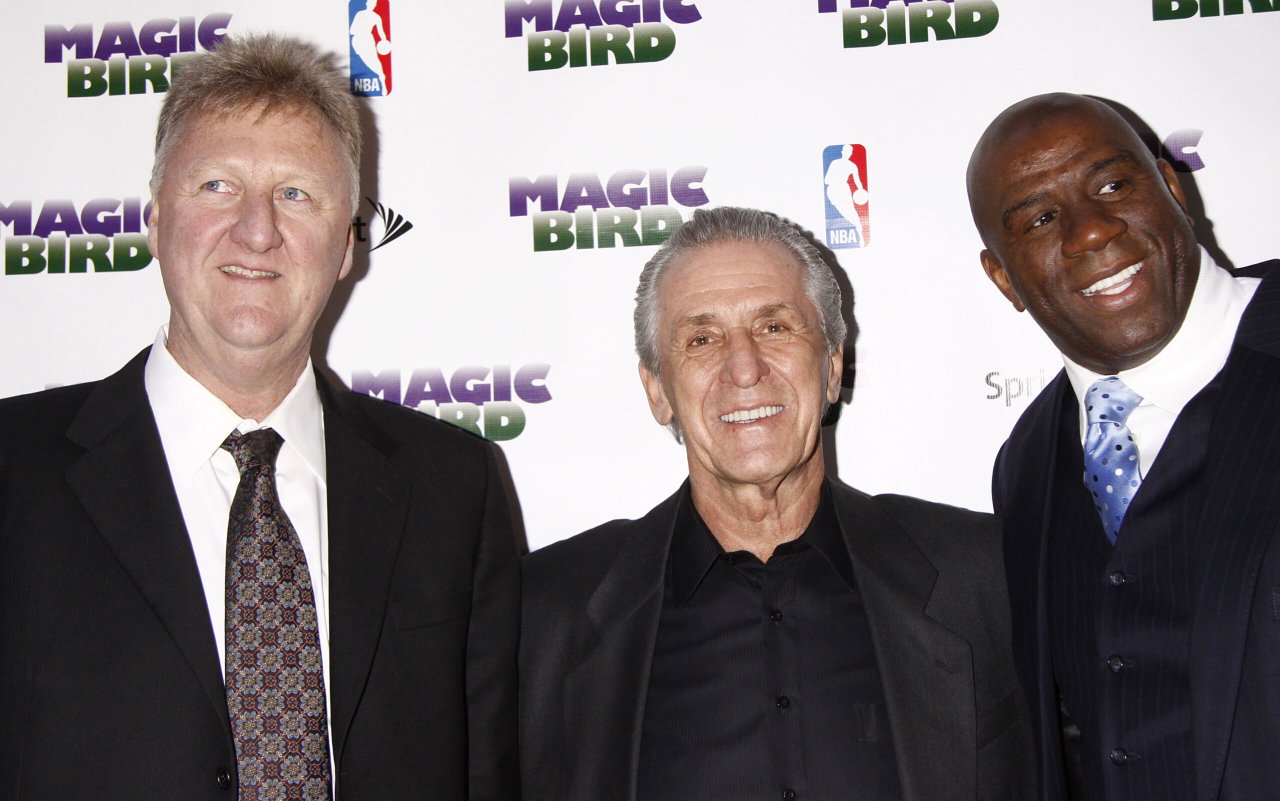
Magic Johnson and Larry Bird’s rivalry helped define the NBA in the 1980s. Their competition extended beyond matchups between the Los Angeles Lakers and Boston Celtics, reaching the Lakers’ locker room through head coach Pat Riley. Former Cal Lutheran standout Steve deLaveaga recently recalled how Riley used Bird’s MVP success to challenge Johnson, triggering a furious reaction from the Lakers legend.
Watch What’s Trending Now!
DeLaveaga had a connection to the Lakers through the basketball camps he worked at during his college career. A January 1988 Los Angeles Times profile reported that he served as a counselor at four camps, including Riley’s, and took part in a three-point shooting contest against Lakers guard Byron Scott. DeLaveaga eventually edged Scott in the contest, giving him a memorable experience around the organization.
Recounting the locker-room incident in an interview shared by Brad Lea on Instagram, deLaveaga described what he witnessed when he first arrived at a Lakers practice: “My first practice I went to the Lakers, I walk in and I watch Magic Johnson kick with his entire foot his locker and crush it and kick it in and slam the door three times, says swear words, gets up, walks out.”
The reason for Johnson’s reaction became clear when deLaveaga and Scott went inside the locker room. Riley had placed a Sports Illustrated cover featuring Bird inside Johnson’s locker after the Celtics star had won his third consecutive regular-season MVP award. DeLaveaga recalled the discovery and the message Riley had left for his point guard: “I look at Byron Scott who I knew a little bit and we walk in the locker. Coach Riley had put the sports illustrator of Larry Bird inside Magic’s locker because he had just won his third MVP. And he said, when are you going to win one, Magic?”
Bird’s MVP run came in three consecutive seasons, making him the first player since Bill Russell to achieve that distinction. Johnson had yet to win the award when Riley placed the magazine cover in his locker, despite already establishing himself as one of the league’s leading players.
DeLaveaga also explained how Riley’s approach was received by players at the time. He contrasted the reaction he witnessed with how players might respond to similar treatment today, adding: “That’s how he challenged his guys. That’s stuff happening today. Players would walk out and get the coach fired. Back then that was motivation.”
Johnson eventually won three regular-season MVP awards of his own, matching Bird’s career total. His victories came in 1987, 1989 and 1990, completing a remarkable achievement for a player who had initially been challenged with Bird’s success as motivation.
Their rivalry had already captured national attention before they entered the NBA. Johnson’s Michigan State team defeated Bird’s Indiana State in the 1979 NCAA championship game. They later faced each other in three NBA Finals, with Boston winning the first matchup and Los Angeles taking the following two.
Johnson went on to lead the Lakers to five NBA championships during his playing career, while Riley coached the team to four titles during the Showtime era. Their success reflected the competitive standards that defined the Lakers during that period.
DeLaveaga’s recollection offers a glimpse into how that competitive culture extended beyond the court. Riley used a simple reminder of Bird’s achievements to challenge Johnson, and the reaction showed just how seriously the Lakers star took that challenge.