
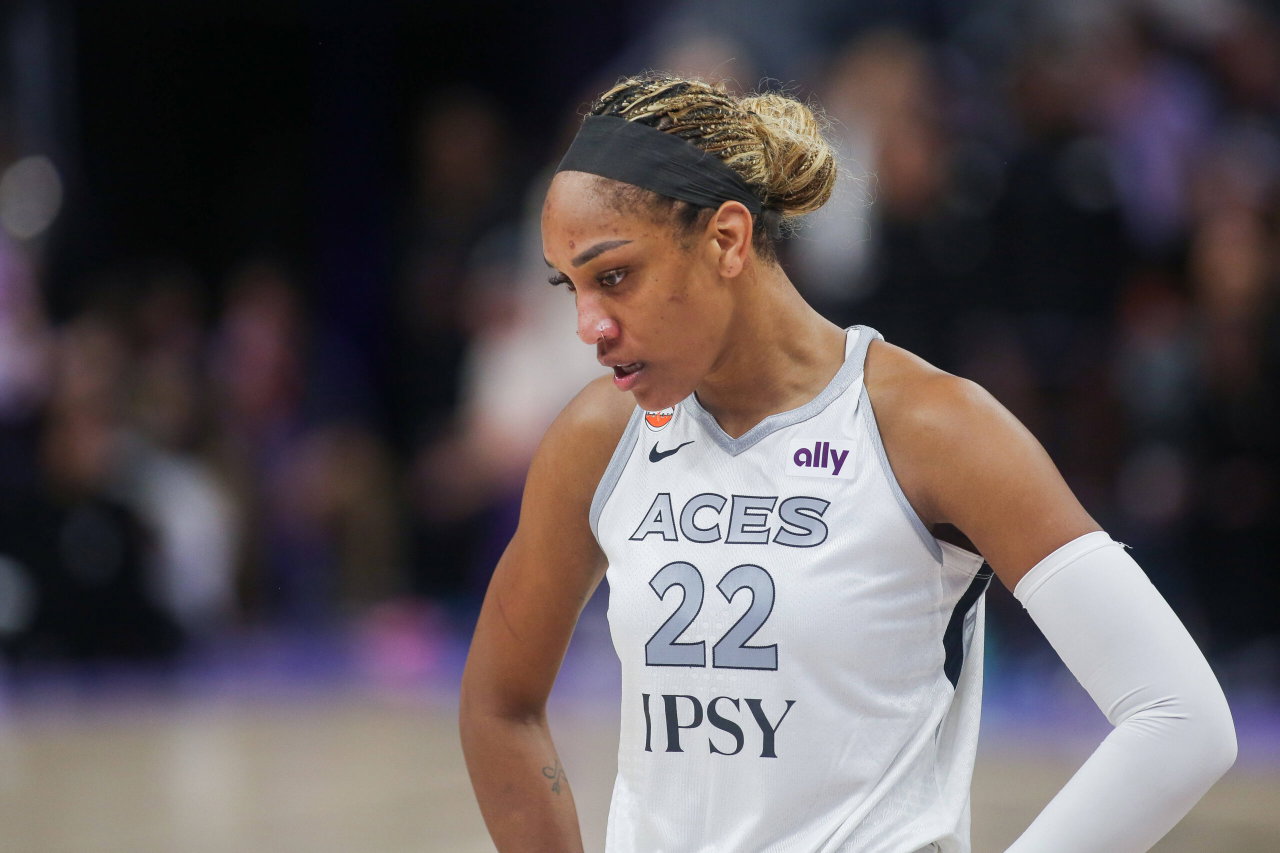
A’ja Wilson’s confrontation with an Indiana Fever fan lasted only moments, but the fallout has taken on a life of its own. What happened courtside has split the reaction, with some focusing on the fan’s actions and others questioning how Wilson responded.
Watch What’s Trending Now!
Now, former NBA champion Stephen Jackson has added another layer to the debate. His focus is not just on what happened between Wilson and the fan, but on how WNBA players are covered when a controversial moment puts them in the spotlight.
Jackson pointed to Stephen A. Smith as an example of the standard he believes WNBA coverage should follow. “One thing about Stephen A. [Smith], I don’t agree with him, but he always kept us accountable. Whenever we did something wrong, he spoke on it, held us accountable. He gave us our flowers, but when we did something wrong, he had us accountable, right?” Jackson said. He then questioned why that same approach is not always applied to WNBA players: “Well, how come these women announcers not holding these WNBA players accountable when they do something? That was foul. Like, everything can’t be correct.”
Jackson’s comments came after Wilson confronted a fan during Game 2 of the first-round playoff series between the Aces and Fever on September 29. With about four minutes left, Sophie Cunningham was involved in a foul with Wilson. As the play stopped, a courtside fan stood, pointed toward Wilson and appeared to take a step toward the court. Wilson then turned toward him, pointed back and stepped across the baseline into the seating area before confronting him face-to-face.
Teammates, staff and security quickly intervened, while Wilson was assessed a technical foul. The fan was briefly escorted away before returning to his seat. Indiana later said arena security had spoken with the fan and witnesses and determined there was no violation of the Fan Code of Conduct.
A’ja Wilson Wasn’t Backing Down
Wilson later explained why she reacted so strongly, making it clear that the issue for her was not simply what the fan said.
“I don’t know if you guys know me, but I don’t really get into the bullsht. I don’t. I try to play my game, keep it pushing. But if I’m just walking, because I just got the foul, I’m chilling, and if I see a man come at me, taking steps toward me and pointing at me, I don’t give a damn what you said. I don’t give a damn how you said it. The tone, that is unacceptable. You don’t step towards me. You never should step and point at me. I’m not for that sht at all. Excuse my French, and God bless me. But that there is unacceptable. And how he gets back in the game because they said he didn’t do anything. Of course he didn’t. And that’s fine. And I apologize to my team because I got us a tech, but it’s just certain things that I’m just not going to allow anymore because it’s just unacceptable. You don’t know me at all to come and step towards me and point at me and say anything out your mouth to me… You don’t have to love me. You can hate me with all your heart. But you don’t know me. But I guarantee you, you will respect me.”
Becky Hammon also said Wilson’s reaction was unusual for her.
“I didn’t exactly see what happened. I kind of saw the aftermath. I’ve never seen A’ja Wilson go like that. So, whatever was done, I can tell you she felt very disrespected in that moment. … I’ve never seen her really react like that. Ever. Whatever it was, it doesn’t have any place, I don’t think, in an arena.”
Stephen A. Smith Had a Different Read
Smith, the very analyst Jackson pointed to, did not see Wilson’s reaction the same way.
“I love me some A’ja Wilson, I think that she’s the best player in the world… But you know what, I think that particular incident based on what we saw on camera and what the arena stated after the investigation into the matter, I think it looks like an overreaction.”
Smith added, “When you tangle with another player, a fan standing up and pointing at you is not a crime. He’s a fan… Respectfully, what did he do? I don’t get it.”
That is the kind of reaction Jackson says he wants to see more of when WNBA players are involved in controversial situations.
Jackson doubled down on that point, saying, “They want to be treated like NBA players, but y’all don’t want to be accountable like NBA players… they quick to jump on an NBA player when [he] does something wrong, or say something foul, or do something in the media, y’all put the jump on them. Jump on the same WNBA players that are doing foul s—t. You go both ways, right? Equality, right?”
At the same time, LaChina Robinson offered a different perspective during the Prime Video broadcast.
“This is really unfortunate, and I feel like this has happened several times here in Indiana. The intensity of the game is enough, and then to have to hear things from the crowd and fans, that should not— that don’t have the right to impact the game at this point and the emotions of these players.”
Robinson also added, “And you know something was said, because you don’t see that kind of reaction from A’ja Wilson. That is just not even in line with her demeanor unless it’s absolutely necessary.”
The research does not establish a measurable league-wide double standard in how WNBA and NBA players are covered. It does, however, show that the Wilson incident produced sharply different reactions: Smith questioned Wilson’s response, Robinson criticized the fan environment, Hammon defended Wilson’s character, and Jackson used the moment to challenge how WNBA players are held accountable.
For Jackson, the issue comes down to one simple standard: praise players when they earn it, but do not stop short of criticism when they cross a line. And after Wilson’s confrontation, he believes WNBA coverage has a clear test in front of it.