
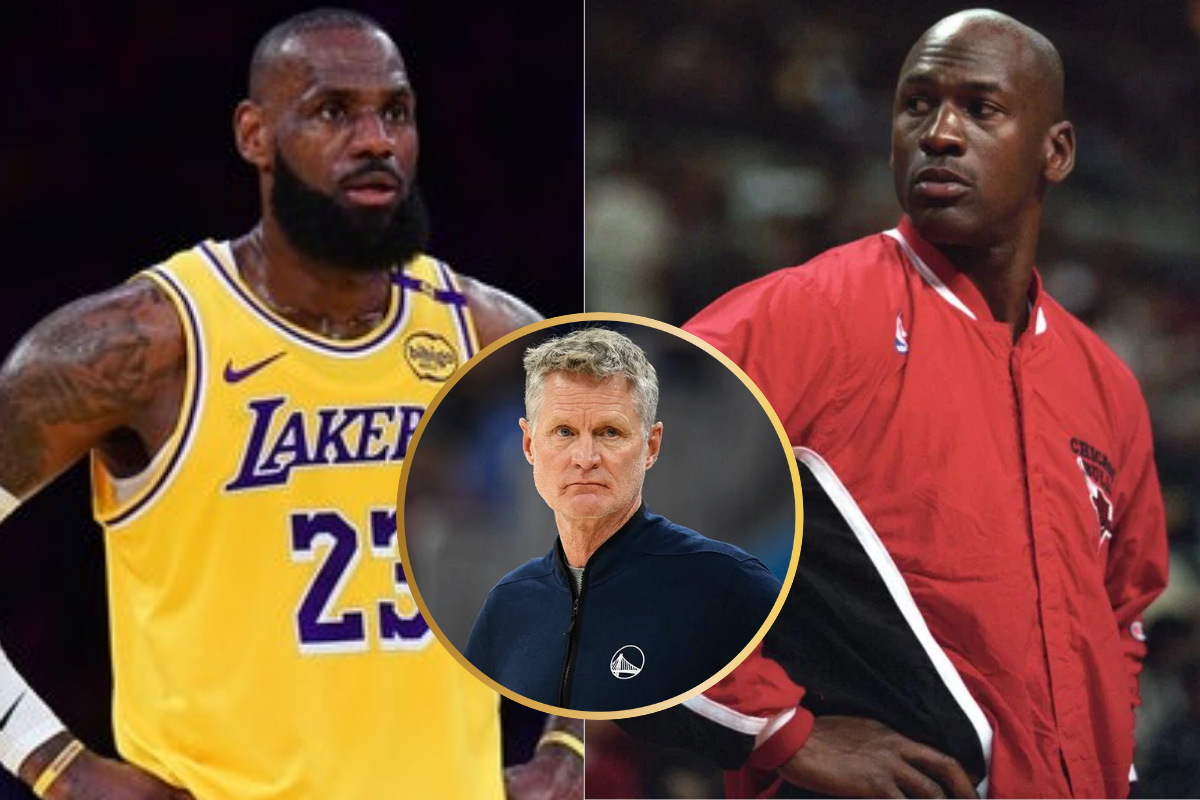
He once described it as a pressure unlike anything he had ever felt from another human being, a weight that came with simply sharing a locker room. He earned that man’s respect by standing up to him during a training camp fight and never backing down. Three decades removed from the Chicago Bulls dynasty, nobody alive holds a better position to compare Michael Jordan to anyone. In a new interview with The New Yorker, Steve Kerr did exactly that, landing on a verdict that elevates both players while fully defining neither.
Watch What’s Trending Now!
Speaking to writer Charles Bethea in a wide-ranging New Yorker interview published this week, Kerr was asked directly to compare his former teammate Jordan to LeBron James, who entered the league the year he retired. He began with a careful distinction. “LeBron’s brilliance doesn’t lie in the same skill set that Michael’s did,” Kerr said. “It lies in more of a holistic game where he dominates with his pace, his athleticism, and his passing. I’ve always felt scoring is secondary for LeBron, but he’s the greatest scorer in the history of the N.B.A.” When Bethea interjected that it seemed almost incidental, the four-time championship-winning coach confirmed it: “Yeah, incidentally.” The framing is a backhanded tribute of the highest order, that a man who has scored more points than any player in NBA history does so almost as a byproduct of everything else he is doing.
From there, Kerr elevated the praise to a level few have ever used, then drew the one line he would not cross. “I think he’s literally the greatest athlete on the face of the planet and in the course of human history,” he said of LeBron. The statement spans every sport and every era. But Kerr immediately followed it with the distinction that still separates the two. “Playing with Michael, I saw the killer instinct, the emotional dominance he had over not only the other team but the officials, the entire arena. I don’t see that with LeBron. So they’re different, as far as the emotional part of it.” This is not a new stance for Kerr. He has held it for years, including in a 2022 interview with The Athletic, where he said, “I think the most underrated aspect of Michael’s game was his emotional dominance in the arena every night. And I still have not seen that from anybody.” The New Yorker conversation does not introduce a new conclusion, it sharpens one he has long believed.
The quality Kerr describes goes beyond simple competitiveness. “Everybody came into a series against Michael knowing they were going to lose,” he said. “There’s never been anybody like that. Maybe Bill Russell. But I’ve never felt the same way on a basketball floor as I did with Michael.” Kerr has often explained that Jordan’s pressure extended to his own teammates, a daily test you had to survive before it made you better. That psychological control over opponents, officials, and the entire arena is something Kerr says he has never seen anyone replicate, not with Tim Duncan in San Antonio, not with Stephen Curry in Golden State, and not in the Finals battles he coached against LeBron.
“They’re Different”: What Kerr’s Comparison Actually Tells Us About Both Jordan and LeBron
The nuance in Kerr’s framing deserves attention. He is not placing LeBron below Michael Jordan. He is defining two completely different forms of greatness. Jordan dominated emotionally in a way that shaped entire arenas, while LeBron dominates physically and intellectually across every facet of the game. Calling LeBron the greatest athlete in human history is not a secondary compliment. It places him above every sprinter, every decathlete, and every physical outlier the sports world has seen. The ability to hold both truths at once is what gives Kerr’s perspective rare credibility.
Kerr has long credited Jordan with shaping his entire post-playing career, from broadcasting to front office work to his role with the Golden State Warriors. That connection does not soften his perspective. If anything, it makes his praise of LeBron’s physical greatness even more striking. Kerr now faces his own uncertainty as he prepares to meet with the Warriors’ front office about his future. But on the Jordan versus LeBron debate, his stance remains clear. One represents unmatched physical evolution. The other represents unmatched psychological control. In Kerr’s view, greatness did not follow one path. It split into two.