With Subtle Dig at NBA Past, Mark Cuban Names Dirk Nowitzki & Ex-Mavs Star Capable of Winning 60 Games

Add us on Google
With Subtle Dig at NBA Past, Mark Cuban Names Dirk Nowitzki & Ex-Mavs Star Capable of Winning 60 Games
Add us on Google

Getty
DALLAS, TX – DECEMBER 25: Dallas Mavericks legend Dirk Nowitzki talks with team owner Mark Cuban before Nowitzki’s statue is unveiled at American Airlines Center on December 25, 2022 in Dallas, Texas. NOTE TO USER: User expressly acknowledges and agrees that, by downloading and or using this photograph, User is consenting to the terms and conditions of the Getty Images License Agreement. (Photo by Ron Jenkins/Getty Images)
Getty
DALLAS, TX – DECEMBER 25: Dallas Mavericks legend Dirk Nowitzki talks with team owner Mark Cuban before Nowitzki’s statue is unveiled at American Airlines Center on December 25, 2022 in Dallas, Texas. NOTE TO USER: User expressly acknowledges and agrees that, by downloading and or using this photograph, User is consenting to the terms and conditions of the Getty Images License Agreement. (Photo by Ron Jenkins/Getty Images)
From the early Boston Celtics and the LA Lakers to the Chicago Bulls dynasty and the recent memory of the Golden State Warriors, the NBA has seen power concentrated with few. But with the decade, the league is considered to be more balanced out than ever. Take 6 different teams with a championship since 2018-19 for instance. The current state, thus, was only rightly pointed out by Mark Cuban, also having witnessed his share of the dominant run with Dirk Nowitzki’s Dallas Mavericks.
Watch What’s Trending Now!
“I think competitively, it’s the best it’s ever been. I remember being in meetings and having small market teams just come and beg for revenue sharing and this and that.” Mark Cuban shared his views on today’s NBA on First Take. “Now, everybody’s competitive and there’s going to be teams that tank for Cooper Flag and so that might not work as well as the NBA wants. But still, there are a lot of really good teams.”
Making his case on the competition further, Cuban adds, “It used to be back in the day like you have Dirk Nowitzki, you bring in Jason Kidd, you can win 60 games. Now, it’s hard for teams to win 60 games and it’s not unusual if no one does.”
Reaching the 60-win mark has indeed been a task, considering in the last 5 seasons, only twice has that barrier been broken by a top seed. From 2012-13 to 2018-19, top-seeded teams had more than 60 wins for 7 seven consecutive seasons. The sixty-game mark is also closer to home for Mark Cuban.
USA Today via Reuters
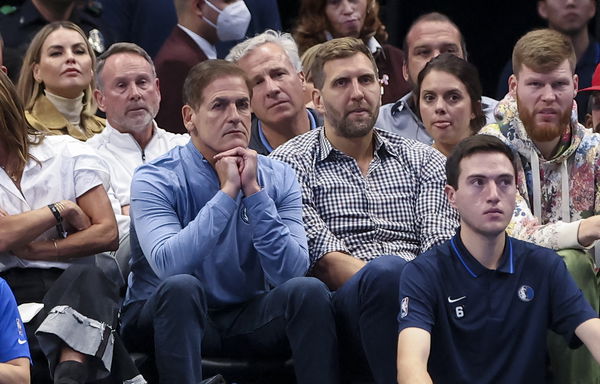
Nov 2, 2022; Dallas, Texas, USA; Dallas Mavericks owner Mark Cuban sits with former player Dirk Nowitzki during the game against the Utah Jazz at American Airlines Center. Mandatory Credit: Kevin Jairaj-USA TODAY Sports
Looking back at Dirk Nowitzki and his Mavs career, he could only win the championship once. Interestingly, in that season too, they just had 57 wins. But 60-wins mark hasn’t evaded him either. He would record the number twice — 2003 and 2006 — and help with the franchise best 67-15 in 2007, the year that Kidd was brought in mid-season.
That has become quite the record to attain in recent times. The best that came out was in 2023-24 with the Celtics’ 64-18. The only other 60-win mark prior came in 2018-19 — Milwaukee Bucks’ 60-22. So when the league is balancing out, why did Cuban give up his shares in the Mavs?
Why did Mark Cuban sell his majority share?
Just ahead of the league’s huge media rights deal of $76 billion spread over 11-year contracts, Mark Cuban sold his majority shares last year. Being the majority owner for 23 years, he realized he might not be equipped for the forthcoming change. “I couldn’t build a Chase Center if I wanted to. My new partners… that’s what they live for.” He also admitted on Shaquille O’Neal’s podcast that, as the arenas continue to become central points with real estate development, he would remain in the dark, because that’s not his expertise.
Cuban sold his majority stake to the Adelson Family at a valuation of over $3.5 billion. But he still kept a 27% minority stake in the franchise. His initial investment was just $285 million, the same year Broadcast.com — founded by Cameron Christopher Jaeb, managed by Todd Wagner and Cuban — was sold to Yahoo for $5.7 billion.
“Revenues are going up and that means salaries are going up. That means everything around the team goes up. And for the first 24 years I was there it was media and Tech and I dominated in media and Tech so it was easy.” So Mark Cuban made it clear that, though the CBA is working for the betterment of the league and the teams are mostly on par, he had to sell his stake so that the franchise gets even better.
Written by

Edited by

Shivatmika Manvi