
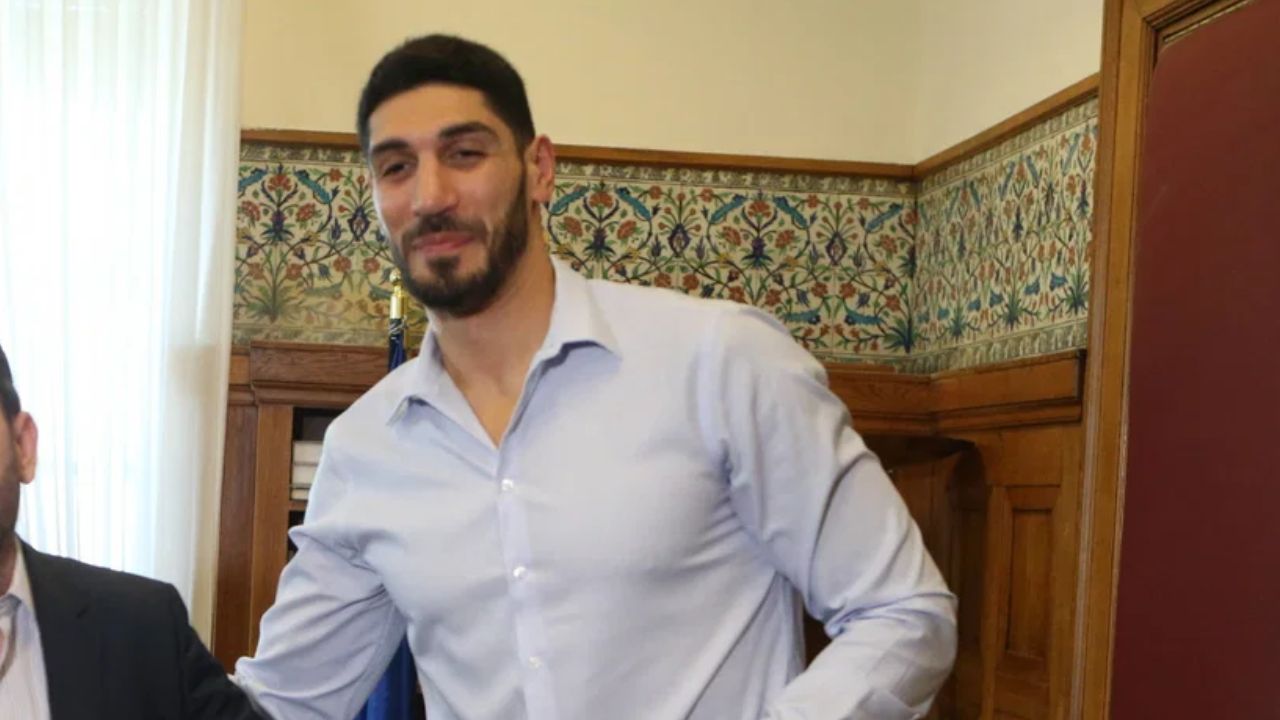
The WNBA prides itself on inclusivity and diversity. But a huge flaw has surfaced. Former NBA center Enes Kanter Freedom, the third overall pick in the 2011 NBA Draft, announced he’s declaring for the 2027 WNBA Draft. Why? He cited the league’s own eligibility criteria as his justification.
Watch What’s Trending Now!
The unexpected announcement video, shared across Kanter Freedom’s social media, has already garnered nearly 50 million views. That attention brought in an unlikely voice: Donald Trump Jr., who added a tongue-in-cheek prediction:
“I’m going to go out in a limb here and predict Enes breaks every record in the WNBA in year one,” tweeted Trump Jr. “She truly is going to make a spectacular women’s basketball player.”
The POTUS’ son’s post alone has racked up over 1 million views, pouring fresh fuel on an already heated conversation… This comes a year after his father signed an executive order to stop transgender athletes from competing in girls’ and women’s sports unless they were assigned female at birth. He promised to deny federal funding to high schools and colleges that do not comply.
Now, Kanter Freedom has said his team had reviewed the league’s eligibility rules and argued that whatever standard applies should apply to everyone equally.
“If simply declaring who you are is all that’s required, then I meet every single requirement necessary to compete in the WNBA,” he declared.
Kanter Freedom was careful to note the move wasn’t meant to mock or disrespect anyone. However, is he technically right in his argument?
The simple answer. Yes.
Article XIII, Section 1(a) of the WNBA Collective Bargaining Agreement says, “Only players who are women are eligible to play in the WNBA.” The policy does not explicitly define the term “woman” or specify any criteria about biological sex, hormone levels, or physical attributes. Crucially, there is also no clause that stops someone from being eligible simply by declaring or self-identifying as a woman.
This debate carries extra weight because no publicly known transgender woman has ever played in a WNBA game. And Kanter Freedom isn’t alone…
Within hours, another former NBA first-round pick, Royce White, said he, too, would seek WNBA Draft eligibility next year.
“I’m transgender,” Republican Senate candidate and former NBA player Royce White said via Fox News Digital. “I’m a woman. I identify as sometimes identifying as a woman for purpose of basketball, professional basketball, so I’ll be declaring for the WNBA draft in 2027 as well.”
White also suggested that he would pursue legal action if he went undrafted.
“That’s ridiculous,” the 35-year-old said. “We’re gonna have to have a huge legal battle about discrimination if I can’t play.”
Their comments immediately sparked reactions across social media. Former NBA star Robin Lopez got candid and wrote, “Biggest issue: If you’re being drafted, people are saying “we want you around for 4 years” & I can’t imagine anybody wants Enes Kanter or Royce White around them for even 4 minutes.”
The matter blew up to such an extent that WNBA commissioner Cathy Engelbert had to publish a league-wide memo addressing growing public questions. She described the debate as “nuanced” and has reportedly set up a task force of team presidents and general managers that will meet next week to discuss transgender athlete participation in women’s basketball.
“We also plan to convene additional discussions and offer listening sessions for any team leaders who would like to participate,” Engelbert wrote. “Your perspectives and feedback are invaluable, and I appreciate those who have already reached out to share their thoughts.”
It is important to note that Kanter Freedom’s declaration came as the WNBA was already facing heat over transgender athlete participation in women’s basketball.
What Happened Before Enes Kanter Freedom Entered the WNBA Conversation
This matter initially gained attention after Indiana Fever guard Sophie Cunningham weighed in on how women’s sports needed to be protected.
“I got a lot of negative feedback about me hating trans. And I’m like, ‘I never once said that,'” Cunningham said. “I think that I am here to extend love. But I also think with that love is truth, being honest. And I want to protect young girls in a locker room, or young girls in sport who shouldn’t have to go against biological men.”
Not too long after, the Fever star doubled down on what she said, calling it “common sense” and something that she’ll “always believe in.”
Despite a heap of criticism surrounding Cunningham, Vice President J.D. Vance told Fox News host Laura Ingraham that he would encourage the WNBA player to “keep speaking her mind.”
There was pushback on the court itself. When Minnesota faced Indiana, Lynx coach Cheryl Reeve wore a shirt reading “Trans kids belong.”
“We need to protect trans kids,” Reeve said on August 1. “To me, it’s a human rights issue. Every kid has a right to sports.”
She wasn’t alone.
Other players began voicing their own support for transgender inclusion, among them Valkyries guard Gabby Williams, who said she’d welcome a transgender athlete onto her roster, or across the court, without hesitation.
What started as only one player’s comment has since hardened into something larger, a fault line running through the WNBA itself, forcing questions about where the league’s policy stands and turning a locker-room debate into one of the most politically charged conversations in the sport.