Imago
Credit: IMAGO
Imago
Credit: IMAGO
You know the saying, Mo’ money mo’ problems.


That certainly appears to be the reality with the 2026 NCAA Men’s Basketball Tournament.
Watch What’s Trending Now!
With the evolution of the NIL in college basketball, it stands to reason that the teams with the biggest pockets are the ones left celebrating when the last shred of confetti lands on the hardwood at the conclusion of March Madness.
And while that’s true, it’s not as clear-cut as the mythology would suggest.
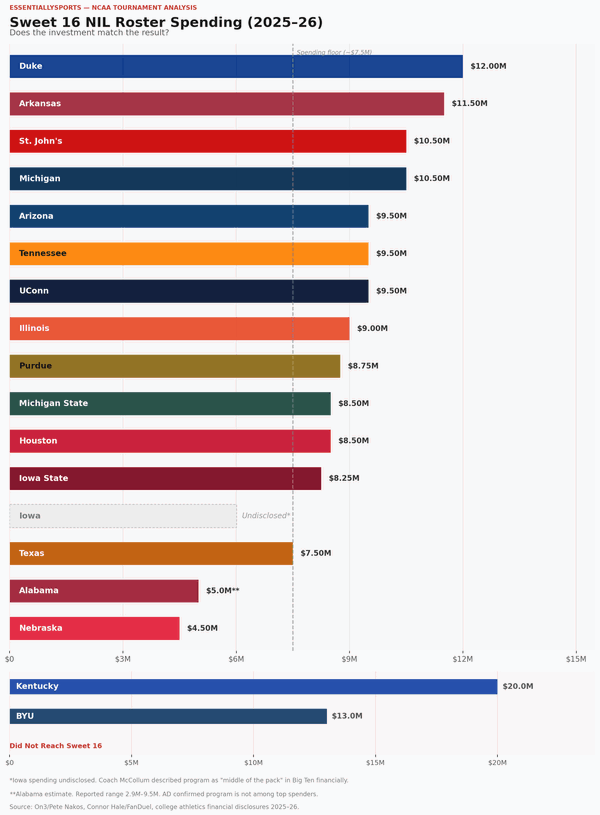
Just ask Kentucky or BYU, the two most expensive rosters in college basketball. Roughly $20 million bought the Wildcats a No. 7 seed and a second-round exit. While the No. 6 Cougars got mauled in the first round. So much for its $13 million roster.
So what does this year’s NIL money afford you? We take a look at the rate of return for the 2026 Sweet 16 teams.
THE FLOOR
Let’s be honest. There’s no shortage of money in college basketball. Some programs simply go “all-in” more than others.
There’s a general buy-in when it comes to the tournament. Based on the spending habits of this year’s Sweet 16 teams, that expenditure floor falls in the neighborhood of $7 to $8 million.
Nebraska, for example, is an exception to the rule, shelling out a “mere” $4.5 million for its surprise Cornhusker squad that went 28-7 (15-5 Big Ten) before being bounced by conference rival Iowa in the Sweet 16.
Iowa is another anomaly. The Hawkeyes are particularly tight-lipped when it comes to revealing their NIL budget with head coach Ben McCollum describing their payouts as “probably middle of the pack in the Big Ten right now — collective and revenue share.”
The March Madness spending floor is for dancing. Is the price of admission worth the dance? Here’s where it gets intriguing.
THE OVERSPENDERS
The numbers speak louder than a final buzzer. The deeper teams went into their vaults for NIL money, the bigger the headline they became when they fell woefully short of delivering in March.
Kentucky is left to consider an internal audit after the most expensive squad in college basketball history lost to a No. 2 Iowa State team that spent 60 percent less on its players.
The nation’s leading scorer, AJ Dybantsa of BYU, poured in 35 points in the opening round, but it wasn’t enough to get the Cougars past No. 11 Texas, the Sweet 16’s NIL floor setter. Now the freshman is off to the NBA Draft, and BYU has a lot of money left lying around.
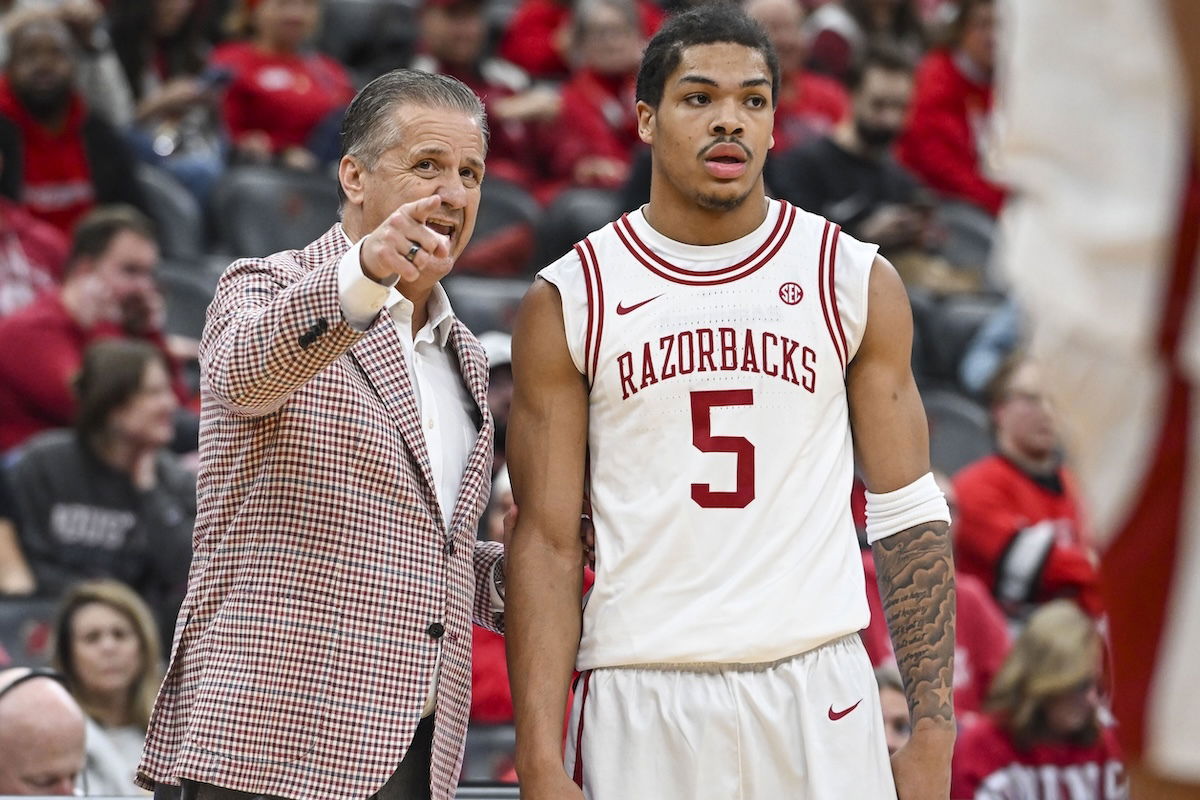
John Calipari and Arkansas still don’t know what hit them after their $11.5 million roster got worked on the boards and in the fiscally responsible department by No. 1 Arizona.
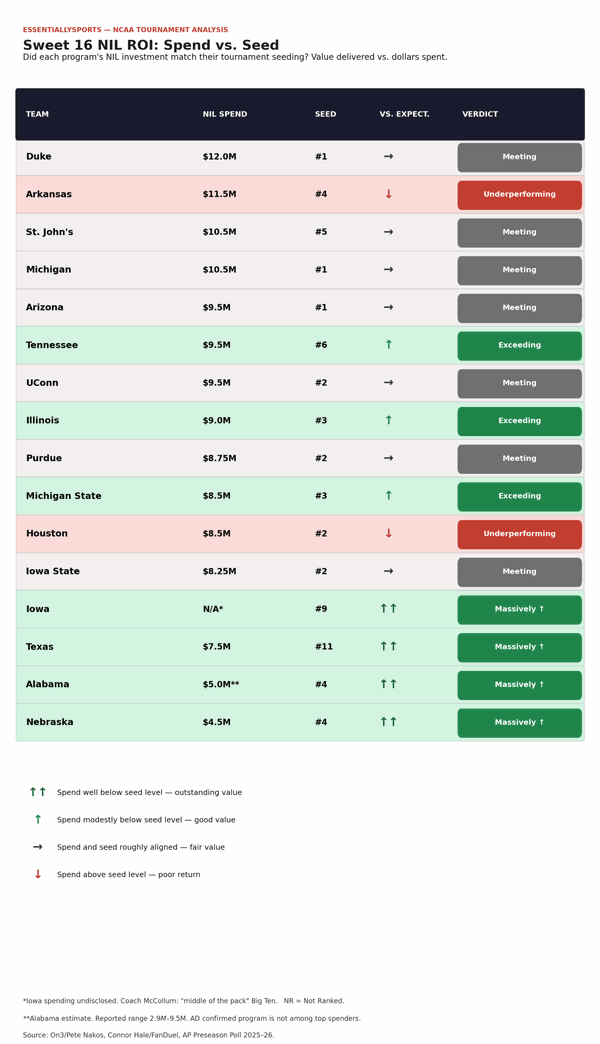
At $8.5 million and No. 2 spots in both the preseason AP Poll and the March Madness tourney, Houston went from exceeding their value to underperforming. All courtesy of an underwhelming loss on their very own home court that’s going to sting for quite some time.
The fact that three of the four teams on this list are either Cougars or Wildcats is another story for a slower day. Right now, the money is telling the tale.
THE VALUE PLAYS
When done correctly, the NIL has proven to be an assist man more generous than Purdue guard Braden Smith. See more on the Boilermakers below.
Here is where the value really pays off with the confluence of talent and money.
An Elite Eight berth for Tennessee is a great value for a No.6-seeded team that spent in the middle of the pack and began the year ranked No 18. The same goes for Illinois and Michigan State, mid-tier for both spending, seeding, and preseason predictions.
Alabama is a bit trickier to lock down. Crimson Tide Athletic Director Greg Byrne claims the program is not among the nation’s big spenders. Estimates place Alabama’s NIL somewhere in the range of $2.9 million to $9.5 million, with some evidence suggesting it is around $5 million.
A trip to the Sweet 16 for any $5 million squad is an excellent return on investment, even if the expectations on the court weren’t as desired.
Someone get Ben McCollum an accounting job … stat!
The Iowa head coach has maximized his team’s investments, even if school officials are only willing to disclose that their NIL spending falls somewhere along the Big Ten median. That would place Iowa somewhere in the $8 million ballpark. Wins over No. 1 Florida and No. 4 Nebraska for a No. 9-seeded team that was unranked to begin the year, and breaking in a first-year head coach, is arguably the best return on investment in the Sweet 16.
Do they make accountant visors in Iowa black and gold?
THE JUSTIFIED SPENDERS
Then there are the teams where the performance justifies the spending.
Purdue endured their share of bumps along the way, but the AP Poll’s preseason No. 1 is exactly where they’re supposed to be en route to the Elite Eight…with Braden Smith setting the NCAA’s all-time career assist mark thrown in for some additional flair.
Should Duke run the table, Cameron Boozer, the first freshman in NCAA history to post 15-plus points and 10-plus rebounds in his first three March Madness games, will be worth every cent that the Blue Devils invested in him out of their $12 million budget. Would this be argued as one of the best NIL deals ever?
“Act like you’ve been there before,” applies to top-seeded Arizona and Michigan, who have built their current legacies via the recruiting circuit and the transfer portal, respectively. The top-seeded Wildcats and Wolverines have reaped the benefits of a system where investing wisely and their results are on par. The rich get richer.
The recruit watching at home is taking notes and while the likes of Boozer are off to the NBA next fall, a fresh new face will step in to take his spot with a fresh new asking price.
THE LANDING
This is just the sample size from this season. The money paints a picture, but March Madness is as fickle as it is unpredictable.
The most expensive team took an early shower, while a No. 9 seed rockets into the Elite Eight. Even if the money can’t physically win games on the hardwood, it’s proving that there’s a spending floor required to get into the dance.
In the case of March Madness, mo’ money often equals mo’ dancing when done right.
