
Imago
Mar 16, 2026; Dayton, OH, USA; Detailed viewed of March Madness logo on the court during a practice session ahead of the first four of the men’s 2026 NCAA Tournament at University of Dayton Arena. Mandatory Credit: Rick Osentoski-Imagn Images
Imago
Mar 16, 2026; Dayton, OH, USA; Detailed viewed of March Madness logo on the court during a practice session ahead of the first four of the men’s 2026 NCAA Tournament at University of Dayton Arena. Mandatory Credit: Rick Osentoski-Imagn Images
The NCAA will crown its Men’s and Women’s Final Four champions this weekend and the champagne is sure to flow…for those old enough, of course.
Watch What’s Trending Now!
Which is unfortunate news for the men as the chasm between the average age of the two tournaments is wider than the distance between this year’s Final Four sites in Indianapolis and Phoenix.
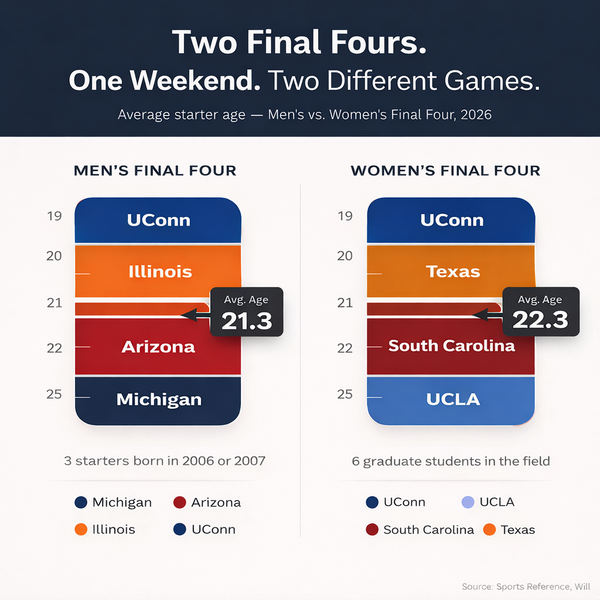
You’ll find three teenage Final Four starters in Indy this weekend for the men’s tournament, compared to Phoenix where the average age is 22.3 and the youngest player is 20 years old.
Same sport. Two different philosophies towards crafting a national champion.
ONE FOR THE AGES
The average roster age in the Final Four for the men is 21.3 years old, in contrast to the 22.3 for the women. And while that might not sound like a lot, the difference is significant.
You’ll find six starters in the men’s Final Four under the age of 21, including three born in 2006 or 2007. In context, Caitlin Clark wasn’t a sophomore at Iowa yet.
On the women’ s side, there are six graduate students suiting up for the women’s Final Four. Lauren Betts is a four-year starter for UCLA, while Raven Johnson has never missed a Final Four in her career with South Carolina.
It all comes down to this.
🎟️ https://t.co/uinvwwRlnm
📺 https://t.co/gcVRxPVaXR
📲 https://t.co/G2KeqiVWZ3
📻 @westwood1sports#WFinalFour pic.twitter.com/QoZcAgJVuj— NCAA March Madness (@MarchMadnessWBB) April 4, 2026
On Sunday, the two will compete for the honor of adding “2026 National Champion” to their resume.
PATIENCE IS A TITLE-WINNING VIRTUE
The obvious answer is simple. The men can jump to the NBA as soon as they turn 19. But it’s a bit more nuanced than that.
An average of 150 men’s players in the Pre-NIL era annually declared for the draft, with roughly 70 opting to eventually stay. The introduction of the NIL has actually slowed the rate of players declaring to an average of 80 with 30 choosing to remain in school.
Yet the incentive to declare is more alluring than ever with a lottery pick fetching around $8-$10 million on a rookie deal.
The women? Paige Bueckers only netted $78,000 for being the No. 1 overall pick in the 2025 WNBA Draft by the Dallas Wings. That number will jump to $500,000 for next year’s top pick under the new WNBA bargaining agreement.
The men also have more options to develop outside of college, such as the G-League, Two-Way NBA contracts and overseas, where the compensation is 5 to 10 times greater than the women’s.
The women’s programs also utilize the transfer portal differently than the men, opting instead for long term program development, rather than a quick-strike roster fix. That’s the approach that’s taken South Carolina’s Dawn Staley to 8 Final Fours in 11 years and UCLA’s Cori Close to the program’s first.
We’ll find out if the method leads to the Bruins first ever women’s national title.
LIKE A FINE WINE
It’s no coincidence to find UCLA and South Carolina, the two oldest squads in this year’s field, facing off in the Finals.
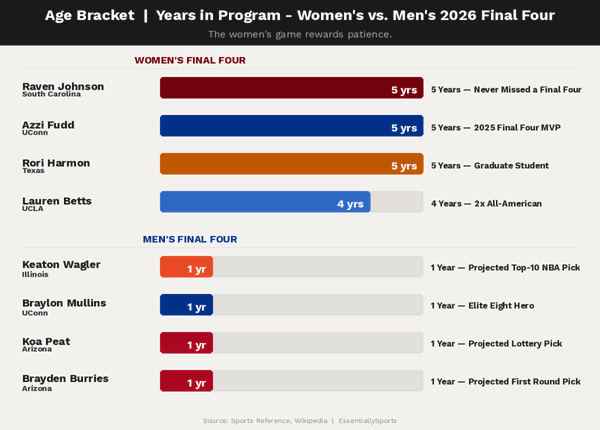
So perhaps the Gamecocks’ Final Four win over UConn, the tournament’s youngest team, isn’t as big of an upset as it appeared.
While the men’s game thrives on the chaos of NIL, portal transfers and one-and-dones, the women’s side has quietly figured out an ideal balance.
Sunday’s title game pits the Bruins vs. Gamecocks, Johnson vs. Betts and the two programs that prioritized patience and long-term player development.
