
Imago
Credit: IMAGO
Imago
Credit: IMAGO
College basketball is no longer operating on a stable set of rules, and the tension around that reality is boiling over. Roster construction, recruiting priorities, and player eligibility are all being reshaped in real time, often without clarity or consistency. For coaches tasked with developing young players, the margin for certainty is shrinking fast.
Watch What’s Trending Now!
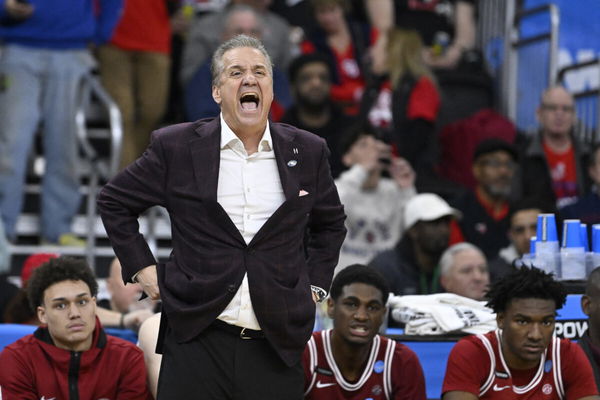
That frustration finally spilled into public view through John Calipari. During a press conference, the Arkansas head coach unloaded on the NCAA’s transfer and eligibility framework, arguing that the system now rewards experience over development and leaves high school prospects behind.
Calipari laid out the current structure before sharpening his critique. “If you stay at the same school for four years, we’ll give you a fifth year. If your coach leaves or is fired, you can transfer without penalty,” Calipari said. “Does anybody care what this is doing for 17- and 18-year-old American kids? … There aren’t going to be any high school kids who, other than dumb people like me, are going to recruit high school kids.”
The rant was not theatrical. It was targeted. And it landed as the NCAA found itself facing fresh legal pressure.
Coach John Calipari is absolutely spot on here.
Why would a coach recruit and develop an American high school kid for 4 years when the system now rewards grabbing ready-made pros from overseas, the G League, or the NBA pipeline?
If we don’t fix this, we’re killing the entire… pic.twitter.com/v50pW4XJNR— Emily Austin (@emilyraustin) January 20, 2026
Calipari’s issue is not theoretical. While NCAA policy maintains that players with NBA contracts are ineligible to return to college, recent decisions have created confusion. Some programs have added former G League players, while others are told the door is closed. That inconsistency makes long-term planning nearly impossible.
From a coaching perspective, the incentive structure is shifting. Developing teenagers over multiple seasons now carries more risk than plugging in older, professionally seasoned players. John Calipari’s concern is that high school athletes are being squeezed out of opportunities before they ever arrive on campus.
That fear is now colliding with the legal system.
Legal Action Puts the NCAA Under the Microscope
John Calipari’s comments gained urgency as the NCAA became the target of a new lawsuit. Former Alabama center Charles Bediako filed legal action seeking the right to return to college basketball after spending three years in the G League without exhausting his eligibility.
In the filing, Bediako’s attorneys argued that preventing him from playing would cause immediate and lasting harm.
“Mr. Bediako will be irreparably harmed if he is not able to join the team immediately because of the lost development and opportunity to become integrated with his teammates,” the lawsuit stated.
Bediako last played college basketball during the 2022–23 season, when he started all 37 games for Alabama, averaged 6.4 points and 6.0 rebounds, and helped anchor a No. 1 NCAA Tournament seed. His case directly challenges the NCAA’s hard line on professional participation.
Recent precedents only complicate matters further. Players such as Thierry Darlan and London Johnson, both with G League Ignite backgrounds, were cleared to play at Santa Clara and Louisville. The mixed outcomes underline Calipari’s central point. The rules exist, but their application is uneven.
Imago
Credit: IMAGO
While eligibility debates rage off the court, Calipari’s Arkansas team is providing its own counterargument on it. On Tuesday, the Razorbacks delivered a statement win, dismantling No. 15 Vanderbilt 93–68.
The result was not built on veteran imports. It was driven by development and execution. Freshman Darius Acuff Jr. scored 17 points on 50 percent shooting, while Karter Knox and Malique Ewin combined for 32 points and anchored a suffocating defensive effort.
Arkansas shot 58 percent from the field, held Vanderbilt to 38 percent shooting, and dominated the glass 39–27. A 25–10 opening run set the tone, and the Razorbacks pushed the lead as high as 31 in the second half. Even Vanderbilt’s Tyler Nickel, who scored 17 points and hit five threes, could not slow the momentum.
The performance reinforced Calipari’s belief that teaching, patience, and player growth still matter, even if the system increasingly pushes coaches toward shortcuts.
Calipari’s rant was not about Arkansas alone. It was a warning shot aimed at a sport drifting away from its developmental roots. With lawsuits challenging eligibility decisions and inconsistent rulings piling up, the NCAA is running out of room to avoid reform.
Arkansas will host LSU next, but the larger test looms beyond the schedule. If the legal pressure continues, the NCAA may be forced to clarify or overhaul its eligibility model entirely.
Until then, Calipari’s stance is clear. Development still wins games. The question is how long the system will allow it to remain a priority.