
Imago
IMAGO
Imago
IMAGO
It’s been 19 games since Cori Close’s UCLA Bruins last walked off the court defeated, a streak that dates back to their Players Era Championship loss to Texas. Since then, they’ve simply forgotten how to lose and now sit as the second-best team in the country. But even with all that winning, the head coach still isn’t completely happy with parts of their game as March Madness gets closer.
Watch What’s Trending Now!
After their latest win over Indiana, coach Cori Close was asked which areas she believes still need improvement before the main event begins. The UCLA coach didn’t hesitate, pointing to three areas she wants Lauren Betts and co. to work on.
“Our emphasis right now is taking care of the ball. We’ve got to limit our turnovers, and by the time we’re going into postseason play, that needs to be something we have a ton of confidence in that we just don’t give away possessions. And then defensive rebounds and 50-50s were the other area for us that we’re really trying to focus on our growth in,” she said.
Turnovers have been an issue for the Bruins this season. They’re currently averaging 12.5 per game, and in their last outing against Michigan State, they gave it away 18 times. That’s a worrying trend heading into matchups with teams like UConn and South Carolina, who feature elite defensive players such as Sarah Strong, KK Arnold, and Raven Johnson.
The Bruins are also averaging 29 defensive rebounds per game, good for a top-25 ranking nationally. But for Cori Close, that’s not enough. If the Bruins want to challenge UConn, she knows that they need to be top five across the board.
That said, you have to give credit to the head coach for what UCLA has done this season. UCLA’s run through the Big Ten has been remarkable. At 15–0 in one of the toughest conferences in the country, with victories over contenders like Ohio State, USC, Maryland, and Michigan State, the Bruins have built a resume few can match. Fourteen Quad 1 wins and just one loss underline just how dominant they’ve been.
Will it be enough to earn the overall top seed? That’s something we’ll have to wait and see. For now, though, Cori Close has already zeroed in on another pressing issue she wants resolved fast.
Cori Close on NIL
NIL has turned college sports upside down, and you can’t help but sit back and think, “wow, this is different.” But at the same time, Cori Close is a bit cautious about where it might lead in this new NCAA landscape that many feel is still pretty unregulated.
Imago
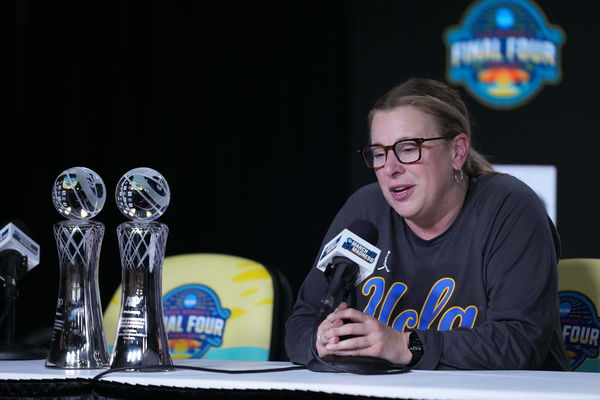
NCAA, College League, USA Womens Basketball: AP Coach and Player of the Year press conference, PK, Pressekonferenz Apr 3, 2025 Tampa, FL, USA UCLA Bruins coach Cori Close speaks after receiving the AP Coach of the Year trophy during press conference at Amalie Arena. Tampa Amalie Arena FL USA, EDITORIAL USE ONLY PUBLICATIONxINxGERxSUIxAUTxONLY Copyright: xKirbyxLeex 20250403_rtc_al2_0259
“I do think we need to be really careful that we don’t crush our game by being too greedy [and] by not having good boundaries and infrastructure,” Close said on Yahoo Sports’ Hoops 360 podcast. “We just have no boundaries at all. There’s no salary cap. There’s no competitive equity. And what’s happening is, the people that are losing, I’m worried, will slow down the growth of the game because it’s shutting out high school athletes. It’s really taking away their percentage of opportunities. And I don’t like it.”
Is she really wrong, though? NIL was supposed to do more than pay players fairly. The idea was that it might also level the playing field and stop powerhouse programs from poaching top recruits. That shift may have impacted schools like Stanford, which still prioritize academics heavily. But for everyone else? Not so much.
In the NIL era, where programs don’t operate under a salary cap, schools with the most donor backing usually end up grabbing the best players. We’ve already seen it in men’s college basketball. For example, Rutgers landing Ace Bailey and Dylan Harper, and BYU signing AJ Dybantsa have been made possible due to the NIL era.
Of course, a counterargument could be made that this is exactly why NIL was introduced to help distribute talent more evenly. But that hasn’t really happened. Much of the top talent still ends up concentrated in major conferences like the Big 12, Big Ten, and SEC, largely because they have greater financial backing. That hardly levels the playing field, and in that sense, Cori Close does have a valid point.
Do you agree with Cori Close on this? Let us know your thoughts in the comments below.
