
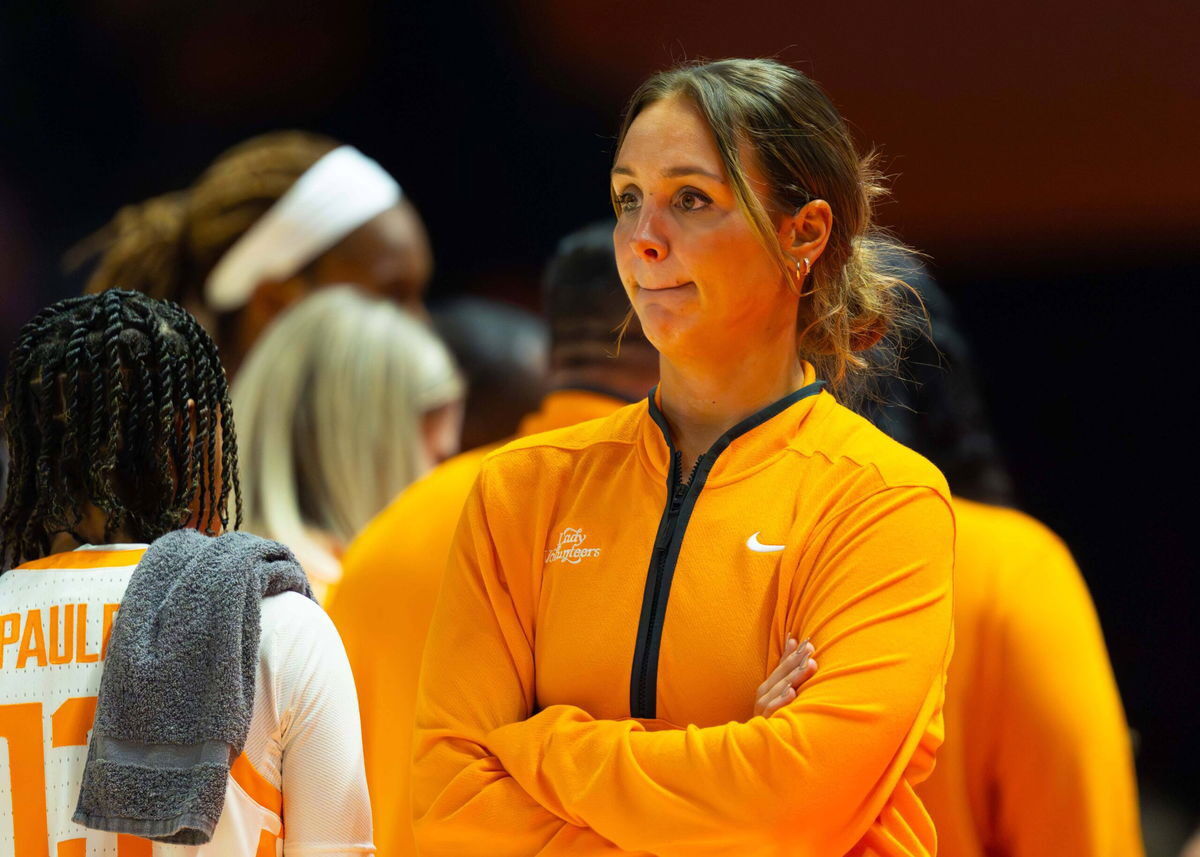
Speed, pressure defense, and team connection defined Kim Caldwell’s teams. At Tennessee, that blueprint became harder to recognize as the 2025–26 season unraveled. Now, her explanation for the collapse begins with the decisions she made and the coaching identity she allowed to slip away.
Watch What’s Trending Now!
Caldwell discussed that reckoning in a Nov. 12 ESPN feature by Andrea Adelson. The interview followed a 16–14 season that ended with Tennessee’s first-round NCAA Tournament exit.
“It is a big job, and there is a steep learning curve, and the world has seen me fail in a very public spotlight,” said Caldwell. “I didn’t handle it the right way a lot of the time. But the only way to learn is to get through it.”
Kim Caldwell’s admission was about more than accepting a disappointing record. She recognized that, in trying to adapt to Tennessee, she had moved away from the coaching blueprint that brought her success. She delegated important parts of the system and pursued highly rated recruits even when they were not ideal fits for her preferred tempo-press. The reset began with accepting that those choices had to change.
How Kim Caldwell Is Rebuilding Tennessee After Hitting Rock Bottom
The contrast between Caldwell’s first two seasons in Knoxville was stark. Tennessee went 24–10 and reached the NCAA Sweet 16 in 2024–25, her debut campaign. The Lady Vols then finished 16–14 and 8–8 in SEC play in 2025–26, losing their final eight games before falling 76–61 to NC State in the NCAA first round. Before the eight-game slide, the team also had a 30-point loss to UConn and a 43-point defeat against South Carolina.
Kim traced part of the decline to a tactical split she had allowed to develop. She handed off responsibility for the half-court offense, half-court defense, and rebounding, while continuing to coach the transition-heavy part of the game.
“My mind is play fast, fast, fast, fast, fast,” she said, explaining that the system no longer worked as one. Tennessee’s scoring average fell from 86.6 points per game in her first season to 76.4 in her second. She said the mismatch between the fast and slow parts of the approach was not obvious until late in the season.
A call from former NBA coach Jeff Van Gundy in April 2026 pushed Kim Caldwell to look beyond the players. After watching her postgame comments following the South Carolina loss, Van Gundy reached out with advice about team culture. “Your team will only be as connected as your staff,” he told her. Caldwell said the message made her realise that the coaching group itself was not connected. She had already hired assistants Isoken Uzamere and Bill Ferrara, and also brought in a communication specialist to help staff and players better understand how to work with one another.
The roster also had to be rebuilt. Tennessee added 13 players through the transfer portal, and two from the prep ranks to assemble a 15-player group for 2026–27. Caldwell and her staff went deeper in their recruiting checks, contacting prospective players’ former AAU and college coaches as well as their parents. They asked whether a player could accept a bench role, handle adversity, and whether those coaches would recruit her again. System fit mattered alongside talent: Kim wanted players who could play fast, shoot from three, rebound, defend, and share minutes in frequent rotations.
Tennessee is not the only women’s college basketball program to have undergone a major rebuild. At Sacramento State, head coach Mark Campbell inherited a team that had won just three games (3-22) before his arrival. He guided the Hornets to 14 victories in his first season before leading them to 25 wins and their first NCAA Tournament appearance in his second. Unlike Caldwell’s situation, Campbell inherited the rebuilding challenge, but his turnaround demonstrates how a new foundation can reshape a program’s trajectory.
The early results have offered an encouraging first sign. Tennessee improved to 4–0 with a 110–64 win over Middle Tennessee on Nov. 12. The Lady Vols recorded 30 steals while forcing 43 turnovers, a defensive display that reflected the pressure Caldwell wants from her team. Still, four nonconference wins do not establish how the rebuilt roster will respond when it faces adversity in SEC play.
Caldwell has not presented the reset as a guarantee. She has described the previous season as a failure she needed to learn from, not an outlier to dismiss.
“If I sweep last year under the rug and say it’s an outlier, and this was just bad circumstances, and I blame it on other people, I will never get better from it,” she said.
Her challenge now is to keep Tennessee connected to the identity she believes in when the competition gets harder.