
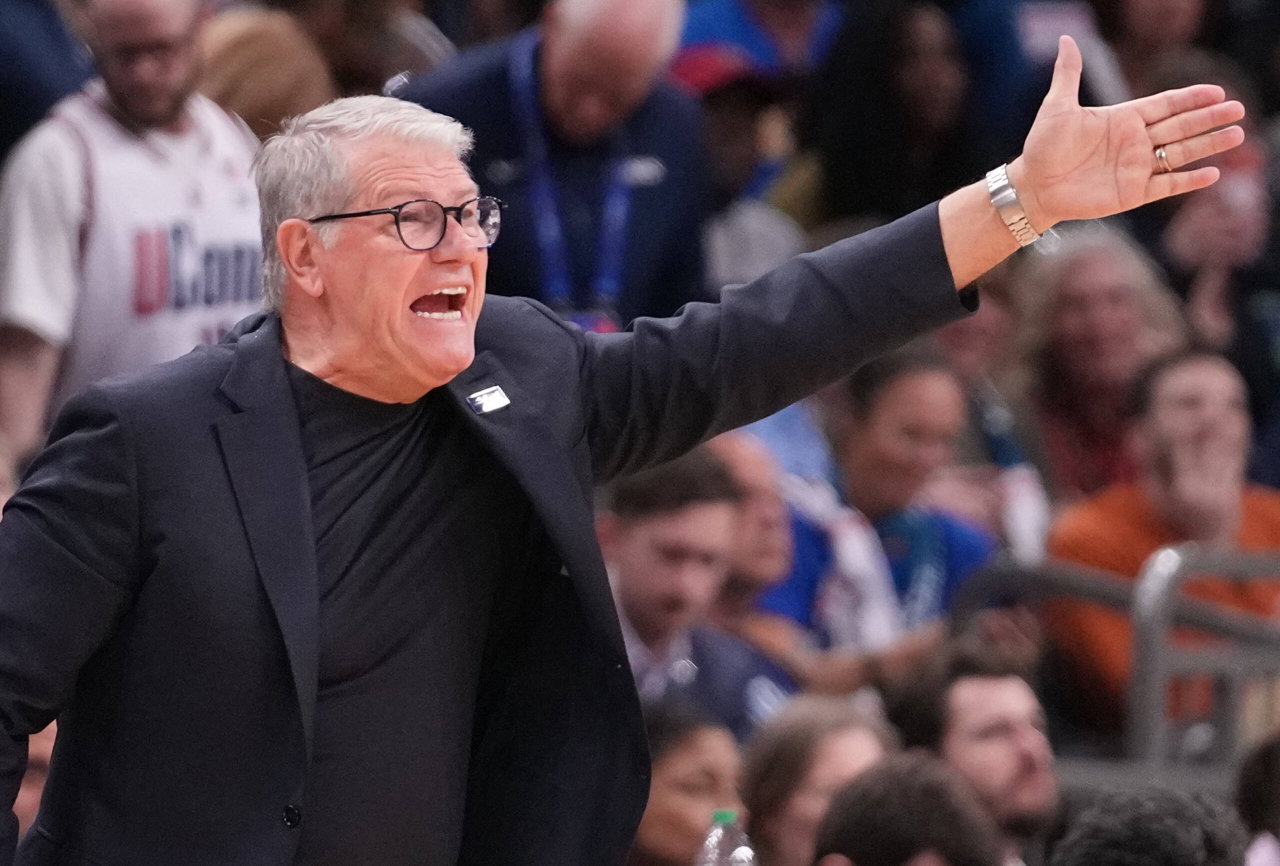
For 30 years, the WNBA had no player on a million-dollar deal. In 2026, that changed. A new collective bargaining agreement raised each team’s salary cap to $7 million, with the maximum contract reaching $1.4 million. Thirty-one players made at least $1 million last season. However, some college recruits are commanding million-dollar NIL deals before playing a single college game. UConn HC Geno Auriemma doesn’t see the point in that.
Watch What’s Trending Now!
Speaking on Thursday, Auriemma answered after the early signing period for the Class of 2027 ended:
“I just don’t see the value of paying a high school kid a million dollars to come out of high school that hasn’t dribbled the ball one time in college…That’s more than 90% of best players in the world in the WNBA.”
With NIL deals changing the college basketball landscape, he believes recruiting conversations have become increasingly focused on money. Geno Auriemma also described what recruiting looks like now.
“We have an agent that talks to their agent because the kids and the parents lie to you,” Auriemma said. “‘It’s not about the money. It’s about academics. It’s about finding the right fit. It’s about the right experience.’ No, it isn’t. Just say it’s about the money, and we can all live happily ever after.”
The numbers help explain his frustration. Under the new deal, the WNBA’s top salary is $1.4 million, and only about 17% of the league’s 180 roster spots earn that much. Yet college players now make the same, or more, in base pay. That gap is why the topic keeps coming back.
In 2025, Cheryl Miller called the setup “backwards” and said college is where the money is, especially after the NILs came in. Back in 2023, Sheryl Swoopes called it sad that college players were earning more than pros. Her comments came amid reports that the WNBA’s revenue grew from $102 million in 2019 to an estimated $ 180-200 million, even as players’ share of revenue through base salaries fell to roughly 9.3% in 2022.
Meanwhile, WNBA players are also looking for ways to increase their earnings during the offseason. Leagues such as Unrivaled offer additional opportunities to keep playing and earn money without necessarily heading overseas.
The gap is wider in other sports. A Forbes estimate says 16 men’s basketball players are valued at $4 million or more in NIL this season. Kentucky’s Milan Momcilovic and Louisville’s Flory Bidunga are each at an estimated $6 million. That is a 46% jump from last year’s top figure of $4.1 million. Football’s top name, Miami quarterback Darian Mensah, is valued at $6.5 million.
NIL values are estimates, and they are not salaries. But they show how much money now flows into college sports. NIL deals help, and revenue sharing lets schools pay players directly. Schools pay to keep players from leaving through the transfer portal.
And while Geno Auriemma questions the value of million-dollar recruiting deals, UConn itself is no stranger to investing heavily in basketball. The Huskies spent more than $34 million on their men’s and women’s basketball programs in FY2025, compared with $20.5 million on football.
The women’s team generated $8.5 million in revenue, the most among the teams in the 2026 Final Four and nearly twice its 2023 figure. The program also brought in $4.2 million through ticket sales and sold out its season tickets for the first time in two decades.
Yet in this recruiting class, spending did not turn into signatures. UConn was in the running for five of the top 10 recruits: Kaleena Smith (No. 1), Ivanna Wilson-Manyacka (No. 2), Eve Long (No. 5), Haylen Ayers (No. 8) and Sydney Savoury (No. 9). It also pursued Hungarian center Kinga Josepovits.
Only Savoury signed. Long picked Notre Dame in May. It is the second straight cycle with just one top-10 signing. The last time UConn signed more than one was 2024, with Sarah Strong at No. 1 and Allie Ziebell at No. 4.
Geno Auriemma tied it to the money.
“We just signed the No. 9 player in the country. We don’t have cachet with guys that are getting a million dollars to go play someplace. They’re getting the cachet,” he said.
He said UConn would get “the guys we’re going to get.” He did not rule out the gap, saying schools are putting in more resources and players are drawn to places they once passed over, which he said fits the growth of the game.
Savoury, a 6-foot guard from Canton, Michigan, said UConn met all her non-negotiables. Auriemma called her a big guard who can score at every level. He said she fills a need for a big wing.
For now, UConn has 11 players returning and one signee. The regular signing period starts April 14, 2027, and Geno Auriemma may turn to the transfer portal or international players.
The league that now pays its stars $1 million will watch what happens next, while UConn’s top player, Sarah Strong, reportedly earns around $1.5 million through her NIL deals.