
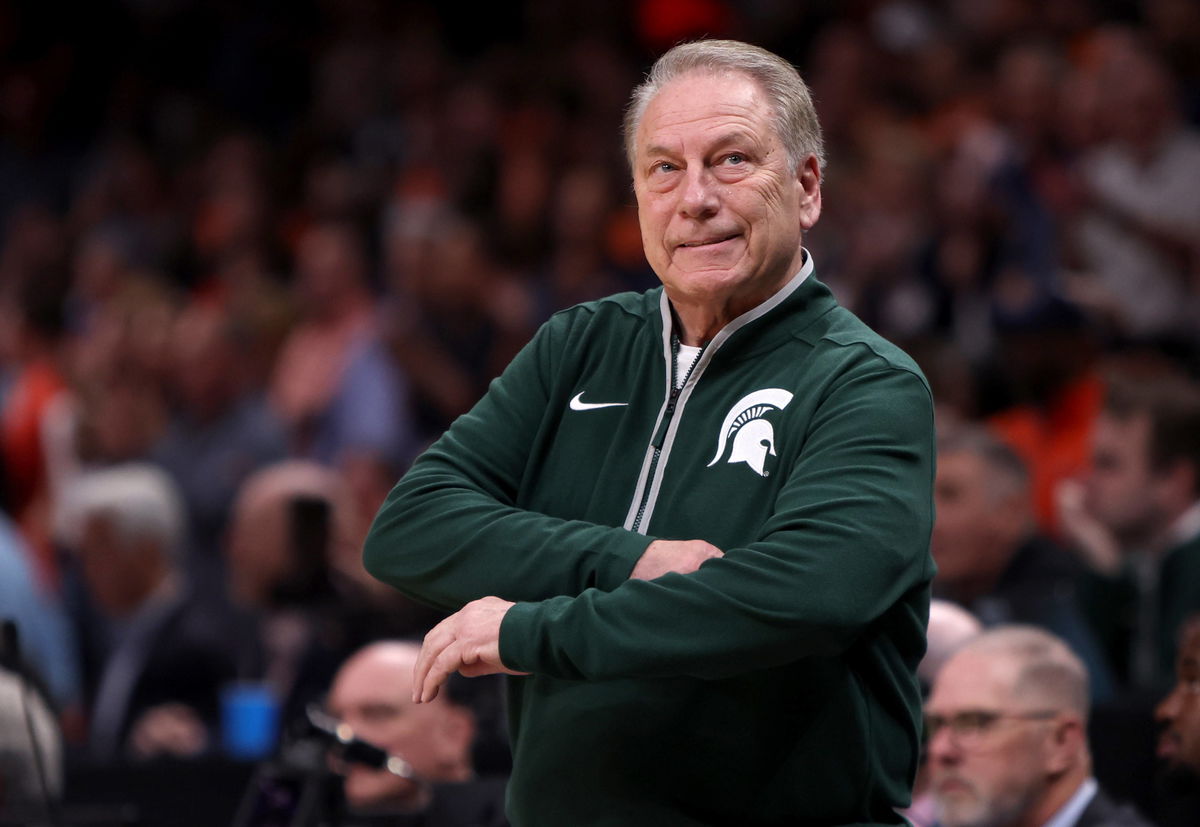
Tom Izzo has never been one to hold back when something in college basketball doesn’t sit right with him. But his latest criticism of the NCAA comes with a personal connection, as the long-time Michigan State head coach spoke up for someone he has known for over 40 years. After learning the limitations placed upon his former assistant, Mark Montgomery, he didn’t hesitate to call the NCAA’s Academic Progress Rate rules “a joke” after the Spartans’ win over Detroit Mercy
Watch What’s Trending Now!
“The first thing I want to do is give Mark credit, and not because he was my former assistant, and not because I’ve known him since he was fifteen years old when I recruited him,” he said per an X post by FOX College Hoops. “I want to give him credit for battling through things that most of you don’t know because I didn’t know. The APR is a joke. It’s a joke.
“You can’t have an APR when kids are allowed to leave whenever they want, so he gets nailed on something he had nothing to do with. But I didn’t argue that he couldn’t go to the tournament, even though last year he was a bucket from going. I couldn’t argue. I knew kids would leave his program, and it would be hard to recruit. But what I found out later on, not that long ago… is that they didn’t let him practice. He has to be off two days a week.”
The Academic Progress Rate (APR) is designed to measure student-athletes’ academic eligibility and retention. Each athlete earns points for staying academically eligible, as well as staying enrolled or graduating, which combine into a team score of up to 1,000.
Teams generally need a multi-year score of 930 to qualify for postseason competition. Detroit Mercy’s men’s basketball program fell below that benchmark, logging a reported multi-year APR of 916, which has triggered a postseason restriction.
The NCAA’s penalty framework also puts restrictions on athletic activities for lower APR scores, including a reduction in the time allowed for practice and additional mandatory days off, with the severity depending on the level of penalty.
For example, Detroit Mercy’s Level-Two penalty drops athletic activity from 20 to 16 hours per week in-season, adds a day off, and replaces the lost athletic hours with academic activities. Additionally, the team will also have to reduce its playing season and number of contests by 10% or cancel its non-championship segment.
This is not a new scenario for the Titans. This is the third time in the last decade that Detroit Mercy has fallen below the APR threshold, with both of the previous instances occurring under the last head coach, Mike Davis.
Detroit Mercy has already publicly raised concerns about how the APR formula stands in the modern college basketball landscape. On May 4, athletic director Robert C. Vowels Jr. acknowledged that the program had fallen below the 930-point mark, but argued that the system placed too much weight on narrow measures.
“With the current APR formula, many in college athletics believe that there is an overreliance on narrow, potentially biased measures that can perpetuate inequities and may undermine the broader educational mission,” Vowels’ statement read.
“Within the current structure, certain student-athlete decisions—such as attending a junior college for further development, stepping away from higher education to pursue professional opportunities both athletically and non-athletically, or navigating the competitive nature of revenue share and NIL—are reflected in APR scores… While these departures do not always result in lost retention points, they can affect the cohort in a way that increases the weight of any eligibility or retention challenges, beyond academic achievement itself.”
The postseason ban is a difficult blow for Detroit Mercy, especially after Montgomery helped revive the program since his hiring for the 2024-25 season. He led the program to a 17-15 record last season, reaching the Horizon League championship game in just his second season.
Tom Izzo expressed frustration with what he sees as the NCAA’s willingness to make an example out of a program rather than consider the circumstances behind the APR.
“There are so many people out there doing things, so we’ll get the University of Detroit and make an example out of them; that is very disappointing for me and for him,” he said. “The ironic part of this whole thing, Mark Montgomery was an Academic All-Big 10 Player. He’s smarter than most of us sitting in the room, and that’s not an insult to you because that includes me.”
The issue means a lot to Izzo, considering that Montgomery not only served as an assistant to him over two stints, but also played under him for four years from 1988 to 1992.
Only time will tell if the situation surrounding Detroit Mercy changes, but what’s clear is that Tom Izzo is firmly in his former assistant’s corner.