
Imago
via Imago
Imago
via Imago
Imago
via Imago
Imago
via Imago
As the SEC Women’s Basketball Tournament returns to Greenville for the 10th time, some coaches are openly questioning what that consistency means for competitive balance. And among them are the LSU Tigers head coach Kim Mulkey and the Texas Longhorns head coach Vic Schaefer.
Watch What’s Trending Now!
Greenville has become synonymous with March in the SEC. Since 2017, the tournament has largely been held at Bon Secours Wellness Arena, creating a familiar postseason rhythm. Packed crowds, heavy garnet and black presence, and an atmosphere that often mirrors a South Carolina home game more than a neutral-site championship.
It has also quietly sparked a broader conversation across the league: at what point does the line between competitive equity and competitive advantage begin to blur?
“I certainly think from a conference tournament standpoint – we all know when they play, they’re gonna have 6- 7 thousand people there,” coach Schaefer said in his recent media availability. “And you’re talking about us here in Austin having to go all the way to the East Coast. We used to have it in Nashville, every now and then. Now we don’t have it, it’s just out there. It’s a long way to go for us. It’s a long way to go for our fans.”
For programs that have to travel across the conference footprint and then face a team playing in front of what feels like a home crowd, the challenge looks different.


Texas coach Vic Schaefer shared similar sentiments when asked last night about Greenville annually hosting the SEC WBB Tournament: https://t.co/D8eDPnmOaP pic.twitter.com/kpJy3fm1Rh
— Danny Davis (@_dannydavis) February 27, 2026
“So again, the part that’s problematic is that Greenville does such a great job. They obviously bid on it, and it’s about money. So at the end of the day, our kids are the ones who suffer from that… They’re always going to have way more people than you’re gonna have. And so it’s just for your kids and their experience, for the student athlete, it is what it is.”
“Would I like to see it in San Antonio? Sure, I’d love to. The river walk is a beautiful place. It will be great for our kids. But other people are gonna have to step up and bid on it. Because right now, Greenville’s the one that writes the check, and they do a great job. Let me tell you, Greenville does a great job,” he further added.
Vic Schaefer repeatedly praised the city. But his concern centered on competitive balance, particularly for programs like the Longhorns. Because they must travel across multiple states, while others enjoy overwhelming crowd support.
Coach Mulkey echoed a similar sentiment. As per reports, while acknowledging the investment from South Carolina and the city of Greenville, Mulkey noted that if the conference wants broader rotation, other cities will need to step forward and submit competitive bids.
While both coaches made it clear that Greenville delivers a first-class event, their concern isn’t about hospitality; it’s about neutrality. And unless another city steps forward with a competitive bid, that dynamic isn’t changing anytime soon.
SEC Tournament Locked in Greenville Through 2028 Amid Vic Schaefer’s Concerns
With the upcoming tournament all set to kick off from March 4th to 8th, the Southeastern Conference has officially announced a three-year extension keeping the SEC Women’s Basketball Tournament in Greenville through 2028. But why?
According to the SEC Sports, Conference commissioner Greg Sankey has cited Greenville’s hospitality, organization, and the arena’s quality as key reasons for the continued partnership.
Imago
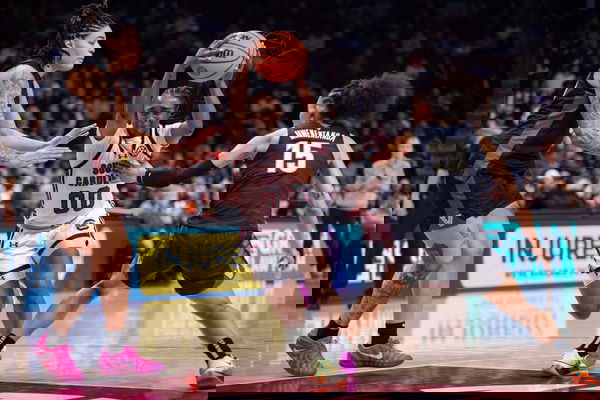
January 25, 2026: South Carolina Gamecocks guard Ta Niya Latson 00 drives to the basket between Vanderbilt Commodores forward Sacha Washington 35 and guard Ndjakalenga Mwenentanda 15 in the second half of the NCAA, College League, USA Womens College Basketball matchup at Colonial Life Arena in Columbia, SC. /CSM Columbia United States – ZUMAc04_ 20260125_zma_c04_213 Copyright: xScottxKinserx
On the other hand, from an operational and financial standpoint, the decision makes sense because the city consistently bids aggressively and delivers packed crowds.
But competitively, the optics remain layered. Hosting the tournament in Greenville gives the South Carolina Gamecocks a significant home-court advantage. However, with this deal locked in, any shift in tournament geography won’t happen before 2029.
In the end, this isn’t about who does a great job. It’s about what neutrality truly means in a conference that prides itself on competitive equity.
For now, the SEC has chosen certainty. And unless another city is willing to “write the check,” as Vic Schaefer put it, March in the SEC will continue to run through Greenville.