
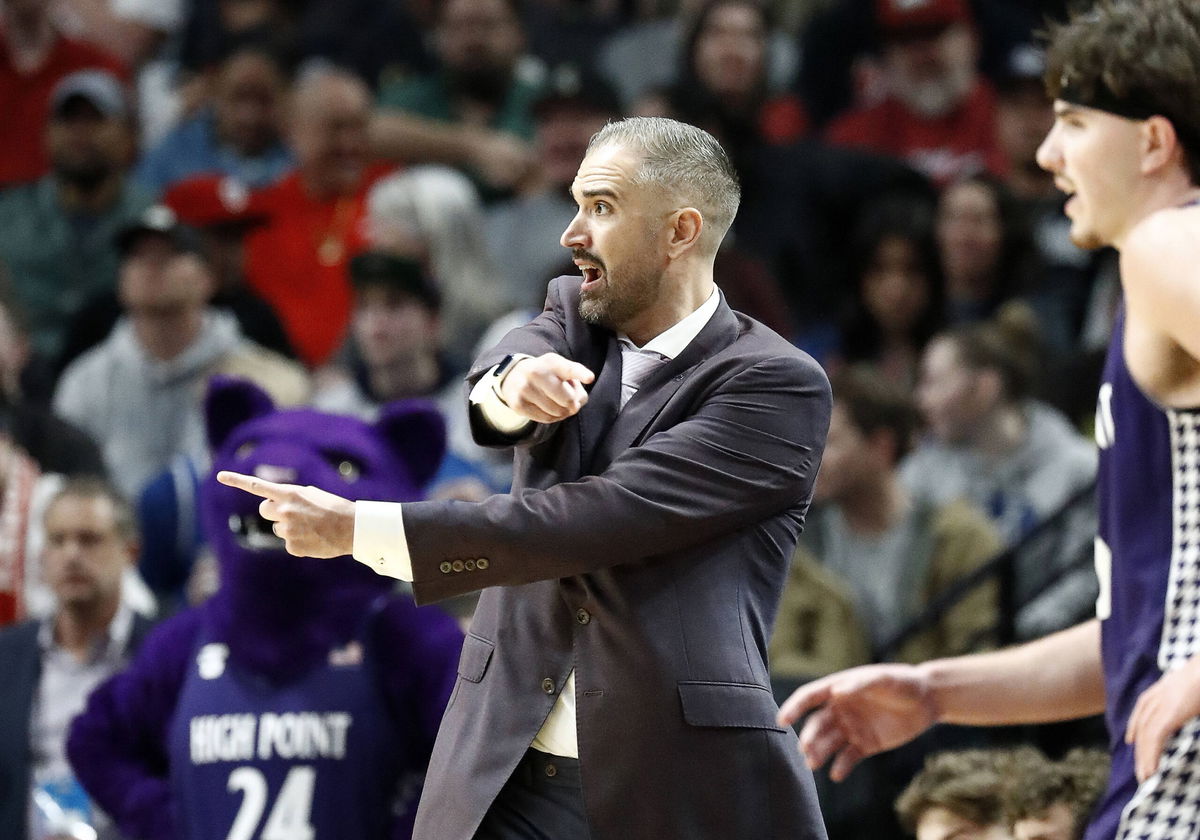
Cinderella’s slipper dropped in the opening round of the NCAA Men’s Basketball Tournament as No. 12 High Point pulled off the stunning upset of No. 5 Wisconsin.
Watch What’s Trending Now!
In the madness that ensued during the postgame interviews, a fired-up Panther head coach Flynn Clayman put the High-Majors on blast for not scheduling programs such as High Point during the regular season.
Despite going 31-4 and claiming the Big South Conference title, High Point was essentially reduced to the school everyone had to Google. Hint, it’s in North Carolina … as many found out on Thursday based upon the Google Trends spike for “High Point University.”
Clayman wasn’t holding back in his enthusiasm.
“Looks pretty obvious to me that high-majors need to play mid-majors early in the season,” said Clayman. “Because they said we didn’t play nobody. We played somebody now.”


"Looks pretty obvious to me that high-majors need to play mid-majors early in the season. Because they said we didn't play nobody. We played somebody now." -High Point HC Flynn Clayman
So the question needs to be asked. Is Clayman correct in his assessment that the High-Major programs avoid the quality Low-Major schools?
Every year, the High-Major programs flesh out their non-conference schedules with home games against Mid and Low-Major teams. Traditionally speaking, these Buy Games net the big school an easy win, while the Low-Major receives a Venmo payout of $90,000. That money goes toward funding travel, scholarships and a school’s general athletic budget.
IS CLAYMAN CORRECT?
As it turns out, Clayman isn’t entirely wrong, even if his message is direct and in your face.
Looking at eight bloodblue(ish) programs – Arizona, Duke, Kansas, Kentucky, Michigan State, North Carolina, Ohio State and Wisconsin – over the past four seasons, the numbers appear to back up Clayman’s claim.
Of the 83 non-conference mid-major matchups during that timeframe, those eight elite programs combined to play just nine Mid- to Low-Major schools that were ranked in the Top-100 according to KenPom’s final season rankings.
Kentucky and Kansas, for example, haven’t played any Top-100 teams. That’s despite the fact that Kentucky has shelled out for nine Buy Games during that time.
The sole outlier is Arizona, which has slated four opponents outside of the Power Conferences. The Wildcats are also renowned for scheduling tough opponents with five contests against AP ranked foes this season. As a result, Tommy Lloyd’s squad has the second-toughest overall strength of schedule.
IT’S NOT JUST THE BLUEBLOODS
The bluebloods aren’t the only ones shunning the smaller schools. A small sample size from the ACC, Big Ten and SEC reveals a similar pattern. Between Iowa State, Mississippi State and Virginia Tech, not one of them has played a Top-100 KenPom ranked team in the last three seasons.
That’s not to pick on the Cyclones, Bulldogs and Hokies. The trend plays out across the entire D1 field.
While programs such as Duke can argue that they avoid these teams to protect their brand and recruiting against an embarrassing early-season loss, the excuse doesn’t hold up well for the likes of Virginia Tech and Mississippi State. Particularly when you consider that the small schools only manage to escape with a win about eight percent of the time and lose by an average margin of 21 points, using the 2019-2020 season as an example.
WHAT’S THE COST?
The system is rigged to reward for quality wins, leaving the bigger schools to avoid competition that’s almost always deemed “inferior,” despite the quickly narrowing talent gap. Thus, the Low-Majors (perhaps unfairly) suffer lower NCAA Net rankings and receive less-favorable seeds in March.
And then a High Point takes down a Wisconsin and folks are left scratching their heads as to how it could have happened. The High-Majors might be able to evade the Mid and Lows in November, but there’s nowhere to hide in March when it matters.
High Point became the 57th No. 12 seed to upend a No. 5 in the NCAA tourney. That’s not a fad nor coincidence. That’s a trend considering that No. 12 seeds win 35 percent of the time.
Which is something that Wisconsin found out the hard way. To quote Clayman, “We played somebody now.”