
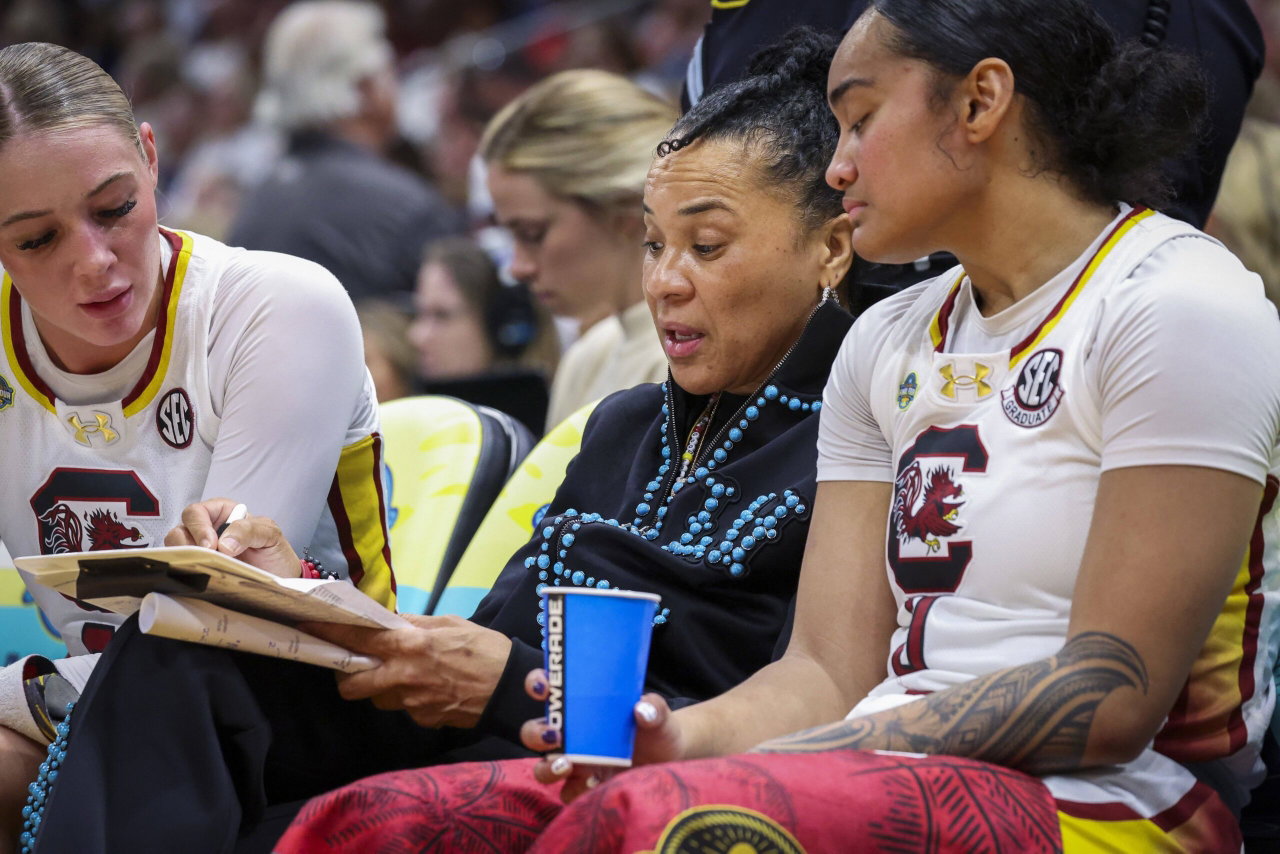
The price of landing elite recruits has become one of the biggest talking points in women’s college basketball. With NIL offers growing and coaches questioning how far programs can go to secure talent, the debate is less about building the best team and more about who is willing to pay to put a good team together. Now, after Geno Auriemma and Cori Close have voiced concerns in the recruiting landscape, Dawn Staley offers a different perspective, explaining why South Carolina sticks to its financial limits.
Watch What’s Trending Now!
“When you’re recruiting young people and their families, we like to throw their number out there before they even come to campus,” Staley said during a media scrum, with her comments recorded and posted to X by reporter Matt Dowell.
“Either you gon’ come to campus with that number, and we can just get down to the business of having a good time and seeing if you fit here. For us, we’ve stuck to our numbers because that’s the numbers that we have. We’re not inflating. That’s the numbers that we see coming in for the following year. And if we get more money, we say, “Hey, we’ll share it.” But you gotta stick to it… The money’s good no matter where they go, but money really can’t make you feel better. Money can’t make you play better. Money can’t drive you when you’re not playing how you visualized.”
Staley’s comments come after Auriemma and Close expressed their own frustration with the financial direction of women’s college basketball. The UConn head coach particularly questioned the value of paying a recruit $1 million or more before they had played a single college game.
UConn, for reference, missed out on several top prospects in the class of 2027. Despite landing five-star prospect Sydney Savoury, who was ranked #9 in the class by ESPN, they missed out on major prospects.
#1-ranked Kaleena Smith was considered a potential Huskies target, but she has shortened her list to USC, UCLA, and Arizona State. #2-ranked Ivanna Wilson Manyacka named UConn in her top five, but ended up committing to UCLA. #8-ranked Haylen Ayers chose Vanderbilt after narrowing her choice to the Huskies and the Commodores.
UConn also missed out on Hungarian standout Kinga Josepovits, who committed to Duke over Auriemma’s program.
“just don’t see the value of paying a high school kid a million dollars that hasn’t dribbled the ball one time in college,” Auriemma said on November 19.
“There’s more schools that are investing more resources, and the players are attracted to places that maybe in the past they weren’t. I think the growth of the game reflects that… I don’t have that conversation with the parents. We have an agent that talks to their agent because the kids and the parents lie to you. They’ll say it’s not about the money. It’s about academics. It’s about finding the right fit. It’s about the right experience. No, it isn’t. Just say it’s about the money, and we can all live happily ever after.”
Just a few days later, Close, UCLA’s head coach, was asked about Auriemma’s comments on NIL by CBS Sports, when she admitted that she thought the NIL numbers should go down.
“When you’re talking about that, you are talking about players getting paid more than A’ja Wilson, who is arguably one of the best players in the world,” she said. “There is something wrong when our six seniors that all got drafted all took pay cuts to go to the WNBA. Something is off with that.”
Close also previously admitted that she felt more like a company’s CEO instead of a basketball coach.
Staley, meanwhile, doesn’t think athletes are to blame for this phenomenon, or even when students leave for another program because it offers more money. In fact, she made it clear that she would instead encourage a player to accept a significantly bigger deal rather than turn down an opportunity that could secure their family’s financial future.
“If somebody’s paying twice and three times as much as us, I say go get the money, it’s generational wealth for some kids,” she said.
“If somebody said you only can make a certain amount and that’s it, we would wrestle with that, right? And it’s all what people are willing to pay. I mean, they paid me a lot of money. They do. Whether they want to do it or not, they’ve done it. So it’s worth it to them. And if the player is worth it to us, we might try to find the money. If we can’t find the money, we go back and say, ‘We can’t find the money; this is our last, our final offer.'”
That is ultimately where Dawn Staley drew her line. South Carolina will make offers and find resources for the players it values, but if another program is willing to pay, she’s not going to ask a player to turn down generational wealth just to join the Gamecocks.