Imago
Trentyn Flowers
Imago
Trentyn Flowers
Imago
Trentyn Flowers
Imago
Trentyn Flowers
College basketball’s latest controversy has nothing to do with a box score, a buzzer-beater, or a rivalry game. Instead, it has reopened a long-simmering debate about where the NCAA draws the line between amateur and professional basketball in the modern era.
Watch What’s Trending Now!
That tension came to a head this week when Charlie Baker issued a blunt public statement addressing the eligibility of players like Trentyn Flowers, whose name has unexpectedly surfaced in college basketball circles despite being under an NBA contract.
In a statement posted publicly, Baker made it clear that the NCAA will not bend on one foundational principle. “The NCAA has not and will not grant eligibility to any prospective or returning student-athletes who have signed an NBA contract (including a two-way contract),” Baker said.
The @NCAA has not and will not grant eligibility to any prospective or returning student-athletes who have signed an @NBA contract (including a two-way contract). As schools are increasingly recruiting individuals with international league experience, the NCAA is exercising…
— Charlie Baker (@CharlieBakerMA) December 30, 2025
The message was unambiguous. While Baker acknowledged that schools are increasingly recruiting players with international professional experience, he emphasized that athletes with NBA contracts fall outside that scope. According to Baker, existing bylaws are being applied to ensure players with American professional experience are not treated differently from international counterparts, but only up to a point.
Baker went further, warning that recent legal challenges attempting to override long-standing eligibility rules could destabilize college sports altogether. He characterized those efforts as “misguided” and said he would work with Division I leadership to protect the NCAA’s current structure.


What does the statement mean for Trentyn Flowers?
Baker’s clarification effectively closes the door on Flowers’ college basketball prospects, at least for now.
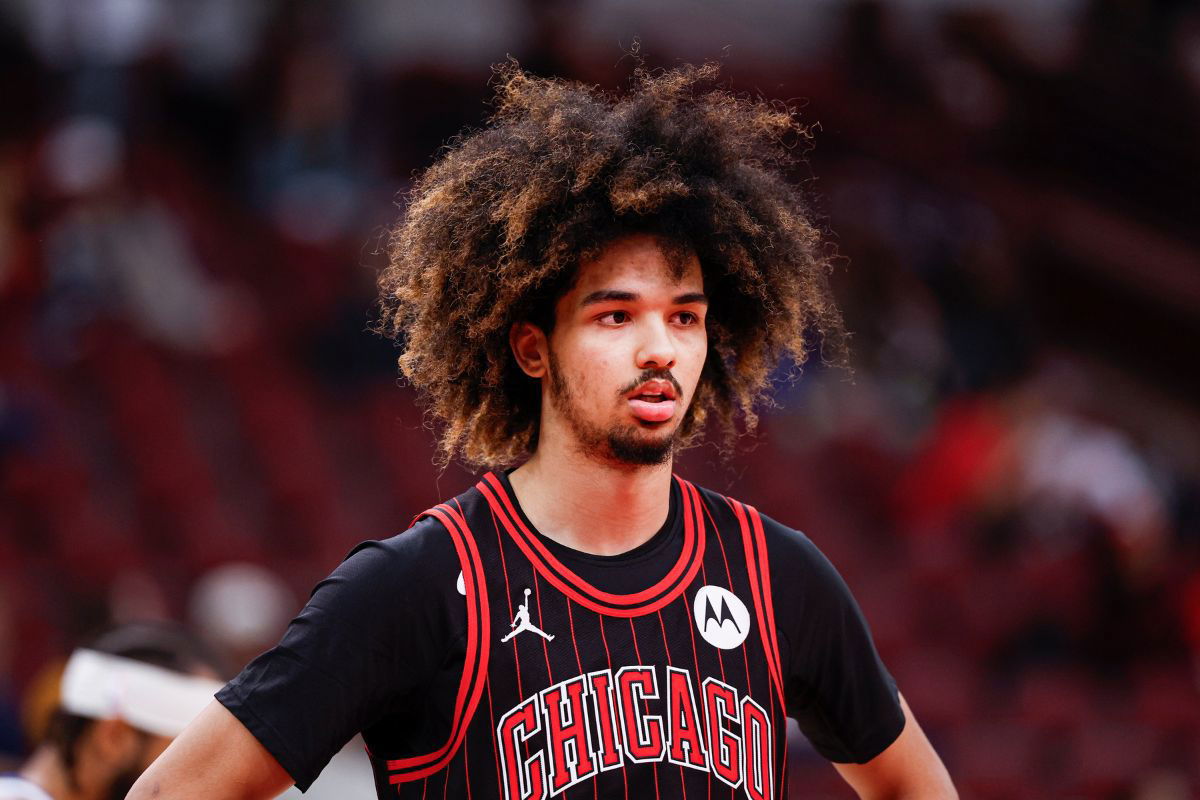
Flowers is currently on a two-way contract with the Chicago Bulls, a designation that explicitly places him under the NBA contract umbrella Baker referenced. Under NCAA rules, that distinction matters. Once a player signs an NBA contract, even a two-way deal, eligibility is no longer available.
In recent days, Flowers’ name had circulated in connection with potential college interest, sparking widespread speculation about whether an NCAA return was possible in the NIL era. Baker’s statement answers that question decisively.
The ruling reinforces a long-held NCAA position: the pathway from college to the NBA remains one-directional. Once crossed, there is no automatic route back.
While Flowers’ situation appears settled, James Nnaji presents a contrasting example and one that helps clarify why Baker’s words matter so much.

Nnaji, a former first-round NBA Draft pick, never signed an NBA contract. Instead, the 21-year-old Nigerian center spent multiple years developing in FC Barcelona’s professional system overseas, logging roughly 130 official games across competitions before leaving the club.
That distinction is critical. Under current NCAA interpretations, professional experience alone does not automatically disqualify a player. Signing an NBA contract does.
Because Nnaji stayed overseas rather than formally joining an NBA roster, his eligibility pathway remained intact, allowing Baylor Bears head coach Scott Drew to pursue him without violating NCAA rules.
Baker’s statement does more than address one player. It draws a clear boundary at a time when NIL deals, overseas pipelines, and professional alternatives have blurred traditional definitions of amateurism.
For coaches, administrators, and programs navigating this new landscape, the message is simple: international experience may be negotiable, but NBA contracts are not.
As college basketball continues adapting to an evolving talent ecosystem, Flowers’ situation now stands as a precedent rather than a loophole. And for the NCAA, Baker’s firm stance signals that while the rules may evolve, some lines remain firmly in place.